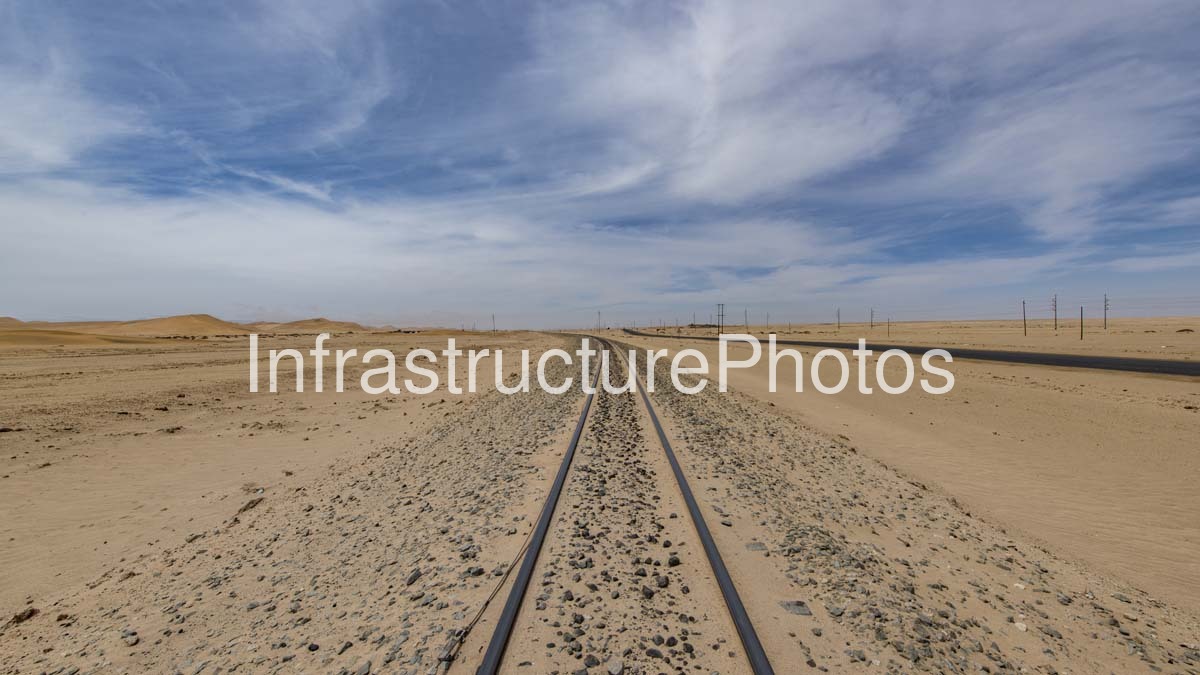
This photograph captures a remarkable transport corridor crossing the arid landscape of Dorob National Park on Namibia’s central Atlantic coast. A single railway track runs directly through the centre of the image, its steel rails extending towards the horizon across a broad gravel and sand plain. To the right, a paved road follows a broadly parallel alignment, while a series of utility and electricity poles extends into the distance. Together, the railway, road and utility infrastructure demonstrate how major transport and service corridors have been engineered across the exceptionally dry Namib Desert.
The railway forms part of Namibia’s important coastal rail network linking Walvis Bay and Swakopmund with Arandis and the interior. Dorob National Park’s management documentation specifically identifies the railway between Walvis Bay, Swakopmund and Arandis as an established infrastructure corridor associated with the park. The railway is therefore a significant transport element within the wider desert landscape, although the railway reserve itself is excluded from the national park’s conservation area.
The railway has a long history. Swakopmund was an important starting point for Namibia’s early railway development, with the first railway connection towards Windhoek established during the German colonial period. The extension from Swakopmund to Walvis Bay was completed in 1914. The original coastal alignment ran very close to the Atlantic Ocean, but in 1980 the section was replaced by a route further inland behind the coastal dunes. The new alignment was designed to accommodate higher axle loads and remains part of the modern TransNamib railway network.
The line’s position through this desert environment highlights the engineering challenges associated with railway construction and maintenance in the Namib. The track formation is built on a broad layer of coarse stone ballast, providing drainage and structural stability beneath the rails. Beyond the ballast shoulder, the surrounding landscape quickly returns to natural desert gravel and sand. Wind-blown sand is a recurring operational challenge along Namibia’s coastal railway corridors, with technical studies identifying the deposition of desert sand on railway infrastructure as an issue requiring ongoing management.
The paved road visible to the right provides an important contrast with the railway. Both routes follow the same general direction through the otherwise open desert, demonstrating the concentration of transport infrastructure along established corridors. The B2 is Namibia’s major east-west highway connecting Walvis Bay with Swakopmund, Arandis, Usakos, Karibib and the interior towards Okahandja. It forms an important component of the country’s wider Walvis Bay transport corridor, linking the Atlantic port with inland Namibia and regional trade routes.
18.27 MB
Reviews
There are no reviews yet.