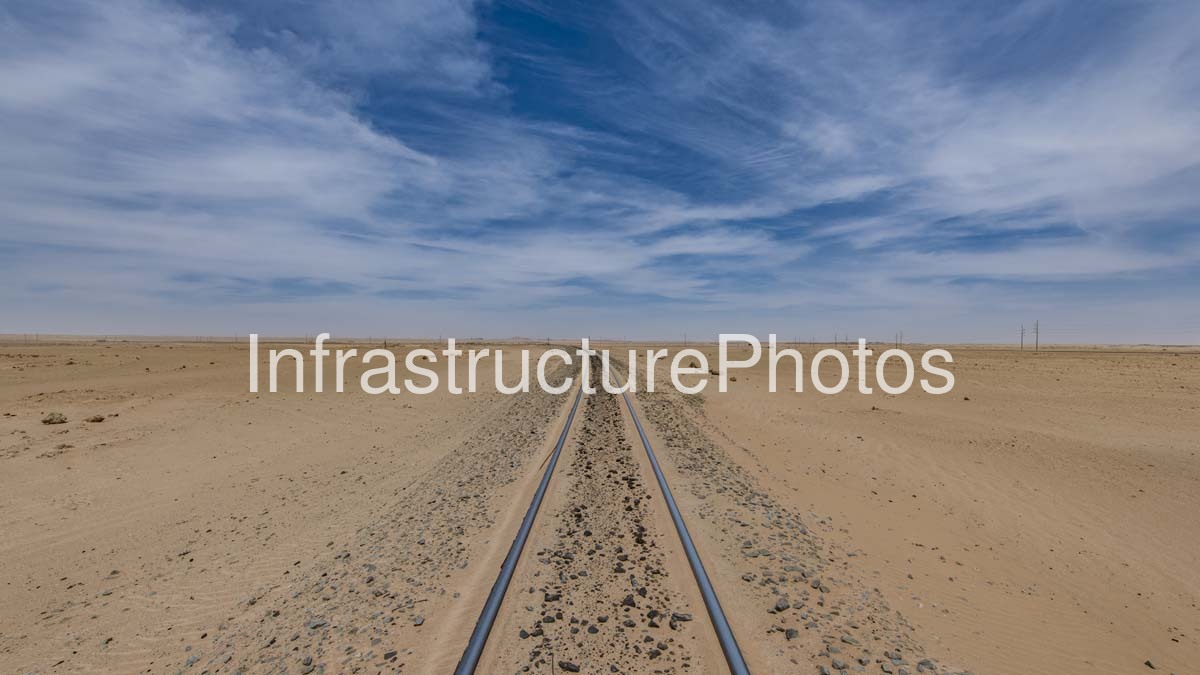
This photograph captures a railway line crossing the stark desert landscape of Namibia’s central Atlantic coast, with two parallel steel rails extending in a remarkably straight line towards the distant horizon. The railway passes through the vast gravel plains and desert environment associated with Dorob National Park and forms part of the important rail connection linking Namibia’s Atlantic coast with the interior. The image was photographed in March 2018 and provides a striking record of railway infrastructure operating across one of the world’s most arid landscapes.
The railway visible in the photograph forms part of the Kranzberg–Walvis Bay railway, which connects the Namibian interior with the country’s principal Atlantic port at Walvis Bay. The route passes through the Erongo Region, connecting important locations including Kranzberg, Usakos, Arandis, Swakopmund and Walvis Bay. The railway has considerable historical importance, originating from the early development of Namibia’s railway network during the German colonial period. The section between Kranzberg and Swakopmund was completed in 1902, while the railway was extended to Walvis Bay in 1914.
The coastal railway has undergone significant changes since its original construction. The first railway extension from Swakopmund towards Walvis Bay was constructed relatively close to the Atlantic coastline. However, in 1980 the coastal section was replaced by an alternative alignment further behind the dunes, allowing the railway to accommodate higher axle loads and improving its operational characteristics. The present route forms part of Namibia’s modern narrow-gauge railway network operated by TransNamib.
The photograph demonstrates the extraordinary engineering challenge of maintaining a railway across the Namib Desert. Unlike conventional railway environments where vegetation, soil and rainfall help stabilise the track formation, this landscape consists largely of loose sand, gravel and exposed desert surfaces. Wind-blown sand can accumulate around railway infrastructure and periodically cover sections of track. Documentation on the Walvis Bay–Swakopmund railway specifically records the problem of wind-blown sand covering the railway and affecting the track bed and sleepers.
The rails appear to run directly through an almost completely barren landscape, with the surrounding terrain consisting of pale sand and gravel plains and only minimal vegetation. The absence of conventional urban infrastructure makes the railway particularly prominent within the composition. Small utility poles can be seen following the general direction of the railway towards the horizon, reinforcing the impression of a linear transport corridor extending through an otherwise immense and sparsely developed landscape.
The railway has historically been vital to Namibia’s mining and industrial economy. The line connects the coast and the port of Walvis Bay with the interior, providing an important freight route for mineral products, industrial materials, fuel and other commodities. The section through the Erongo Region is particularly important because it serves an area containing major mining operations, including the uranium-producing region around Arandis and the broader Central Namib mining district.
Arandis is an important railway location on the route between the coast and the interior. The town developed around mining activity and remains closely associated with Namibia’s uranium industry. The railway provides an important connection between this inland industrial area and Walvis Bay, where cargo can be transferred through the country’s major commercial port.
The landscape surrounding the railway is part of the extraordinary Namib coastal desert environment. Dorob National Park was proclaimed in 2010 and extends along a substantial section of Namibia’s central Atlantic coastline. Its environment includes extensive gravel plains, coastal dunes, sandy areas and specialised desert ecosystems. The railway corridor is specifically recognised in descriptions of the park and surrounding conservation area, although the railway itself is treated as an established transport corridor rather than unrestricted park terrain.
The railway’s presence in this landscape illustrates the long-standing relationship between infrastructure and Namibia’s desert geography. Railways were among the earliest large-scale engineering projects constructed across the Namibian interior, enabling goods and people to move between the Atlantic coast and inland settlements. The original Swakopmund–Windhoek railway was begun in 1897, forming part of the early railway network that ultimately connected the coast with Windhoek and other parts of the territory.
The modern railway continues that legacy. Although the trains and engineering standards have changed considerably since the early twentieth century, the fundamental role remains similar: providing a strategic land-based connection between Namibia’s interior and its Atlantic port. The railway is particularly valuable for bulk freight because rail can move heavy loads over long distances more efficiently than road transport.
The image is especially striking because of its minimalist composition. The twin rails create a powerful vanishing-point perspective, drawing the viewer’s eye directly into the immense desert horizon. The railway formation creates the only strong artificial line across the otherwise uninterrupted landscape. The vast blue and white sky occupies much of the upper frame, while the almost featureless desert foreground emphasises the scale and isolation of the railway.
The photograph also records the constant interaction between infrastructure and the desert. Fine sand has accumulated around the track formation, while the surrounding terrain remains almost completely exposed. Maintaining a railway in such an environment requires continual inspection and management of the track, particularly where wind-blown sand can affect the ballast, sleepers and rails. The railway’s ability to continue operating through this environment is a testament to the engineering and maintenance required to keep Namibia’s coastal transport corridor functional.
19.52 MB
Reviews
There are no reviews yet.