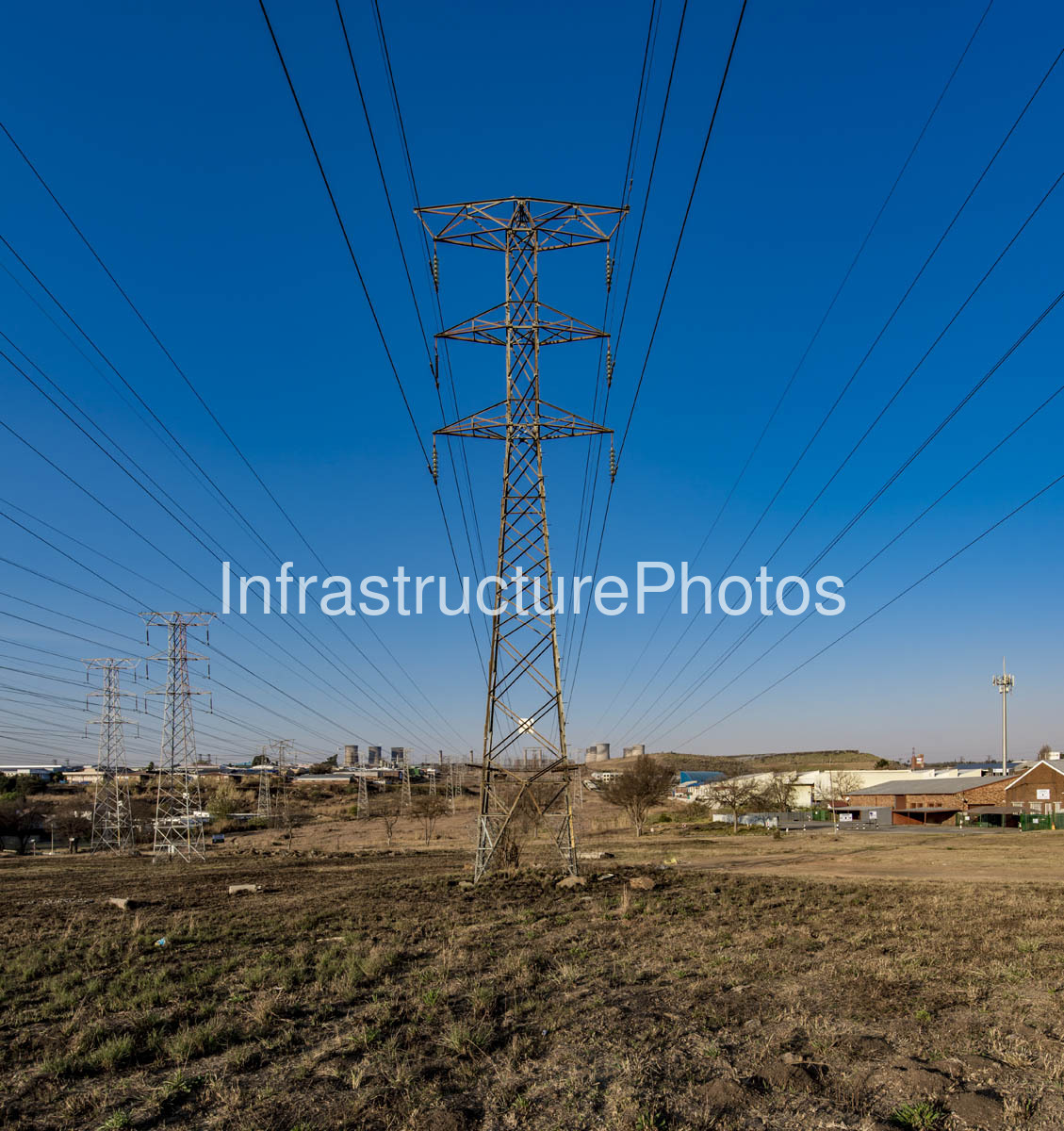
This photograph captures a prominent high-voltage electricity transmission corridor in the eastern Johannesburg metropolitan area, with a lattice-steel transmission tower dominating the foreground and the distinctive cooling towers and industrial structures of Kelvin Power Station visible in the background. The composition illustrates the close relationship between large-scale electricity generation and the transmission infrastructure required to move power into an urban electricity network. Multiple overhead transmission circuits radiate across the landscape, creating strong geometric lines that converge towards the distant power station and associated electrical infrastructure. The combination of pylons, conductors, substations and generation infrastructure makes this an important example of the electricity landscape supporting the Johannesburg metropolitan area.
The transmission tower in the foreground is a tall lattice-steel electricity pylon carrying multiple high-voltage circuits. Its three vertically arranged crossarm levels support conductors on either side of the tower, while long strings of suspension insulators can be seen hanging from the crossarms. Additional transmission towers extend into the distance on both sides of the image, demonstrating the density of the electricity network in this part of Gauteng. The extensive overhead network reflects the importance of the area as an electricity generation, transmission and distribution corridor, particularly given its proximity to major industrial, commercial and residential loads in Johannesburg and the wider Ekurhuleni region.
Visible behind the transmission infrastructure is Kelvin Power Station, a historic coal-fired power station in Kempton Park, within the City of Ekurhuleni. Kelvin is unusual within South Africa’s electricity sector because it is one of the country’s few major power stations that has operated independently of Eskom ownership. The station was originally developed and owned by the City of Johannesburg and was subsequently privatised in 2001. It consists of two co-located generating stations, Kelvin A and Kelvin B, with a historic combined nameplate capacity of approximately 600 MW.
Kelvin A represents the older section of the complex. Its first generating unit entered commercial operation in March 1957, and the station originally comprised six 30 MW generators and 11 chain-grate boilers, providing a total installed capacity of approximately 180 MW. Kelvin A was subsequently placed under care and maintenance and was shut down in 2012 because of ageing infrastructure. The surviving structures and cooling towers are important reminders of the earlier generation of South African power-station engineering and of the rapid expansion of electricity supply that accompanied Johannesburg’s industrial growth during the middle decades of the twentieth century.
Kelvin B forms the newer and historically larger operating component of the complex. It comprises seven 60 MW steam turbine-generator sets and seven pulverised-fuel boilers, giving an installed capacity of 420 MW. Over time, operational constraints and the age of the plant have reduced the amount of generation available compared with its original nameplate capacity. Recent technical documentation identifies Kelvin B as the operating station, while Kelvin A remains associated with decommissioning and heritage considerations. The power station’s cooling system includes large hyperbolic cooling towers, several of which are clearly visible beyond the transmission lines in this photograph.
Kelvin’s strategic importance extends beyond its generating capacity. Its location within the Johannesburg metropolitan electricity network places generation close to one of South Africa’s largest concentrations of electricity demand. City Power has historically sourced a significant portion of its bulk electricity from Kelvin in addition to Eskom, and the station has supplied roughly 10% to 14% of Johannesburg’s electricity requirements at various times. A 20-year power purchase agreement between Kelvin and City Power formed part of the 2001 privatisation, further establishing the facility as an important independent source of electricity for the city.
The surrounding transmission infrastructure is therefore particularly significant. Electricity generated at Kelvin is transformed and exported through the site’s switchyard into the regional grid, where high-voltage networks distribute electricity towards Johannesburg’s commercial, industrial and residential areas. The Sebenza intake substation, constructed near Kelvin Power Station, further illustrates the strategic importance of this location. The 400 kV–275/132 kV Sebenza substation was developed to strengthen the north-eastern Johannesburg electricity network and improve supply stability, highlighting the increasingly interconnected nature of generation, transmission and distribution infrastructure in the region.
The photograph is particularly effective in documenting this infrastructure relationship. The foreground pylon provides a powerful vertical element, while the numerous conductors sweep diagonally across the blue sky and visually connect the transmission corridor with the distant Kelvin complex. The dry winter landscape, scattered vegetation, industrial buildings and communications mast provide additional context for the setting. In the distance, Kelvin’s cooling towers and associated industrial structures form an unmistakable industrial skyline, placing the transmission infrastructure within the broader story of Johannesburg’s long-established electricity network.
14 MB
Reviews
There are no reviews yet.