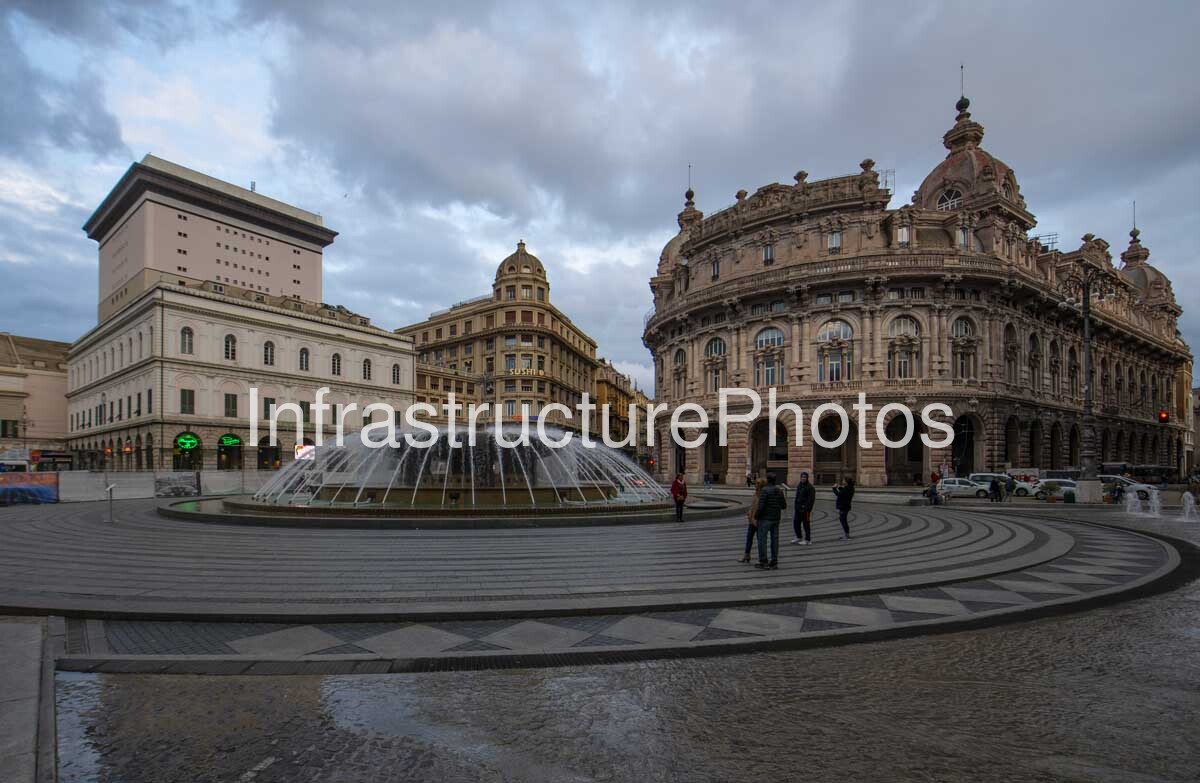
Piazza De Ferrari is the monumental heart of Genoa, Italy, and one of the city’s most recognisable urban spaces. This wide architectural view captures the square’s defining fountain together with several of the historic and cultural buildings that surround it, most notably the Palazzo della Nuova Borsa on the right and the Teatro Carlo Felice on the left. The photograph also records the distinctive Palazzo del Credito Italiano and the surrounding historic streetscape, demonstrating how Piazza De Ferrari brings together architecture from different periods into a single civic setting. The square is Genoa’s principal public gathering place and is regularly used for civic celebrations, cultural events and major public occasions.
The Location is Piazza De Ferrari, Genoa, Liguria, Italy. The square is named after Raffaele De Ferrari, Duke of Galliera, a prominent Genoese banker and philanthropist who contributed substantially towards the expansion of Genoa’s port. Its present character emerged during a period of major urban transformation when Genoa expanded beyond its medieval core and established new streets connecting the historic centre with the developing commercial city. Via XX Settembre, Via Dante and Via Petrarca converge in the vicinity of Piazza De Ferrari, creating the principal eastward approaches to the square. The resulting urban composition became one of the clearest expressions of Genoa’s transformation into a modern European commercial centre.
At the centre of the composition is the Piazza De Ferrari Fountain, one of the city’s most recognisable landmarks. Designed by architect Giuseppe Crosa di Vergagni and completed in 1936, the monumental bronze fountain was conceived as the central visual feature of the square. Its broad circular basin and numerous jets create a dramatic dome of water, while the surrounding paving follows the same circular geometry. Additional water features were introduced during the square’s later redevelopment, but the principal fountain remains the defining element of the piazza.
The paving surrounding the fountain is an important architectural component in its own right. Broad bands of light and dark stone radiate around the fountain in sweeping concentric curves, visually expanding the circular form across much of the square. In this photograph, the wet surface of the paving reflects the subdued light and creates additional depth in the foreground. The geometry produces a powerful visual transition between the open public space and the dense architectural enclosure beyond it.
On the right is the extraordinary Palazzo della Nuova Borsa, also known as the Palazzo della Borsa. Completed in 1912, the building was designed by engineers Dario Carbone and Amedeo Pieragostini and was created as Genoa’s purpose-built stock exchange. Its exterior adopts an exuberant Neo-sixteenth-century architectural vocabulary, while its interiors were designed by Adolfo Coppedè in the Liberty tradition. The building’s elaborate façade was deliberately intended to communicate the financial strength and importance of Genoa during the early twentieth century, when the city’s stock exchange was among Italy’s most significant financial institutions.
The Palazzo della Nuova Borsa is one of the most visually dominant buildings in the photograph. Its sweeping curved frontage follows the geometry of Piazza De Ferrari, while the massive rusticated arches at ground level support several increasingly ornate upper storeys. Columns, pilasters, sculptural figures, balustrades, decorative panels and elaborate roof elements create an exceptionally rich façade. The building’s curved form contrasts strongly with the more restrained architecture surrounding it, making it one of the most recognisable landmarks in Genoa.
The building visible towards the centre of the composition is the Palazzo del Credito Italiano, completed in 1914 and designed by Giuseppe Tallero. Its prominent rounded corner and domed tower provide a distinctive transition between Piazza De Ferrari and Via Dante. Originally constructed as a banking headquarters, it forms part of a group of major financial and commercial buildings erected around the square during the early twentieth century. Together with the Palazzo della Borsa, the building illustrates the importance of Piazza De Ferrari as the financial centre of modern Genoa.
On the left is the Teatro Carlo Felice, Genoa’s principal opera house. The original theatre was designed by the Genoese architect Carlo Barabino and opened in 1828. It was constructed on the site of the former San Domenico convent and became one of the most important cultural institutions in the city. The original building was severely damaged during the Second World War, with much of the theatre destroyed by bombing. The reconstruction ultimately produced the modern Teatro Carlo Felice designed by Aldo Rossi with Ignazio Gardella and other collaborators, while preserving the original Neoclassical pronaos by Barabino.
The large, comparatively plain upper volume visible behind the historic lower façade of the theatre is particularly interesting. It reflects the technological requirements of the modern opera house, including the substantial stage tower required to accommodate contemporary theatrical production. The present theatre deliberately combines the surviving historic elements with modern construction and technology. The Teatro Carlo Felice describes its stage tower as approximately 63 metres high, making it one of the most prominent vertical elements in the central Genoese skyline.
The relationship between the theatre and the square is also significant. The Teatro Carlo Felice occupies the edge of Piazza De Ferrari and extends towards Galleria Mazzini. Its modern reconstruction incorporates a covered pedestrian plaza that provides a connection between the piazza and the historic gallery. This means the theatre functions not only as a performance venue but also as an important piece of urban infrastructure, integrating cultural activity with pedestrian movement through the city centre.
The Palazzo della Nuova Borsa and Teatro Carlo Felice therefore represent two very different architectural eras. The theatre originated in the Neoclassical period of the nineteenth century, although its present building is largely a twentieth-century reconstruction, while the Palazzo della Borsa represents the exuberant commercial architecture of the early twentieth century. Between them stands the Palazzo del Credito Italiano, adding another layer of financial and institutional architecture. The three buildings create an unusually rich architectural panorama around the fountain.
The square itself demonstrates how Genoa’s architecture has evolved through both construction and reconstruction. Its buildings reflect the city’s medieval origins, its period as a powerful maritime republic, nineteenth-century urban modernisation, early twentieth-century commercial expansion and postwar rebuilding. The result is not a single architectural style but a complex urban composition in which different generations of architecture coexist.
The photograph’s dramatic weather contributes strongly to this sense of architectural history. Heavy grey and blue clouds fill the sky, while softer light breaks through above the buildings. The wet paving reflects portions of the architecture and fountain, giving the square a subdued but atmospheric appearance. The water jets become particularly prominent against the darker background, creating a strong horizontal and circular focus.
Pedestrians crossing the square provide human scale, while vehicles moving around its perimeter demonstrate that Piazza De Ferrari remains an active part of contemporary Genoa. Temporary barriers and modern street infrastructure are visible alongside buildings more than a century old. This juxtaposition is important: Piazza De Ferrari remains a functioning civic and commercial environment rather than a preserved architectural museum.
The photograph therefore captures Piazza De Ferrari as an architectural crossroads. The fountain establishes the civic centre; the Palazzo della Nuova Borsa represents Genoa’s financial history; the Palazzo del Credito Italiano records the city’s banking expansion; and the Teatro Carlo Felice represents its enduring cultural life. Together they form one of the most important urban ensembles in Genoa.
17.7 MB
Reviews
There are no reviews yet.