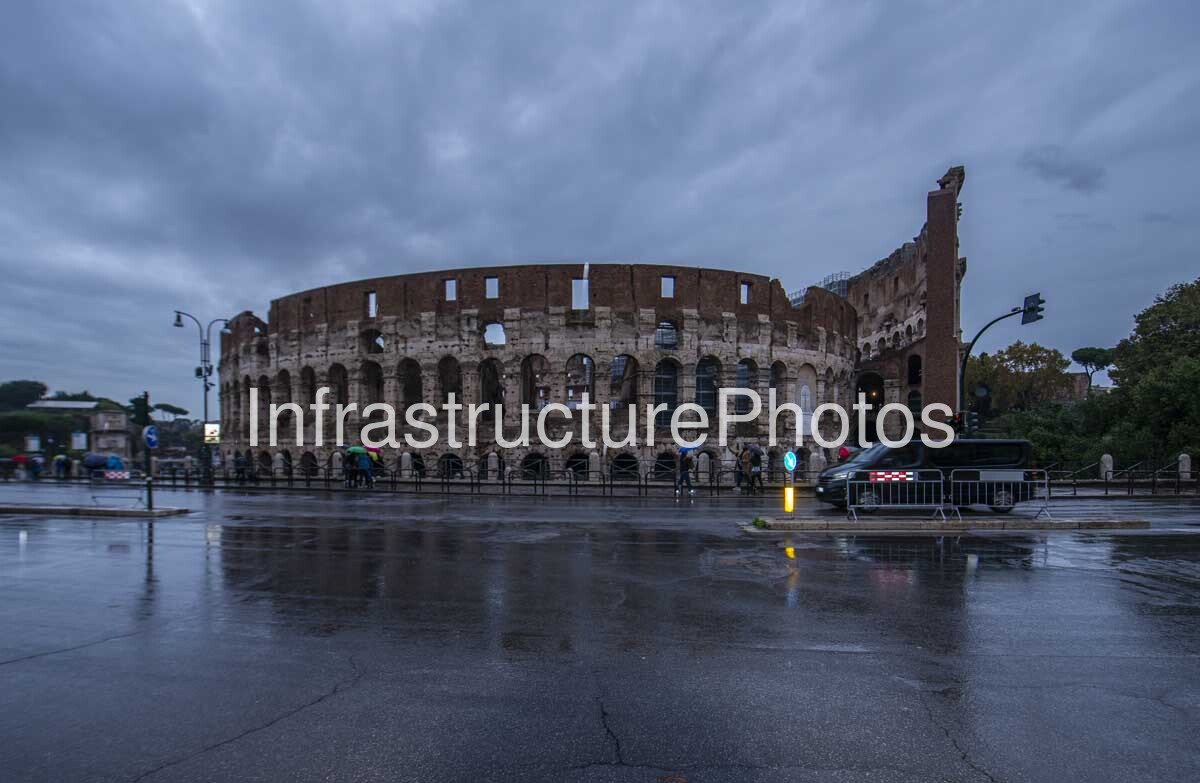
he Colosseum, formally known as the Flavian Amphitheatre, dominates this atmospheric photograph from Rome, its weathered arches and exposed masonry standing against a dark, rain-filled sky. Built almost two thousand years ago, the monument remains one of the world’s most recognisable examples of Roman architecture and engineering. In this view, the surviving northern elevation presents the enormous scale and repetitive structural rhythm of the amphitheatre, while wet paving and rain-soaked streets create striking reflections in the foreground. The umbrellas of visitors gathered along the perimeter provide a sense of scale, emphasising the immense proportions of the ancient structure.
Construction of the Colosseum began under the Emperor Vespasian around AD 70–72 and the amphitheatre was inaugurated by his son Titus in AD 80. Further work continued under Domitian. It was constructed in the valley between the Palatine, Esquiline and Caelian hills, on the site of an artificial lake associated with Nero’s Domus Aurea. The decision to build the amphitheatre on this location was politically significant, returning land that had been appropriated for Nero’s imperial palace complex to a public function. The official Archaeological Park of the Colosseum identifies the monument as one of the principal archaeological sites within central Rome.
The structure is an extraordinary example of Roman amphitheatre design. Its elliptical plan was engineered to accommodate enormous crowds while allowing spectators to enter, leave and reach their seating areas efficiently. The exterior was organised into superimposed levels of arches, producing the characteristic repetitive façade visible in this photograph. Behind these arches were circulation corridors, stairways and seating areas, creating a sophisticated system of movement within the monument. The surviving façade demonstrates the Roman mastery of combining monumental architectural expression with highly practical structural and circulation requirements.
17 MB
Reviews
There are no reviews yet.