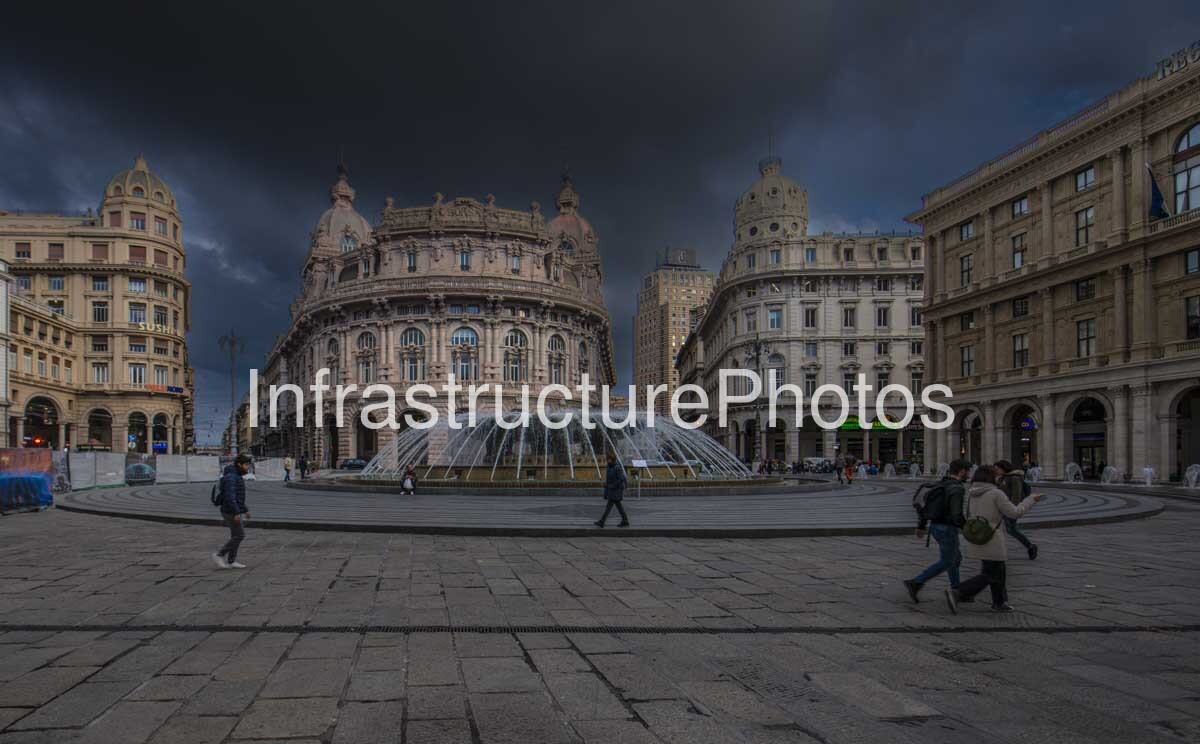
Piazza De Ferrari is the monumental civic heart of Genoa, Italy, and one of the most recognisable urban spaces in Liguria. Located at the meeting point of the historic city centre, Via XX Settembre, Via Dante and the approaches to Genoa’s historic commercial districts, the square brings together architecture from several centuries. This aerial-style architectural view captures the dramatic character of Piazza De Ferrari, with its monumental fountain occupying the foreground of the square and the richly decorated Palazzo della Nuova Borsa forming the principal architectural focus beyond it. The surrounding buildings create a remarkable ensemble in which nineteenth- and early twentieth-century architecture stands alongside the much older Palazzo Ducale and the historic urban fabric of Genoa. Piazza De Ferrari is officially regarded as the city’s principal square and remains an important gathering place for public events and civic celebrations.
At the centre of the composition is the Palazzo della Nuova Borsa, commonly known as the Palazzo della Borsa. Constructed between 1906 and 1912, the building was created to accommodate Genoa’s new stock exchange and represented the growing economic importance of the city during the transformation of its commercial and financial centre. The building was developed as part of the major urban changes that reshaped Genoa during the late nineteenth and early twentieth centuries, particularly the creation and expansion of Via XX Settembre and the enlargement of Piazza De Ferrari. The Chamber of Commerce of Genoa records that the site was acquired in 1906 and that the building was inaugurated on 20 July 1912 following an extensive construction programme.
Architecturally, the Palazzo della Borsa is particularly interesting because its exterior and interior express different aspects of early twentieth-century Italian design. The façade is generally described as eclectic and Neo-Renaissance or neo-sixteenth-century in character, with a highly elaborate decorative treatment intended to convey prosperity, prestige and financial power. Its rounded frontage follows the geometry of Piazza De Ferrari, creating the distinctive curved composition seen in this photograph. Large rusticated elements, arched openings, pilasters, sculptural decoration, elaborate window surrounds and a strongly articulated upper storey give the building a theatrical presence. The architectural project is associated principally with Dario Carbone, with Amedeo Pieragostini also associated with the building’s engineering and construction, while Adolfo Coppedè was responsible for the celebrated interior decoration.
The Palazzo della Borsa’s interiors are particularly important to Genoa’s architectural heritage. Adolfo Coppedè designed the former trading hall in the Liberty style, the Italian interpretation of Art Nouveau. The historic Sala delle Grida, where brokers once conducted transactions, remains in the building and is now used for exhibitions, conferences and cultural events rather than financial trading. The Chamber of Commerce continues to own the historic hall, which has been adapted as a public exhibition and event venue. This transformation illustrates how historic commercial architecture can acquire a new civic and cultural role while retaining the physical character and memory of its original purpose.
The monumental bronze fountain visible in front of the Palazzo della Borsa is another defining element of Piazza De Ferrari. Designed by architect Cesare Crosa di Vergagni and completed in 1936, the fountain helped give the square the balanced composition that largely defines its appearance today. Its broad circular basin and multiple water jets form a powerful foreground element, while the curved Palazzo della Borsa provides an architectural backdrop. The contrast between the moving water, stone paving and richly ornamented façades is especially effective in photography.
48 MB
Reviews
There are no reviews yet.