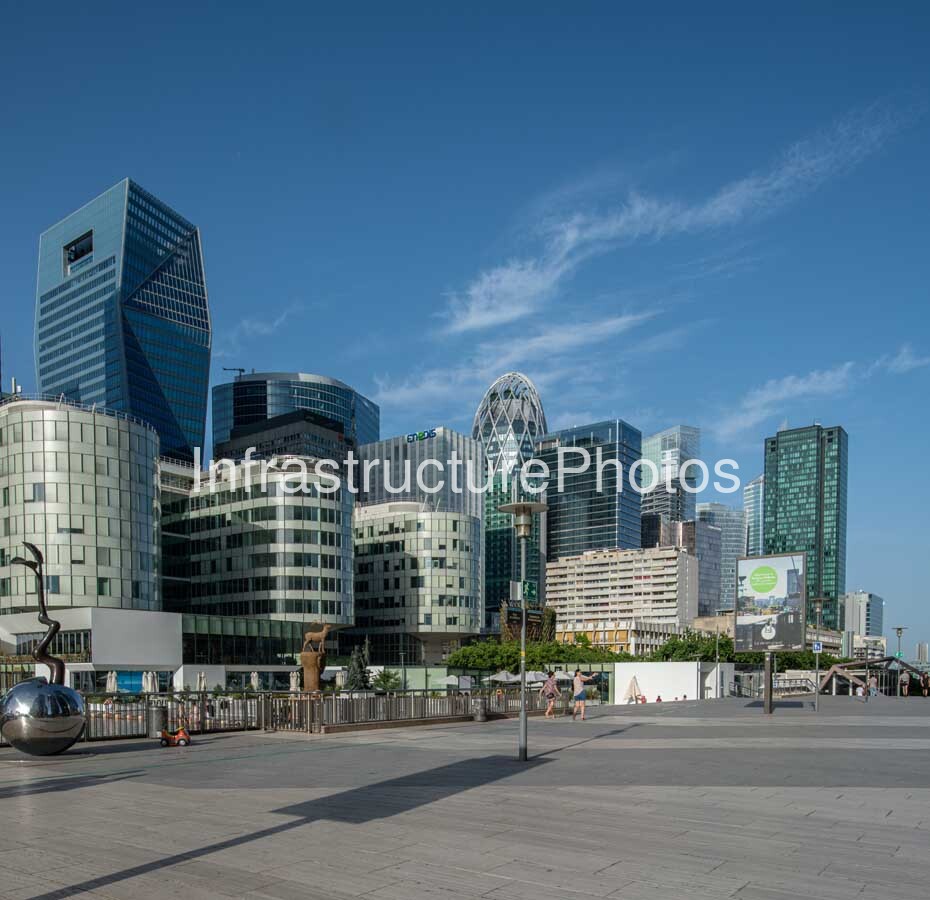
Tour D2 is one of the most distinctive towers in La Défense, the major business district immediately west of Paris. Completed in 2015, the 175-metre office tower was designed by French architect Anthony Béchu and American architect Tom Sheehan and occupies a prominent position at 17 bis Place des Reflets in Courbevoie. Its unusual ovoid form and exposed structural exoskeleton distinguish it from the predominantly rectilinear office towers that surround it, making D2 one of the defining pieces of contemporary architecture in La Défense. The tower contains approximately 54,530 square metres of floor area and rises 37 storeys.
The photograph presents D2 from the elevated public realm of La Défense, with the tower occupying the left side of the composition. Its most recognisable architectural feature is the diagonal steel exoskeleton that crosses the glazed façade. Rather than concealing the structural system behind a conventional curtain wall, Béchu and Sheehan made the external steel lattice an integral part of the building’s identity. According to Paris La Défense, the metal mesh contributes approximately 50 percent of the tower’s structural stability. D2 was also the first high-rise building in France to combine a concrete core with a steel load-bearing exostructure, making its structural approach an important part of its architectural significance.
The tower replaced the former Bureau Veritas building, which had occupied the site since 1984. Its construction formed part of a wider programme to reconnect areas of La Défense that had historically been separated by the Boulevard Circulaire. Public-realm works were undertaken simultaneously with the tower, including the creation of new public spaces, improved pedestrian connections, upgrades to the Reflets public car park and a more urban treatment of the surrounding boulevard. The result was therefore not simply the replacement of an older office building but a broader transformation of the site and its relationship with the surrounding district.
D2’s form places it within a notable international lineage of contemporary towers that use curved or aerodynamic geometries. Paris La Défense specifically compares its ovoid profile with major international landmarks including the Agbar Tower in Barcelona, designed by Ateliers Jean Nouvel, and 30 St Mary Axe in London, designed by Norman Foster. Yet D2 has a character of its own because of its exposed diagonal structural lattice. The steel framework creates a diamond-like pattern across the façade, giving the building a strong visual rhythm that changes depending on the viewing angle and the intensity of daylight.
The surrounding architecture in this photograph demonstrates the extraordinary variety of La Défense. D2 stands among towers and commercial buildings from several generations, ranging from the large office developments of the 1970s to much more recent high-rise projects. The district currently contains around 60 significant towers and buildings, making it one of Europe’s most concentrated collections of commercial architecture.
Immediately beyond D2, the photograph reveals a series of glass and steel office buildings, while the large open pedestrian area in the foreground demonstrates one of the defining planning characteristics of La Défense. Much of the district was constructed around an elevated pedestrian deck, allowing people to move between offices, retail facilities, public spaces and transport connections above much of the vehicular infrastructure. This separation of pedestrian and road circulation has helped La Défense accommodate an exceptionally dense concentration of commercial development.
The image also captures the district’s extensive programme of public art. The prominent circular and lattice-like artwork visible further into the scene contributes to La Défense’s reputation as an open-air museum as well as a business centre. The district contains a large collection of contemporary artworks integrated into its plazas, pedestrian routes and spaces between buildings. This artistic programme has developed alongside the architecture and forms an important part of the identity of La Défense.
One of the particularly interesting aspects of this view is the juxtaposition between D2 and the older towers around it. The tower’s exposed diagrid represents a very different approach to structural expression from the smooth curtain-wall façades of many neighbouring buildings. Its architecture communicates the structural forces of the building directly through the exterior, while the surrounding towers often present a more uniform glazed surface. The result is a layered architectural landscape in which different technological and aesthetic approaches coexist.
D2 was also designed with environmental performance in mind. Paris La Défense notes that the building incorporates modern green-building technologies and achieved HQE and BREEAM certifications, together with BBC RT2005 labelling and compliance with RT2012 standards. Its design therefore combines an expressive structural system with contemporary expectations concerning energy efficiency and environmental performance.
The tower provides approximately 4,200 workstations over around 49,000 square metres of usable space. Its location near the Esplanade de La Défense metro station and its integration into the pedestrian network make it highly accessible within the wider business district. The building’s position also places it within walking distance of many of La Défense’s most important architectural landmarks, including Cœur Défense, the Légende Tower and the Grande Arche.
Architecturally, D2 is significant because it demonstrates how a modern office tower can use structure as an expressive architectural language. The diagonal steel lattice is not merely decorative; it forms part of the building’s load-bearing system while simultaneously giving the tower its distinctive visual character. The ovoid plan further reduces the apparent mass of the building, allowing it to appear relatively slender when viewed from the surrounding public spaces.
17 MB
Reviews
There are no reviews yet.