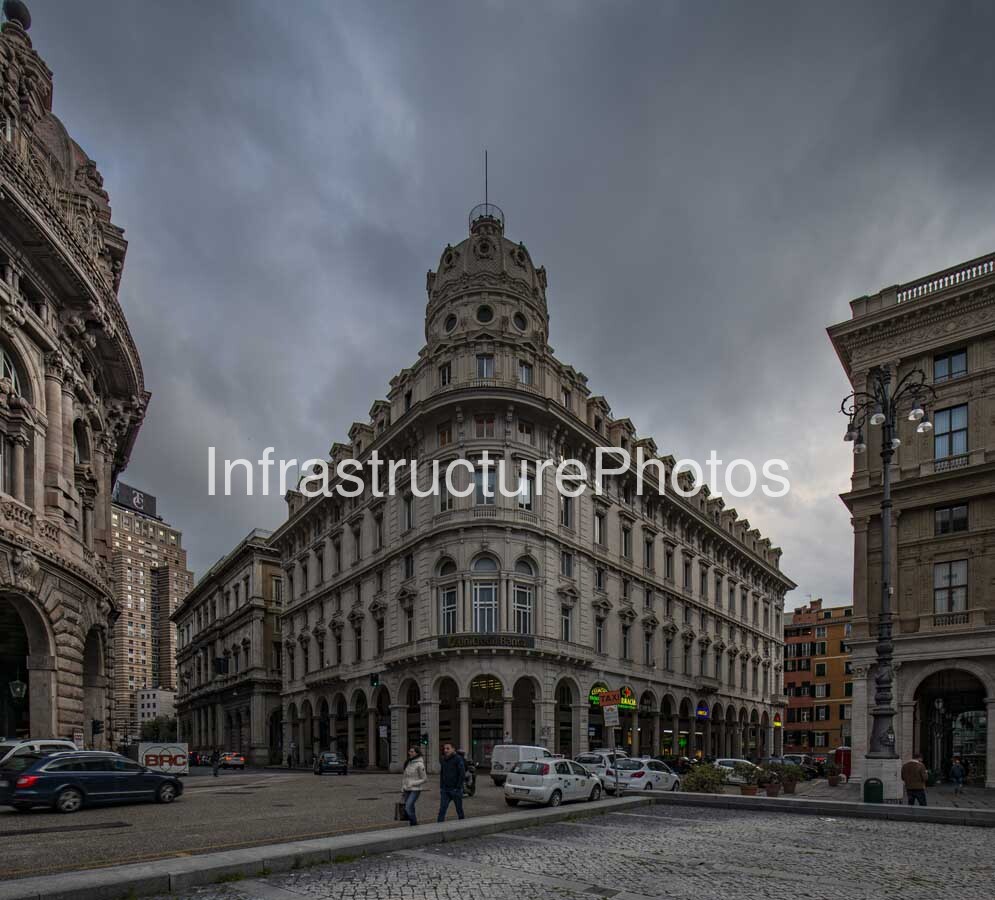
The Palazzo del Credito Italiano is one of the major early twentieth-century buildings defining Piazza De Ferrari in Genoa, Italy. Located at the junction of Via Dante and Via Federico Alizeri/Petrarca within the central city, the building occupies a prominent position opposite the Palazzo della Nuova Borsa and forms part of the remarkable architectural ensemble surrounding Genoa’s principal public square. Completed in 1914, the building was designed by architect and engineer Giuseppe Tallero for Credito Italiano and was conceived as a prestigious banking headquarters during a period when Genoa was undergoing major urban and commercial transformation. Its monumental scale, restrained historicist ornamentation, continuous arcades and highly distinctive domed corner make it an important component of the architectural identity of Piazza De Ferrari. The building is today associated with UniCredit, although its historic identity remains closely connected to Credito Italiano.
The Location is Piazza De Ferrari, Genoa, Liguria, Italy, with the building extending towards Via Dante and Via Federico Petrarca. Piazza De Ferrari became the centre of Genoa’s modern commercial district during the late nineteenth and early twentieth centuries. The development of Via XX Settembre, Via Dante and Via Petrarca transformed the surrounding urban fabric and established new routes between the historic centre and the expanding city. Four major commercial and institutional buildings were subsequently erected around the square between the late 1890s and the 1920s, including the Palazzo della Nuova Borsa, Palazzo del Credito Italiano and the building now occupied by Regione Liguria.
The Architect was Giuseppe Tallero, who designed the Palazzo del Credito Italiano in 1914. Tallero was an important figure in Genoa’s early twentieth-century architectural development and was also involved in the later design of the Palazzo della Navigazione Generale Italiana, now the Palazzo della Regione Liguria. Contemporary architectural documentation identifies Tallero as the author of the 1914 Palazzo del Credito Italiano, while later work on the neighbouring Palazzo della Navigazione Generale Italiana was developed by Cesare Gamba in collaboration with Tallero.
The Completed date is 1914. Its construction formed part of a remarkable period of development around Piazza De Ferrari, when Genoa’s principal financial institutions competed to establish prestigious headquarters close to the new stock exchange. The Palazzo della Nuova Borsa was completed in 1912, followed by the Palazzo del Credito Italiano in 1914 and the Palazzo della Navigazione Generale Italiana in 1924. This sequence of construction effectively transformed Piazza De Ferrari into the financial and administrative heart of modern Genoa.
The Architectural Style of the Palazzo del Credito Italiano can be described as eclectic historicism with strong Neo-Renaissance and late nineteenth-century monumental influences. Compared with the exuberant Palazzo della Nuova Borsa immediately to its left, the building adopts a more restrained architectural language. Its façade is organised around regular vertical bays, tall windows, decorative pilasters and an extensive arcade at street level. The building nevertheless possesses a powerful monumental quality, particularly at its corner where the façade curves upwards into a prominent domed tower. This combination of a formal historicist façade and a highly expressive corner element gives the building a strong presence within the square.
The domed corner is perhaps the most distinctive feature captured in this photograph. Rising above the surrounding roofline, the tower is composed of several progressively smaller levels, culminating in an ornate circular drum and shallow dome. Small round windows, decorative panels and sculptural details articulate the upper section, while the long façades descend symmetrically towards the surrounding streets. The tower acts as a visual marker from several directions and helps pedestrians orient themselves within the complex geometry of Piazza De Ferrari.
The building’s ground floor is particularly characteristic of the architectural language used throughout Genoa’s modern centre. A continuous sequence of rounded arches forms a covered arcade, providing sheltered pedestrian circulation and connecting the building with the wider network of porticoes found along Via XX Settembre. These arcades are an important feature of Genoese commercial architecture, allowing shops, businesses and pedestrians to occupy the edges of the street while protecting movement from the weather. Via XX Settembre remains particularly renowned for its extensive porticoes, decorated ceilings, mosaic floors, bay windows and richly ornamented façades.
The Building Use was originally a major banking headquarters for Credito Italiano. The establishment of large financial institutions around Piazza De Ferrari was closely linked to Genoa’s economic development and the relocation of banking activity towards the new commercial centre. The building was not merely an office block but a carefully positioned architectural statement representing the financial power and prestige of its institution. The Palazzo del Credito Italiano was one of the principal buildings associated with this new financial district, alongside the stock exchange and other banking institutions.
The building subsequently became associated with UniCredit, reflecting the evolution and consolidation of Italy’s banking sector. Its continued banking-related identity illustrates how the architecture of Piazza De Ferrari has remained connected to commercial and financial activity even as individual institutions and corporate identities have changed. The building therefore retains both historic and contemporary relevance within Genoa’s urban centre.
15.6 MB
Reviews
There are no reviews yet.