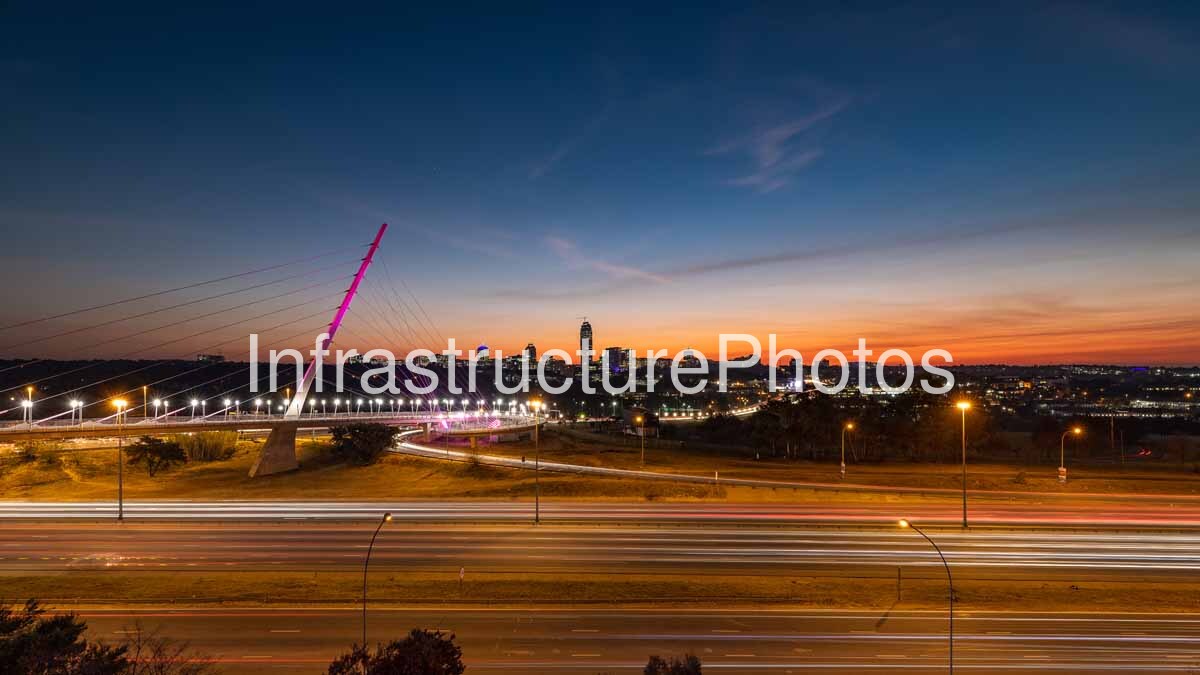
This photograph captures the Grayston Pedestrian and Cycle Bridge at dusk, spanning the M1 motorway at the Grayston Drive interchange in Sandton, Johannesburg. The illuminated cable-stayed structure forms a striking foreground element, while the lights of the M1 create long exposure trails and the distinctive Sandton skyline rises beyond it against a dramatic sunset. The image brings together three important elements of Johannesburg’s urban landscape: transport infrastructure, pedestrian connectivity and the high-rise commercial architecture of Sandton.
The Grayston Pedestrian and Cycle Bridge, also known as the Great Walk Bridge, was developed by the City of Johannesburg as part of an initiative to improve pedestrian and cycling connectivity between Alexandra and Sandton. Before the bridge was constructed, the M1 motorway represented a significant physical barrier between the two areas. The project created a dedicated and safer route for pedestrians and cyclists across one of Johannesburg’s busiest motorways. The Johannesburg Development Agency identified that more than 10,000 people travelled between Alexandra and Sandton each day, highlighting the importance of providing infrastructure designed around people as well as vehicles.
The bridge is particularly distinctive because of its single inclined pylon and fan of stay cables. Rather than relying on multiple conventional support structures, the main span is visually suspended from the prominent raked pylon, creating an elegant diagonal element against the skyline. The structure combines a cable-stayed system with a concrete deck, producing a clean and contemporary appearance that contrasts with the extensive road infrastructure beneath it. The bridge has been recognised as a landmark structure within Sandton’s urban landscape.
The bridge forms part of a wider pedestrian and cycling corridor linking Alexandra and Sandton. The project was conceived as a community-focused intervention intended to improve mobility and provide safer access to employment, commercial facilities, public transport and other amenities in Sandton. The Johannesburg Development Agency described the wider Great Walk project as a means of strengthening connections between communities that had previously been separated by vehicle-dominated infrastructure.
The photograph’s timing adds another dimension to the infrastructure. Taken during the transition from daylight to night, the sky retains a vivid orange and gold band along the horizon while the upper sky moves into deep blue. The bridge’s architectural lighting becomes increasingly prominent as natural light disappears, highlighting the cables and the sweeping form of the structure.
The M1 motorway occupies a substantial portion of the foreground. Traffic travelling along the highway has been transformed by the long-exposure technique into continuous ribbons of white and red light. These light trails emphasise the enormous volume of movement carried by the motorway and create a visual contrast with the pedestrian bridge above it. The result is a strong representation of Johannesburg as a constantly moving metropolitan environment.
Beyond the bridge, the Sandton skyline provides the second major focal point. The cluster of illuminated office towers and high-rise buildings forms a distinctive urban silhouette against the setting sun. Sandton is one of Johannesburg’s most important commercial centres, and its concentration of modern office buildings has made the skyline one of the most recognisable in South Africa.
The relationship between the bridge and skyline is particularly effective. The cable-stayed structure occupies the left side of the composition, while the skyline extends across the horizon behind it. The inclined pylon creates a strong diagonal that directs the eye towards the city centre, visually connecting the transport infrastructure in the foreground with the commercial district in the distance.
The surrounding landscape also remains visible despite the onset of darkness. Areas of open land, vegetation, roads and lower-density development occupy the spaces between the motorway and Sandton’s high-rise core. This helps illustrate the layered nature of Johannesburg, where major highways, pedestrian infrastructure, open spaces, residential neighbourhoods and high-density commercial development exist within a relatively compact metropolitan environment.
The bridge’s engineering is also notable. The permanent structure includes a concrete box-girder deck and cable stays supported by a single raked pylon. The wider project was designed by Royal HaskoningDHV, with Glenn Mills identified as the architect and Concor Infrastructure as the main contractor. The bridge received recognition through South African engineering awards for its design and execution.
The main bridge forms part of a broader network of infrastructure improvements around Sandton, Alexandra and the M1. Nearby projects included dedicated Rea Vaya infrastructure and other bridges intended to improve public transport and non-motorised movement through the area. The Grayston bridge therefore represents more than an isolated architectural landmark; it forms part of a larger attempt to improve movement through one of Johannesburg’s most important economic corridors.
From an architectural and infrastructure photography perspective, the image is particularly strong because it captures the bridge under changing light while simultaneously documenting the surrounding city. The illuminated cables, moving traffic, sunset and high-rise skyline create several layers of visual information. The photograph records both the physical structure and the activity surrounding it, demonstrating how infrastructure can become an important part of a city’s visual identity.
The Grayston Pedestrian and Cycle Bridge has become a recognisable feature of Sandton’s landscape. Its distinctive pylon and illuminated cables provide a strong architectural counterpoint to the straight lines of the M1 motorway and the vertical forms of the city’s towers. In this photograph, the bridge becomes a visual gateway into the Sandton skyline, illustrating the relationship between movement, architecture and urban development in Johannesburg.
25 MB
Reviews
There are no reviews yet.