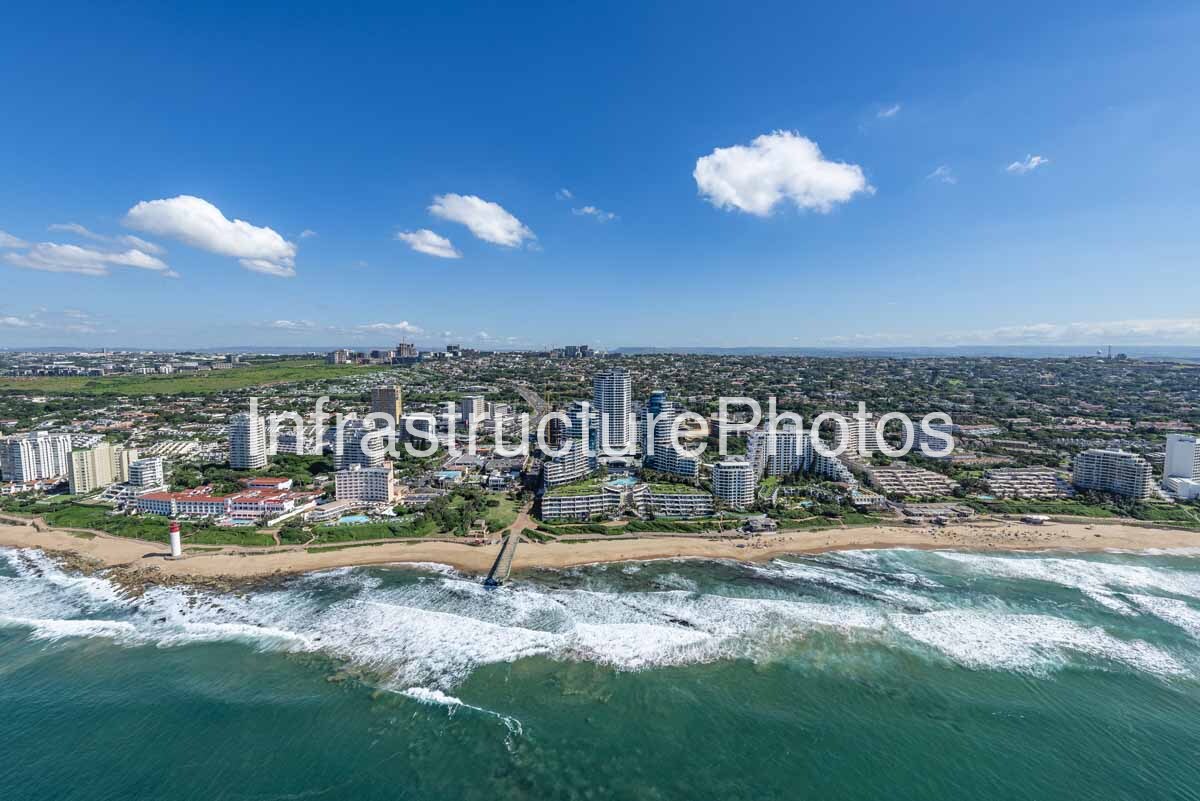
This aerial photograph presents a sweeping view of The Pearls of Umhlanga and the surrounding coastal landscape of Umhlanga, KwaZulu-Natal. Captured from offshore, the image places the Indian Ocean prominently in the foreground, with the beachfront, luxury residential developments and expanding urban landscape extending inland towards the horizon.
The Pearls of Umhlanga is one of the defining developments of the Umhlanga coastline and has played a significant role in transforming the area’s skyline. The large mixed-use development incorporates luxury residential apartments, retail facilities and leisure amenities arranged close to the beachfront. The development was constructed over a number of phases beginning in the mid-2000s, with the final phase completed in 2018.
Several of the development’s prominent residential towers are clearly visible in the centre of the photograph. Their contemporary forms, balconies and extensive glazing create a distinctive cluster of high-rise architecture against the lower-density urban fabric surrounding them. The towers form a recognisable part of the modern Umhlanga skyline and demonstrate the area’s transition from a predominantly coastal resort environment into a major residential and commercial node.
The photograph also illustrates the relationship between the development and the coastline. A sandy beach runs along the edge of the built environment, while the ocean occupies almost half of the composition. Waves breaking along the shore create a strong horizontal transition between the built landscape and the sea. A long pier extending into the ocean is also visible near the centre of the image, providing an important landmark within the coastal setting.
Beyond The Pearls, the urban landscape becomes progressively less dense. Numerous residential properties, apartment blocks and commercial buildings extend across the gently rising terrain. The mixture of low-rise neighbourhoods and newer high-rise developments illustrates the rapid urbanisation that has taken place along this section of the KwaZulu-Natal coastline.
The image provides an especially useful perspective of Umhlanga’s urban development pattern. High-density buildings are concentrated close to the coastline, while lower-density residential areas extend inland. This creates a distinctive transition from beachfront towers to suburban neighbourhoods and then to more open areas towards the horizon.
The development’s architecture is characterised by contemporary residential forms, extensive balconies and strong vertical elements. The towers vary in height and form, creating a layered skyline rather than a uniform wall of buildings. Landscaped areas between the buildings introduce vegetation into the development and soften the transition between the architecture and the surrounding coastal environment.
The broader landscape is equally important to the photograph. Umhlanga’s subtropical vegetation remains visible between buildings and across residential neighbourhoods, while areas of undeveloped or agricultural land can be seen further inland. The combination of dense development, vegetation, coastline and open land provides a visual record of a rapidly evolving urban environment.
The bright blue sky and scattered white clouds contribute to the sense of openness in the image. Strong sunlight highlights the buildings and coastline while creating clear definition between the urban areas, vegetation and ocean. The aerial perspective allows these elements to be viewed together in a way that would not be possible from street level.
The Pearls of Umhlanga represents a significant chapter in the development of the KwaZulu-Natal coastal property market. The broader project was reported at approximately R3.5 billion and ultimately incorporated around 700 apartments and 60 shops. Its successive phases contributed to the emergence of a much more prominent high-rise skyline in Umhlanga.
The architectural team associated with The Pearls included Cooper, Seedat & Seedat Architects, with Arup involved in engineering and other professional services.
From an architectural photography perspective, this image is particularly valuable because it documents not simply an individual building but an entire urban district. The Pearls occupies the centre of the composition, while surrounding apartment buildings, residential neighbourhoods, roads, landscaped areas and the coastline establish its relationship with the wider city.
39 MB
Reviews
There are no reviews yet.