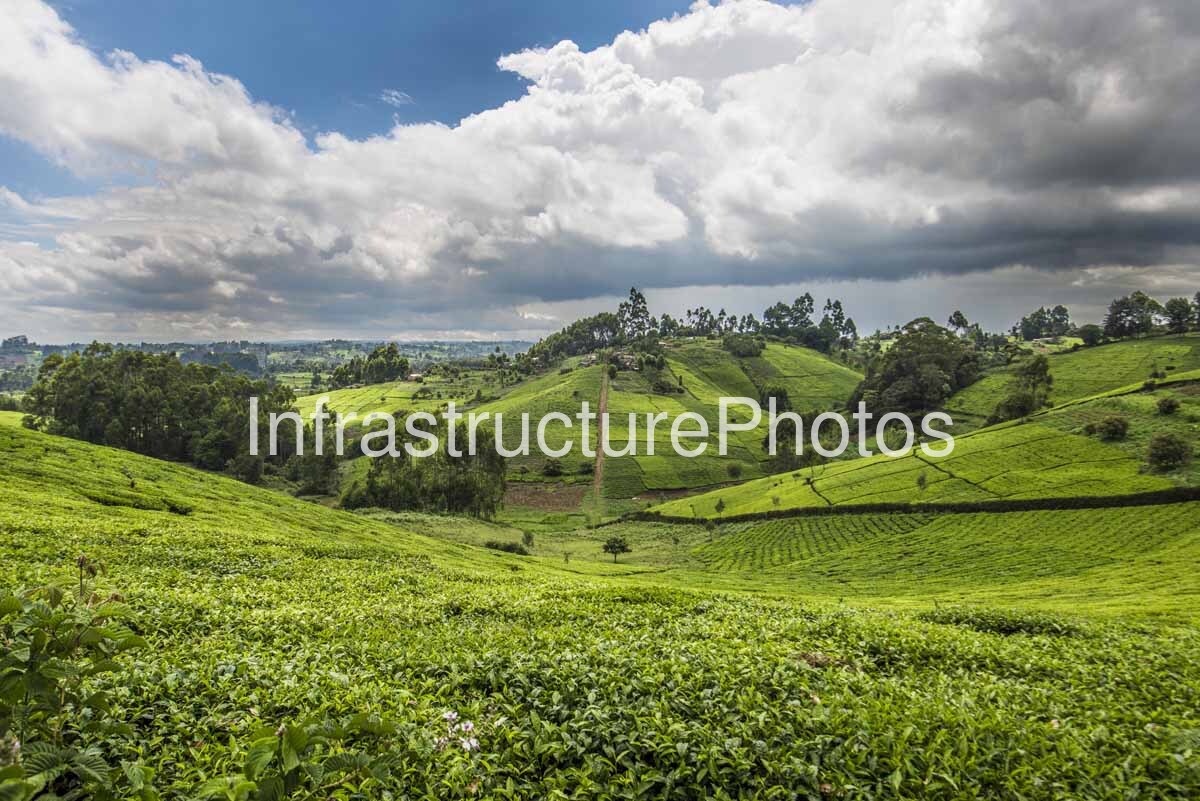
This photograph captures the expansive tea-growing landscape of Kenya’s highlands, where carefully cultivated tea fields sweep across a series of rolling hills beneath a dramatic sky. The vivid green plantation dominates the foreground and extends deep into the landscape, creating strong patterns of rows and contours that emphasise the scale of agricultural production.
Tea cultivation is one of Kenya’s most recognisable agricultural activities and has shaped large areas of the country’s highland countryside. The combination of elevated terrain, fertile soils, moderate temperatures and reliable rainfall provides favourable conditions for growing tea. Kenya’s principal tea-growing regions include areas around Kericho, Bomet, Nandi, Kisii, Nyamira and other parts of the western and central highlands.
The photograph provides a particularly clear view of how tea cultivation interacts with the natural topography. Rather than being planted across a flat landscape, the tea follows the slopes and contours of the hills. The repeated rows create flowing patterns across the terrain, while narrow strips of vegetation and access paths divide different sections of the plantation.
The foreground is filled with densely planted tea bushes, their small leaves creating a textured green surface. Further into the image, the plantation rises and falls over successive hills, producing a strong sense of depth. The changing elevation allows the rows of tea to become progressively smaller towards the horizon, giving the photograph an impressive sense of scale.
Scattered trees provide an important contrast to the uniformity of the tea fields. Groups of tall eucalyptus and other trees rise above the plantation, particularly along boundaries, valleys and areas between cultivated sections. These trees introduce vertical elements into an otherwise predominantly horizontal landscape and help define the natural contours of the terrain.
The valleys between the hills also reveal the relationship between cultivated land and natural drainage. Lower areas contain more trees and vegetation, while the surrounding slopes have been extensively developed for tea production. This creates a landscape where commercial agriculture is closely integrated with the existing terrain.
One of the defining characteristics of the photograph is the dramatic sky. Large cumulus clouds stretch across the horizon, with bright white formations contrasting against deep grey areas associated with approaching or passing rainfall. Patches of blue sky break through the clouds, creating changing illumination across the tea fields. The combination of strong sunlight and heavy cloud cover gives the landscape exceptional colour and depth.
The rich green tones of the plantation are particularly striking beneath the changing light. Sunlit sections appear bright and almost luminous, while shaded areas create darker bands across the hills. This variation makes the rows of tea particularly visible and gives the landscape a highly sculptural quality.
Tea farming is an important component of Kenya’s agricultural economy, with production taking place through both large-scale estates and smallholder farming systems. The cultivated landscape seen here represents a broader agricultural environment in which tea fields extend across large areas of rural countryside.
29 MB
Reviews
There are no reviews yet.