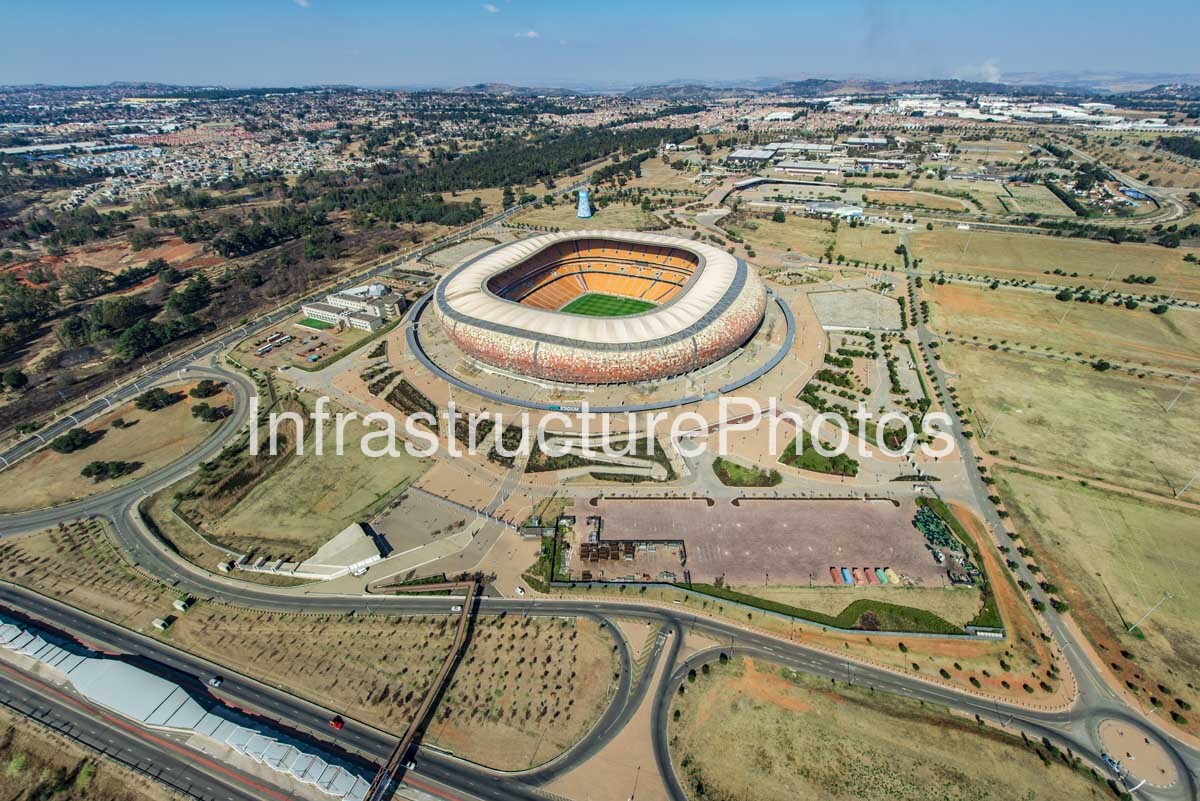
FNB Stadium, widely known as Soccer City and affectionately called The Calabash, dominates this aerial view of the Nasrec precinct in Johannesburg. The photograph captures the stadium from an elevated perspective, revealing its distinctive circular form, enormous roof structure and African-inspired façade within the expansive landscape surrounding the venue. Major roads, landscaped areas, pedestrian approaches, parking areas, sporting facilities and open land stretch away from the stadium, while Johannesburg’s suburban and commercial landscape extends towards the horizon.
The stadium is one of South Africa’s most significant sporting and architectural landmarks. Originally opened in 1989, the existing venue underwent a major redevelopment between 2007 and 2009 in preparation for the 2010 FIFA World Cup. The transformation more than doubled the stadium’s capacity, creating a 94,736-seat venue capable of hosting the tournament’s opening match and final. Populous describes the completed stadium as a celebration of African culture and spirit, with the design deliberately responding to its location and cultural context.
The defining architectural idea behind the redevelopment is the African calabash, a traditional vessel whose rounded form inspired the stadium’s enormous outer envelope. The design was developed by Boogertman Urban Edge and Partners in collaboration with Populous, with the structural roof and façade developed by schlaich bergermann partner. The result is an unmistakable architectural form in which the building’s circular geometry, earthy colours and layered façade create a powerful visual identity.
The stadium’s exterior is composed of coloured glass-fibre-reinforced concrete panels arranged in an earthy mosaic pattern. The colours and textures were selected to reinforce the African character of the building, while gaps within the façade create the impression of a starlit African sky when the stadium is illuminated from within. A continuous ring of lighting around the base represents the fire traditionally associated with a calabash vessel. These details give the building a cultural narrative that goes considerably beyond conventional sports-stadium architecture.
Above the seating bowl, the stadium’s enormous roof forms another major architectural and engineering statement. The roof is supported by an approximately 800-metre-long, three-chord ring structure, with the undulating roof extending approximately 36 metres beyond the supporting structure. The roof and façade together cover approximately 68,000 square metres. The roof membrane uses PTFE/glass material, while the façade incorporates glass-fibre-reinforced concrete panels.
The completed stadium measures approximately 320 metres in diameter and rises around 40 metres above the playing field. Its huge scale is particularly apparent in this aerial photograph, where the stadium appears as a single monumental object surrounded by an extensive network of roads and landscaped public areas. From ground level, the building’s size can be difficult to comprehend; from above, its complete geometry and relationship with the surrounding precinct become immediately apparent.
The stadium was selected as the venue for the 2010 FIFA World Cup final, making it one of the most important buildings associated with South Africa’s hosting of the tournament. It also hosted the opening match and became one of the defining architectural images of the World Cup. Populous records a total capacity of 94,736 and notes that the redevelopment included extensive improvements to seating, concourses, VIP facilities, media areas, changing rooms and spectator infrastructure.
Beyond the World Cup, FNB Stadium has developed into a major multi-purpose venue for football, rugby, concerts and large public events. It has hosted international rugby, including Springbok matches, as well as major football fixtures and performances by internationally recognised artists. FNB, which has held the stadium’s naming rights since its original opening in 1989, notes that the venue has welcomed millions of spectators through hundreds of events since the 2010 tournament.
The stadium’s historical significance extends well beyond sport. In 1990, Nelson Mandela delivered his first major Johannesburg speech after his release from prison at the stadium. More than two decades later, the venue hosted his memorial service on 10 December 2013. These moments established FNB Stadium as an important part of South Africa’s political and cultural history as well as its sporting heritage.
23,3 MB
Reviews
There are no reviews yet.