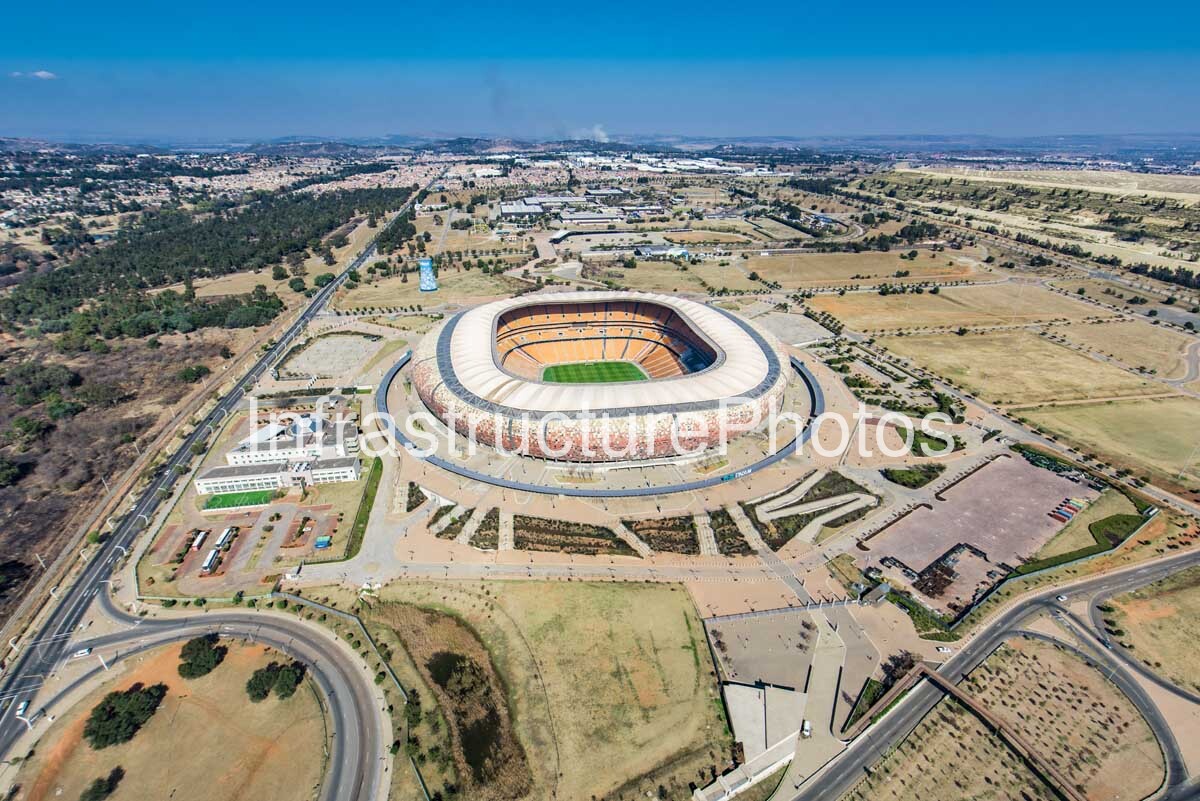
Few buildings are as instantly recognisable in South Africa as FNB Stadium, also known as Soccer City and affectionately known as The Calabash. This aerial photograph captures the landmark stadium at Nasrec in Johannesburg, surrounded by the expansive urban landscape of southern Johannesburg, major transport routes, landscaped open spaces and the wider Soweto precinct. From above, the stadium’s distinctive circular form and enormous scale are particularly evident, revealing how the building dominates its surroundings while remaining integrated into a much larger sporting and urban landscape.
FNB Stadium has occupied an important place in South African history since it first opened in 1989. The original stadium was substantially transformed between 2007 and 2010 ahead of the FIFA World Cup, effectively creating the architectural landmark visible today. The redevelopment more than doubled the stadium’s capacity, from approximately 40,000 seats to 94,736, making it the largest stadium in Africa. The upgraded venue opened in 2009 and became the centrepiece of South Africa’s hosting of the 2010 FIFA World Cup.
The stadium’s most distinctive architectural feature is its façade, inspired by the form of an African calabash, a traditional vessel with deep cultural associations across the continent. The concept was developed by Boogertman Urban Edge + Partners in collaboration with Populous and was selected as the preferred design for the redevelopment. The calabash concept was intended to create an architectural identity rooted specifically in Africa rather than simply reproducing the visual language of international stadium design.
The completed stadium consists of a three-tiered seating bowl enclosed within the dramatic circular outer envelope. The exterior is composed of earthy-toned fibre-reinforced concrete panels, with patterns and colours inspired by African culture. Small openings within the façade create a visual effect reminiscent of a starlit African sky, while a continuous band of lighting around the base of the building evokes the appearance of a fire burning beneath a traditional calabash. These details give the stadium a strong visual identity both during the day and when illuminated at night.
Above the seating bowl is one of the stadium’s most impressive engineering elements: an enormous cantilevered roof supported by a triangular spatial ring truss. The roof extends approximately 36 metres beyond the supporting structure and is clad in a PTFE-coated membrane. The overall roof and façade structure covers approximately 68,000 square metres, while the stadium itself has an external diameter of roughly 320 metres. The roof and façade engineering was developed by schlaich bergermann partner, working alongside PDNA as structural engineers.
The redevelopment was an enormous construction undertaking. Work began in 2007 on the existing stadium, with the project completed in time for the 2010 tournament. Approximately 9,000 tonnes of structural steel and 85,000 cubic metres of concrete were used in the redevelopment. The project brought together South African and international architectural, engineering and construction expertise to transform the existing facility into a world-class stadium capable of hosting the FIFA World Cup’s opening and final matches.
The stadium became one of the defining symbols of the 2010 FIFA World Cup in South Africa. It hosted the opening match between South Africa and Mexico, as well as the tournament final between Spain and the Netherlands. During the tournament it was known officially as Soccer City, before returning to the FNB Stadium name following the World Cup. Today, FNB continues to hold the naming rights, maintaining a partnership that dates back to the stadium’s original opening in 1989.
Beyond football, the stadium has played a much wider role in South African sporting and cultural life. It has hosted major rugby fixtures, including international Springbok matches, as well as football matches, concerts and large public gatherings. Its history also extends far beyond sport. In 1990, Nelson Mandela delivered his first major Johannesburg speech following his release from prison, while the stadium later hosted his memorial service on 10 December 2013. These events have cemented FNB Stadium’s place within the country’s political, cultural and sporting history.
The aerial perspective in this photograph provides an especially useful understanding of the stadium’s relationship with its surroundings. Unlike a ground-level photograph, the elevated view reveals the complete circular geometry of the building and the extensive pedestrian and vehicular infrastructure arranged around it. Broad access roads, landscaped areas, parking facilities and pedestrian routes radiate around the stadium, while major arterial roads and surrounding development connect the venue to Johannesburg’s wider metropolitan transport network.
The stadium’s location at Nasrec also places it within a significant sporting and events precinct. The surrounding landscape includes expansive open areas and other major facilities, while the nearby Soweto area forms an important part of the stadium’s geographical and cultural context. The stadium is therefore not an isolated object but a major piece of metropolitan infrastructure embedded within Johannesburg’s complex urban landscape.
Architecturally, FNB Stadium represents a particularly successful example of context-driven contemporary African architecture. Rather than hiding its cultural references behind a generic international sports aesthetic, the design embraces the calabash as its central architectural idea and translates that concept into structure, façade, colour and lighting. The result is a building that is immediately identifiable from the ground and, even more dramatically, from the air.
The stadium has received significant international recognition for its architecture, including the World Architecture Festival award for World’s Best Sport Building, the 2010 Leaf Awards Overall Award and the Sapoa Excellence Award for Best Stadium. It also received recognition through the IOC/IAKS Awards and South African steel and architectural awards.
17.8 MB
Reviews
There are no reviews yet.