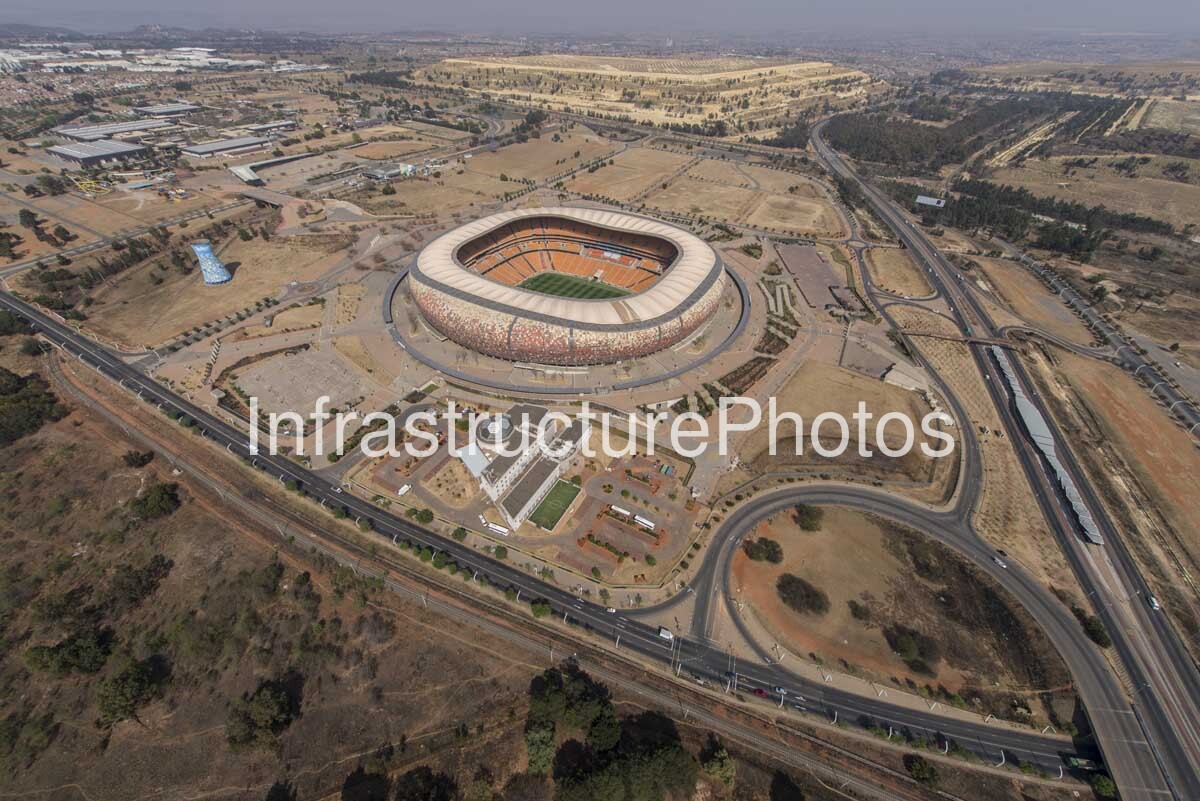
This aerial photograph captures FNB Stadium, widely known as Soccer City and affectionately nicknamed The Calabash, from high above the Nasrec precinct in Johannesburg. The elevated perspective reveals the stadium as the dominant architectural element within a vast landscape of roads, rail infrastructure, landscaped public spaces, parking areas, sporting facilities and open land. The circular stadium and its distinctive earth-toned façade contrast strongly with the surrounding Johannesburg landscape, making the building immediately identifiable even from considerable distance.
FNB Stadium has become one of South Africa’s defining architectural landmarks, but its significance extends well beyond sport. The stadium first opened in 1989 and was extensively redeveloped ahead of the 2010 FIFA World Cup, with Populous leading the transformation of the existing venue. The redevelopment increased the capacity from approximately 40,000 to 94,736 spectators, creating the largest stadium in Africa and a venue capable of hosting the opening match and final of the World Cup. The redeveloped stadium opened in 2009.
The architectural concept is rooted in African cultural symbolism. The stadium’s monumental outer form was inspired by the calabash, a traditional African vessel, and the design was developed by Boogertman Urban Edge and Partners and Populous. The intention was to create a stadium that expressed African culture and identity rather than simply reproducing a conventional international sports venue. The resulting architecture combines contemporary engineering with references to traditional African forms, materials and symbolism.
The stadium’s façade is perhaps its most recognisable architectural feature. A palette of earthy colours wraps around the exterior in a mosaic-like composition, giving the enormous structure the appearance of a giant ceramic vessel. The façade incorporates openings that create the impression of a starlit African sky when the stadium is illuminated from within, while a continuous ring of lights around the base represents the fire beneath a traditional calabash. These elements turn the stadium into more than a functional sporting structure, giving it a strong cultural and visual identity.
The roof is equally impressive from an engineering perspective. Designed by schlaich bergermann partner, the integrated roof and façade structure has an overall diameter of approximately 320 metres. The roof and façade cover approximately 68,000 square metres, while the roof projects roughly 36 metres beyond its supporting structure. An approximately 800-metre-long three-chord ring structure forms the principal structural element around the stadium, supporting the undulating roof and its PTFE/glass membrane.
The aerial perspective in this photograph makes the scale of that engineering particularly apparent. The stadium appears almost self-contained at the centre of an enormous precinct, with the sweeping roof forming a complete oval around the seating bowl. From this height, the complex relationship between the roof, façade, playing field and surrounding public realm becomes much easier to appreciate than from ground level.
The redevelopment was driven by the requirements of the 2010 FIFA World Cup. Existing seating tiers were remodelled to improve sightlines, an extended upper tier was constructed, and new concourses, VIP facilities, changing rooms, media areas and spectator infrastructure were incorporated into the venue. The result was a stadium capable of accommodating more than 94,000 spectators while maintaining close visual and acoustic connections between the crowd and the playing field.
FNB Stadium subsequently became one of the defining images of the 2010 FIFA World Cup in South Africa. It hosted the tournament’s opening match between South Africa and Mexico and the final between Spain and the Netherlands. The building became closely associated with the country’s first hosting of the FIFA World Cup and remains one of the most recognisable physical symbols of that event.
Its importance, however, predates the World Cup and extends into South Africa’s political and cultural history. FNB notes that the stadium hosted Nelson Mandela’s first major Johannesburg speech following his release from prison in 1990, while it later became the venue for his memorial service on 10 December 2013. The stadium has therefore been a gathering place for moments of national significance as well as major sporting events.
Today, FNB Stadium remains a major multi-purpose venue hosting football, rugby, concerts and large public events. Its role has expanded beyond the original World Cup brief, and the stadium continues to attract major sporting and cultural gatherings. FNB states that the venue has welcomed millions of spectators across hundreds of events since the 2010 tournament.
24 MB
Reviews
There are no reviews yet.