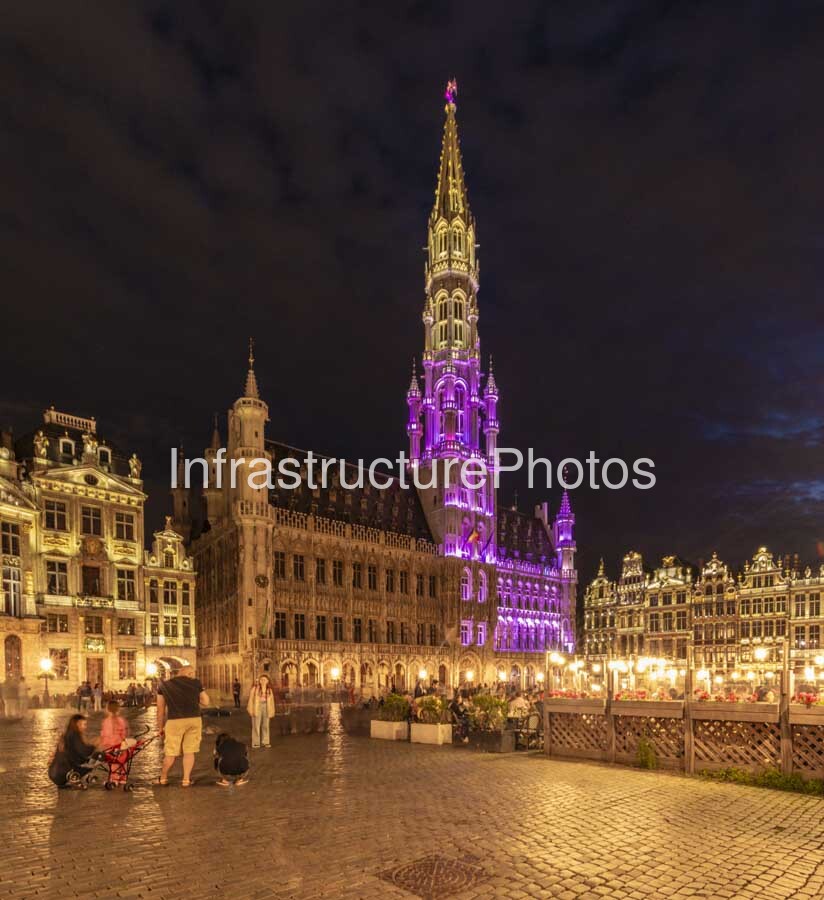
Brussels Town Hall rises dramatically above the historic Grand-Place in this atmospheric night photograph, its intricate Gothic façade illuminated in vivid purple and gold against a dark, cloud-filled Belgian sky. The 96-metre tower dominates the composition, drawing the eye upwards from the cobbled square to its highly ornamented lantern and slender spire. At street level, the warm illumination of the surrounding historic buildings, outdoor restaurants and cafés creates a lively contrast with the deep tones of the night sky, capturing the Grand-Place as both an architectural monument and a functioning public space.
Located in the heart of Brussels, Belgium, the Grand-Place is one of Europe’s most celebrated historic urban spaces and was inscribed on the UNESCO World Heritage List in 1998. UNESCO describes the square as an exceptionally coherent ensemble of public and private buildings, predominantly dating from the late 17th century. Its architecture represents an extraordinary combination of Gothic, Baroque, Renaissance and later historicist influences, reflecting the commercial wealth and political importance that Brussels acquired as a major mercantile centre of northern Europe.
The principal building in this image is Brussels Town Hall, also known as the Hôtel de Ville de Bruxelles. Construction began in 1402, and the original building was completed in 1454 following the installation of the statue of Saint Michael at the top of the spire. The development took place in several stages, with the earlier sections of the building constructed during the first half of the 15th century and the imposing tower added later. The City of Brussels records the completion of the Town Hall in 1454, while the present tower and its associated works belong to the major expansion of the building during the 1440s and early 1450s.
The architectural history of the building is therefore more complex than that of a single-period monument. The early work is associated with Jacob van Thienen, while Jan van Ruysbroeck is particularly associated with the monumental tower. Later architects and restorers, including Victor Jamaer, Willem de Vogel and others, contributed to subsequent alterations and restoration campaigns. Visit Brussels identifies Jan van Ruysbroeck as the architect of the Town Hall tower, while the building’s documented architectural history records several phases of construction and restoration.
Architecturally, the Town Hall represents a pinnacle of Brabantine Gothic and is distinguished by its richly articulated façade, pointed arches, elaborate tracery, sculptural decoration and vertical emphasis. The tower is the defining element of the building. Rising above the Grand-Place, it consists of a substantial multi-level base that transitions into an increasingly delicate upper structure, culminating in an octagonal lantern and tall pyramidal spire. UNESCO describes the City Hall as the most famous landmark of the Grand-Place and specifically identifies it as a pinnacle of Brabant Gothic architecture.
The building also carries the marks of Brussels’ turbulent history. In August 1695, French forces under Louis XIV subjected Brussels to a devastating artillery bombardment. Much of the medieval centre was destroyed or severely damaged, including portions of the Town Hall. Reconstruction followed rapidly, with Guillaume de Bruyn supervising much of the rebuilding and Corneille van Nerven responsible for a new rear wing. The rebuilding of the Grand-Place produced the remarkable architectural unity visible today, as the city authorities deliberately restored the square with considerable ornamental richness rather than replacing it with an entirely new urban composition.
50 MB
Reviews
There are no reviews yet.