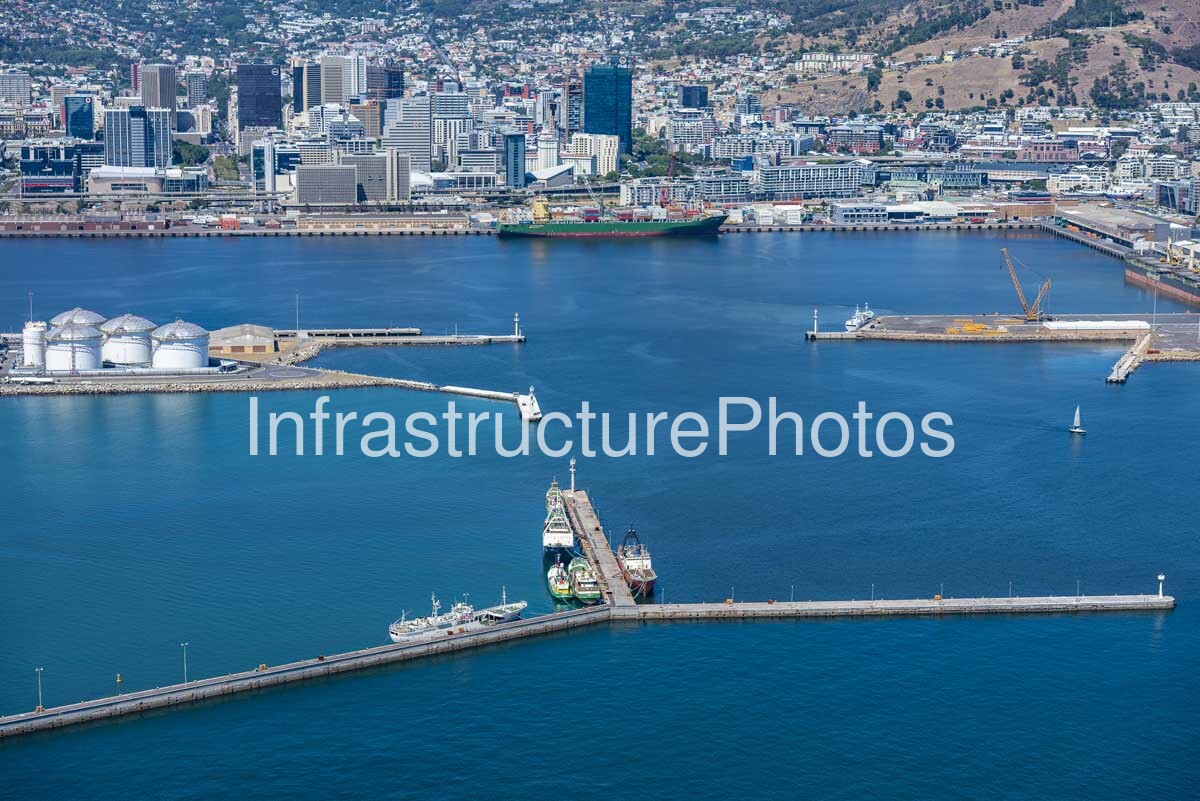
his aerial photograph captures the working heart of the Port of Cape Town, looking across the harbour towards the Cape Town CBD and Foreshore. The image highlights the extensive maritime infrastructure of Duncan Dock, including breakwaters, berths, service quays, vessels and the industrial facilities of the harbour. Prominent in the foreground are the long harbour walls and marine berths, while the storage tanks of the Eastern Mole are visible to the left.
Duncan Dock is the older inner dock of the modern Port of Cape Town and accommodates a range of maritime activities, including the Multi-Purpose Terminal, fruit handling facilities, ship repair infrastructure, the tanker basin and other general cargo operations. The Eastern Mole forms an important protective harbour structure and accommodates liquid-bulk and fuel-storage infrastructure. FFS Refiners operates a fuel-storage facility at the Eastern Mole, while the area also provides bunkering services to vessels.
Beyond the harbour, the photograph provides a striking view of Cape Town’s dense central business district and Foreshore development, including the distinctive roofline of the Cape Town International Convention Centre. The juxtaposition of working port infrastructure, commercial development and the historic city creates a strong representation of Cape Town’s role as a major maritime and economic gateway. Transnet National Ports Authority describes the Port of Cape Town as a full-service general cargo port supporting container, liquid-bulk, dry-bulk and break-bulk operations, as well as fishing, cruise and ship-repair activities. Duncan Dock was completed in 1945, with subsequent expansion and redevelopment of the Port of Cape Town continuing over many decades.
32 MB
Reviews
There are no reviews yet.