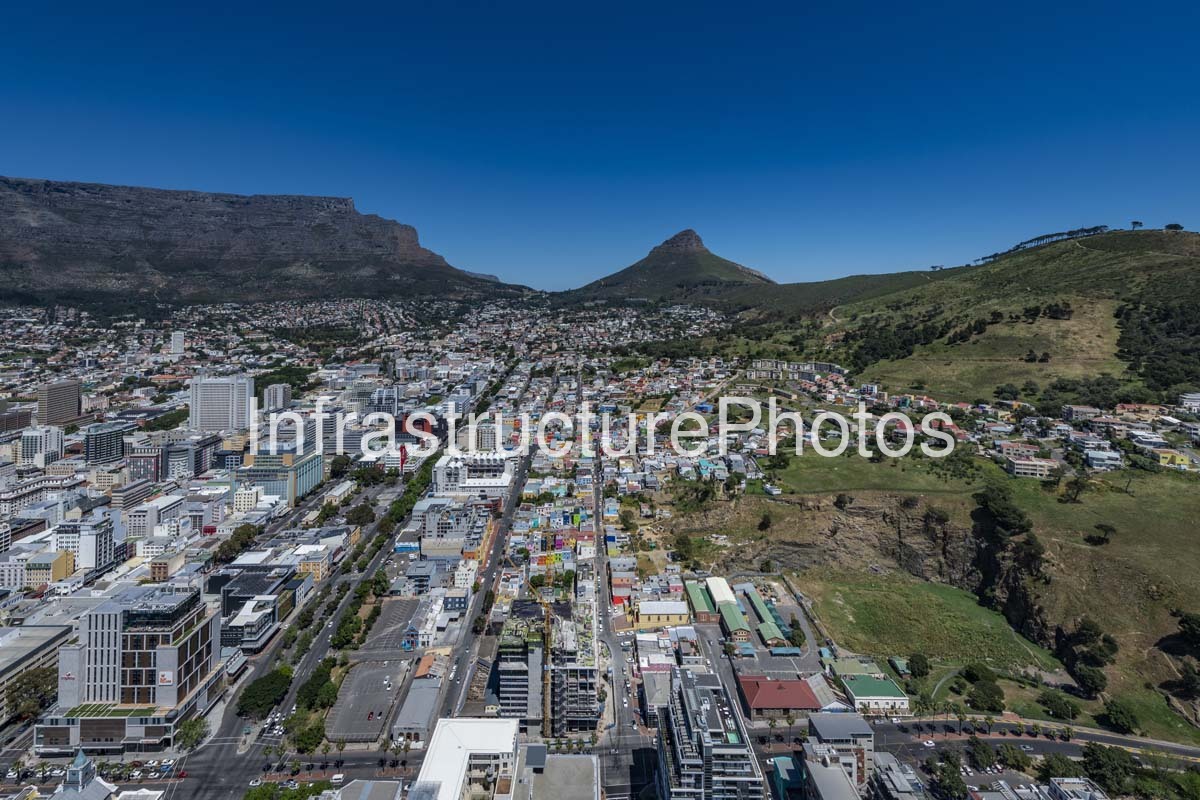
This aerial photograph presents a sweeping view across Bo-Kaap, Cape Town’s historic hillside neighbourhood, with the dense urban fabric of the city centre extending towards the dramatic slopes of Table Mountain and Lion’s Head. The elevated perspective clearly illustrates the relationship between the historic residential quarter, the modern commercial city and the natural landscape that defines Cape Town’s distinctive urban setting.
Bo-Kaap occupies the lower slopes of Signal Hill immediately above Cape Town’s central business district. The neighbourhood developed from the 18th century onwards and is recognised as one of the city’s most important cultural and architectural heritage areas. The City of Cape Town describes Bo-Kaap as the oldest residential neighbourhood in South Africa, with a unique architectural character and a long-established cultural heritage.
Bo-Kaap’s architectural character is particularly evident from above. Much of the historic area consists of one- and two-storey row houses positioned close to the street, with repetitive proportions, raised stoeps, parapets and narrow urban frontages. The City’s heritage guidelines identify this consistent scale and rhythm as an important component of the neighbourhood’s character. The colourful façades visible throughout the neighbourhood have become one of Cape Town’s most recognisable visual identities, while the area’s mosques, streets and historic houses reflect its deep Cape Muslim heritage.
The landscape becomes increasingly prominent towards the right of the photograph, where the dense development gives way to the open slopes of Signal Hill and the green spaces surrounding the urban edge. Above the city, Table Mountain dominates the left side of the horizon, while Lion’s Head rises prominently near the centre. These geological landmarks form the defining backdrop to Cape Town and help explain the compact, valley-like form of the City Bowl.
The foreground also reveals the continuing transformation of the city, with modern commercial and residential developments occupying land close to the historic neighbourhood. Construction activity, new buildings and open parcels demonstrate how Cape Town continues to evolve while the heritage fabric of Bo-Kaap remains an important part of its identity. The City has recognised the need to balance development with the protection of the area’s cultural, architectural and social heritage.
31 MB
Reviews
There are no reviews yet.