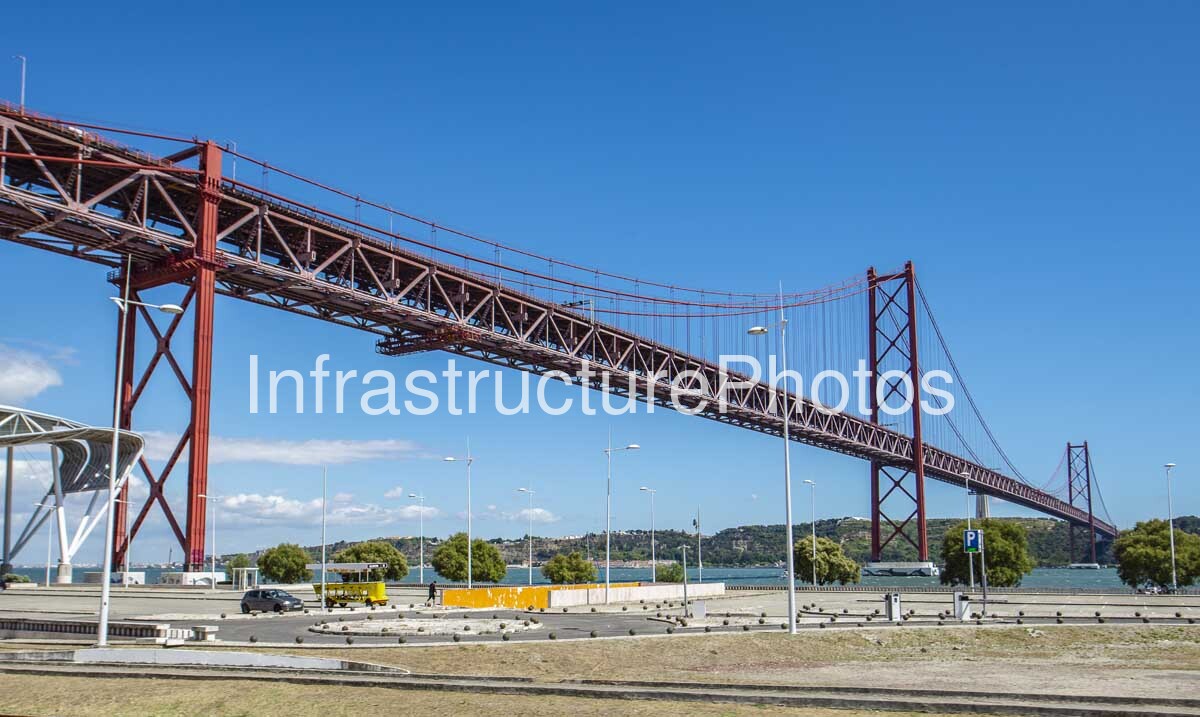
The 25 de Abril Bridge (Ponte 25 de Abril) is one of Lisbon’s most recognisable landmarks and one of Portugal’s most important pieces of twentieth-century transport infrastructure. Spanning the Tagus River between Lisbon and Almada, the striking red suspension bridge has become an enduring symbol of the Portuguese capital, combining monumental engineering with a highly distinctive visual presence. This photograph captures the bridge from the northern bank, looking across the surrounding transport and waterfront landscape towards the southern shore.
The origins of a major crossing over the Tagus at Lisbon stretch back to the 19th century. In 1879, engineer Miguel Paisproposed a road-and-rail bridge connecting the eastern side of Lisbon with Montijo, although that proposal was never realised. Serious investigations into a crossing at the present location began during the 1950s, eventually leading to an international competition for a bridge between Alcântara and Almada. The final project was awarded in 1962 to a consortium led by United States Steel International of New York, with construction beginning on 5 November of that year.
The suspension bridge was designed by the New York engineering practice Steinman, Boynton, Gronquist & London, working in conjunction with Portugal’s Gabinete da Ponte sobre o Tejo and the Laboratório Nacional de Engenharia Civil. The collaboration combined international expertise in long-span suspension bridge engineering with Portuguese engineering and construction oversight. The bridge was completed in less than four years and officially opened to road traffic on 6 August 1966. It was originally named the Ponte Salazar, after the Portuguese prime minister António de Oliveira Salazar, before being renamed the Ponte 25 de Abril following the 25 April 1974 Revolution.
At the time of its opening, the bridge represented an extraordinary engineering achievement. It had a 1,012.88-metre main span, with the principal towers rising approximately 196 metres above the water. The distance between the main anchorages exceeds 2.2 kilometres. Infraestruturas de Portugal records that the structure required approximately 82,000 tonnes of steel and 300,000 cubic metres of concrete, while 6.6 million cubic metres of soil and rock were excavated during construction.
The bridge’s visual resemblance to San Francisco’s Golden Gate Bridge is immediately apparent, particularly in the red-painted steel towers, suspension cables and deep structural trusses. However, the 25 de Abril Bridge has its own distinctive engineering character. The enormous steel stiffening truss running beneath the roadway gives the structure considerable visual weight, while the suspension cables and vertical hangers create a strong rhythmic pattern along the length of the crossing.
An important aspect of the original design was the provision for a future railway connection. Although the bridge initially opened carrying road traffic only, its structure had been prepared for the eventual installation of a railway deck. Increasing commuter traffic between Lisbon and the rapidly expanding communities south of the Tagus ultimately made this essential. Major strengthening works were undertaken during the 1990s, including the installation of the railway deck and widening of the road carriageway. The railway connection opened in 1999, completing the bridge’s intended road-and-rail function.
15 MB
Reviews
There are no reviews yet.