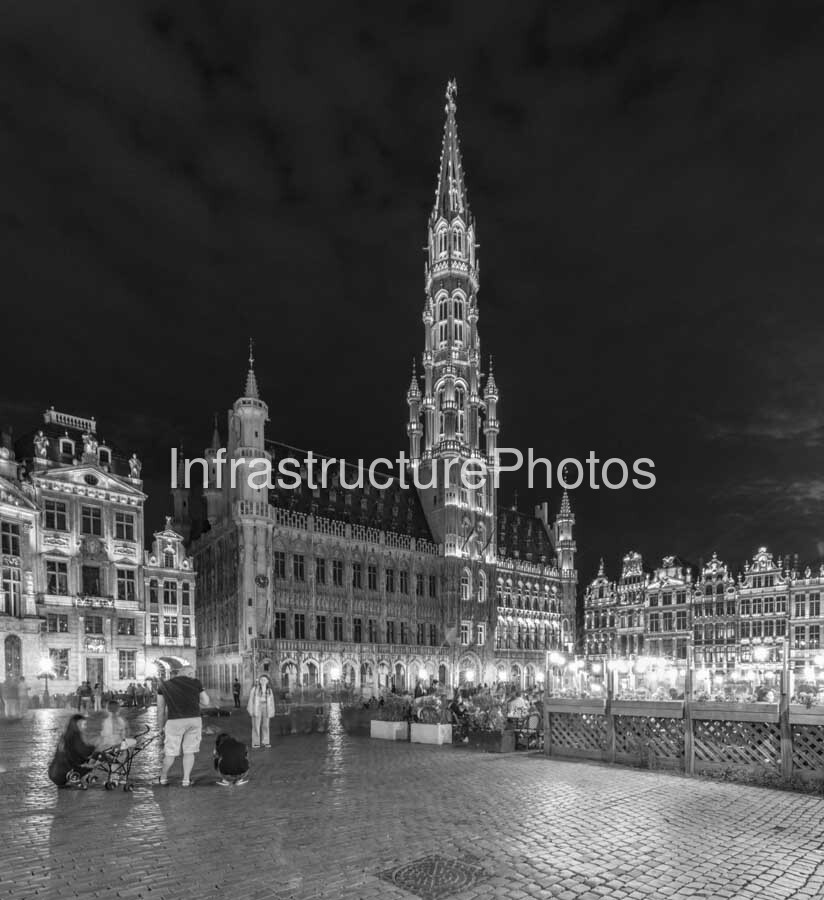
The Grand Place in Brussels is captured here at night in striking black and white, with the illuminated Gothic façade and soaring tower of the Brussels Town Hall dominating the composition. One of Europe’s most celebrated historic squares, the Grand Place is the architectural and civic heart of Brussels and has been a UNESCO World Heritage Site since 1998. The square developed from a medieval market known as the Nedermerckt, or Lower Market, before gradually becoming surrounded by guildhalls, merchants’ houses and civic buildings. Today, its extraordinary architectural ensemble reflects centuries of commercial prosperity, political power, destruction, reconstruction and restoration.
The principal building in the photograph is the City of Brussels Town Hall, one of the great surviving examples of 15th-century Gothic civic architecture in Belgium. Construction began in 1401, with the building developing in several phases during the first half of the 15th century. The regional architectural heritage inventory identifies Jacques van Thienen and Jehan Bornoy among the architects associated with the earlier phases, while Jean van Ruysbroeck was responsible for the later tower works between 1449 and 1455. The tower rises approximately 96 metres above the square and is crowned by a statue of Saint Michael, the patron saint of Brussels. Its extraordinary vertical emphasis provides the dominant architectural landmark of the Grand Place.
The Town Hall’s architecture is characterised by elaborate Gothic tracery, pointed arches, pinnacles, sculptural decoration and an intricate vertical composition. In this photograph, the absence of colour concentrates attention on the building’s geometry and illumination. The tower appears almost luminous against the dark sky, while the repeated windows, arcades, statues and vertical stonework create layers of detail across the façade. The black-and-white treatment also gives the scene a distinctly cinematic quality, emphasising the contrast between the illuminated historic architecture and the darkness surrounding it.
The Grand Place itself is an exceptional architectural ensemble rather than simply a square dominated by one building. Following the bombardment of Brussels by Louis XIV’s French forces in 1695, much of the surrounding medieval building stock was destroyed. The square was subsequently rebuilt within only a few years, producing the remarkably cohesive collection of Baroque, Gothic and later architectural façades visible today. The Town Hall survived the bombardment comparatively well, although it suffered fire damage and subsequently underwent restoration and modification.
Across the square, the richly decorated guildhalls and former merchants’ buildings form a continuous architectural enclosure. Their ornate façades contain elaborate gables, pilasters, columns, statues, decorative stonework and gilded details. Although many of these buildings were reconstructed after 1695, their designs reflect the wealth and identity of Brussels’ guilds and commercial organisations. UNESCO considers the Grand Place an outstanding example of the successful blending of architectural and artistic styles that characterised the culture of a prosperous northern European mercantile city.
The square’s origins are closely connected to trade. From the 12th century onwards, the market became an increasingly important centre of commercial activity, with halls and buildings serving different trades including bread, meat and textiles. During the medieval period, the Grand Place also became a centre of civic administration, political activity, public ceremony and judicial events. The construction of the Town Hall represented the growing influence of the city’s wealthy urban population, with the building becoming a powerful architectural symbol of municipal independence.
36 MB
Reviews
There are no reviews yet.