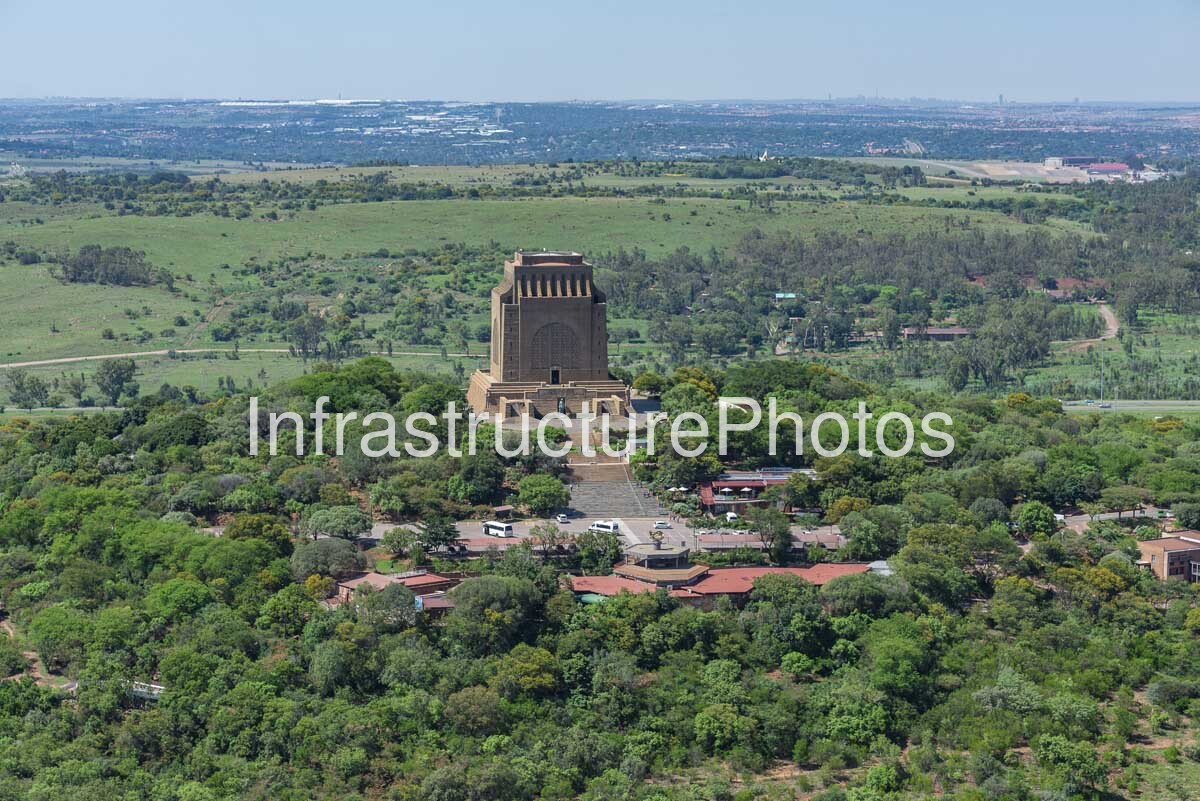
This aerial photograph captures the Voortrekker Monument rising above the heavily wooded landscape of Groenkloof, south of central Pretoria. Positioned prominently on Monument Hill, the monumental granite structure is surrounded by gardens, roads and natural vegetation, while the broader Gauteng landscape stretches across the horizon beyond it. The photograph provides a strong sense of the monument’s deliberate relationship with its elevated setting and its role as one of Pretoria’s most recognisable architectural and heritage landmarks.
The Voortrekker Monument was designed by South African architect Gerard Leendert Pieter Moerdijk, one of the country’s early Afrikaans architects and a prolific designer of churches and public buildings. Moerdijk’s design was selected by the Volksmonument Committee in 1936 following a public process to determine the form and content of a national monument commemorating the Voortrekkers. The cornerstone was laid on 16 December 1938, and the completed monument was inaugurated on 16 December 1949 by the then Prime Minister, D. F. Malan.
Architecturally, the monument is an imposing expression of monumental historicism, drawing on classical and traditional architectural references while developing a distinctive visual language specifically for the memorial. Constructed primarily from granite, its massive geometric form, monumental staircase, elevated podium and strong vertical proportions give it an almost fortress-like appearance. The building was conceived not simply as a structure but as a symbolic monument in which architecture, sculpture, interior decoration and landscape work together to communicate a particular interpretation of Voortrekker history.
The building’s interior is centred around the Cenotaph Hall and its symbolic cenotaph. One of the monument’s most distinctive architectural features is the dome and opening above the cenotaph. At noon on 16 December each year, a shaft of sunlight enters through the opening and illuminates the centre of the cenotaph. The alignment was deliberately incorporated into the architectural design and forms one of the monument’s best-known symbolic elements.
The monument was developed during the period of the 1930s centenary commemorations of the Great Trek, when the creation of a permanent memorial became an important cultural and political project for sections of Afrikaner society. The foundation stone was laid during the 1938 celebrations, when a symbolic ox-wagon trek travelled from Cape Town towards Pretoria. Eleven years later, the completed monument became the centrepiece of the 1949 inauguration celebrations. The event attracted an exceptionally large crowd and the monument subsequently became an important symbol within Afrikaner cultural and political history.
The monument’s historical significance is complex and inseparable from the development of Afrikaner nationalism during the first half of the 20th century. Its symbolism reflects a particular interpretation of the Great Trek and the history of the Voortrekkers, and the monument played an important role in constructing and reinforcing that historical narrative. Today, the site remains an important place for understanding South Africa’s contested history, while also functioning as a major heritage, cultural and visitor destination. The monument’s custodians describe it as a cultural home of Afrikaner heritage while explicitly welcoming visitors from all backgrounds.
Moerdijk’s architectural approach is particularly evident when viewed from the air. The building is carefully positioned within an extensive landscaped setting, with its principal axis extending through the surrounding grounds. The monumental staircase creates a powerful processional approach, while the raised position of the building ensures that it remains visible across large portions of Pretoria. The relationship between the monument, its gardens and the surrounding natural landscape is therefore an important component of its architectural character.
The setting visible in this photograph has changed considerably since the monument was completed. Today, the monument sits within a protected natural and heritage environment, while Pretoria’s extensive suburban development can be seen spreading across the distant horizon. The contrast between the dense greenery immediately surrounding the monument and the sprawling urban landscape beyond demonstrates the unusual position the site occupies within the metropolitan area.
The monument’s wider precinct also includes an amphitheatre constructed in 1949 to the north-east of the main structure, capable of accommodating approximately 20,000 people. Over subsequent decades, museums and other visitor facilities were added to the site. A museum was established within the monument in 1957, while later developments expanded the interpretation of the site’s history. A new expanded museum exhibition, Vrijheidsreis, opened in 2022.
Gerard Moerdijk’s importance to South African architecture extends well beyond the Voortrekker Monument. He designed approximately 80–90 churches as well as banks, hospitals, municipal buildings and private residences. His work frequently incorporated elements such as domes, octagonal plans, Cape Dutch gables and locally adapted architectural forms. His portfolio also included the Reserve Bank building in Bloemfontein, the Libertas Building in Pretoria and the Merensky Library at the University of Pretoria.
This aerial image is particularly valuable as an architectural record because it shows the Voortrekker Monument within its full landscape context. Rather than presenting the building as an isolated object, the photograph illustrates the carefully maintained grounds, surrounding woodland, approach roads and the expansive Gauteng landscape beyond. The distant urban development reinforces the monument’s position as a historic landmark within a rapidly evolving metropolitan environment.
The Voortrekker Monument remains one of South Africa’s most visually distinctive memorial structures. Its monumental scale, granite construction, symbolic architectural composition and elevated setting have made it an enduring feature of Pretoria’s skyline and a significant example of 20th-century South African memorial architecture.
Location: Voortrekker Monument, Eeufees Road, Groenkloof, Pretoria, Gauteng, South Africa.
Architect: Gerard Leendert Pieter Moerdijk (also known as Gerard Moerdyk).
Completed: 1949; cornerstone laid on 16 December 1938 and monument inaugurated on 16 December 1949.
Architectural Style: Monumental historicism incorporating classical, traditional and South African architectural influences.
Building Use: National memorial, heritage site, museum and cultural attraction.
28 MB
Reviews
There are no reviews yet.