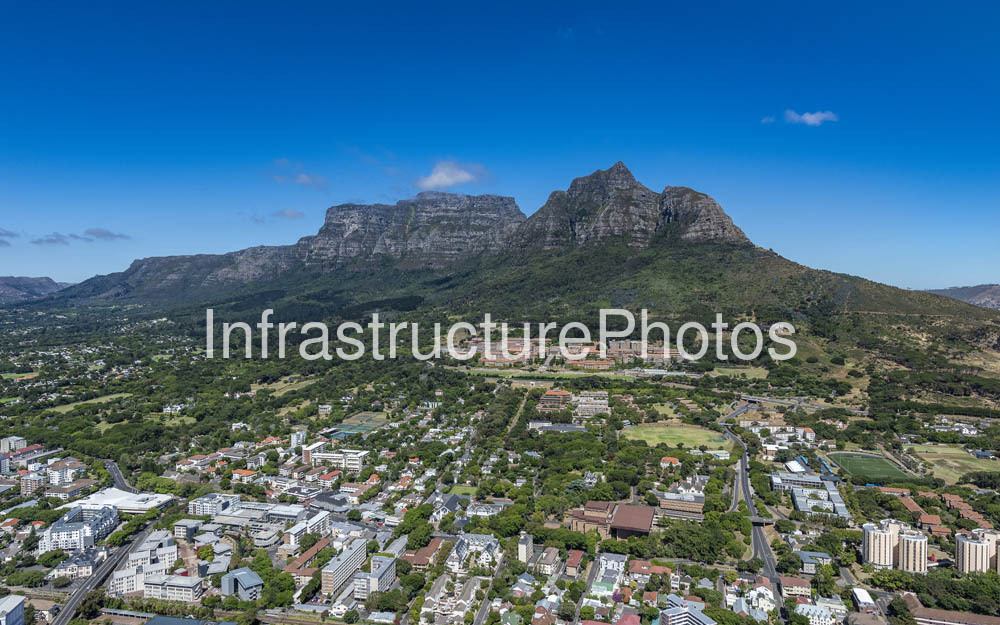
This expansive aerial photograph captures the University of Cape Town’s historic Upper Campus and its surrounding suburbs, framed dramatically by the Table Mountain massif in the background. The image provides a striking overview of one of Cape Town’s most recognisable urban landscapes, where a major university campus, established residential neighbourhoods, sports facilities, mature vegetation and the rugged slopes of Table Mountain come together in a remarkably compact setting. The university buildings occupy the central portion of the photograph, while the mountain dominates the skyline, emphasising the exceptional natural setting of the UCT campus.
At the centre of the image is the University of Cape Town’s Upper Campus, located on the slopes of Devil’s Peak within the historic Groote Schuur Estate. The campus is distinguished by its extensive collection of red-tiled academic buildings, many of which form the historic architectural core of the university. The original buildings at the Groote Schuur site were ready for occupation in 1928, with most university departments transferring to the new campus during 1929 and 1930. The development represented the third home of the institution that had originated as the South African College in 1829.
The architectural development of Upper Campus began with architect J.M. Solomon, who was appointed to design the new university, with Sir Edwin Lutyens acting as consulting architect. Following Solomon’s death in 1920, architects Hawke, McKinlay and C.P. Walgate were appointed to complete the designs. Their work retained the essential character of Solomon’s scheme while making important adjustments to accommodate the difficult mountainous terrain and the available construction budget. One of the most significant planning decisions was to arrange the buildings along a curve following the contours of the slope rather than maintaining the straight alignment originally envisaged by Solomon. This response to the topography remains one of the defining characteristics of the Upper Campus.
The historic architecture visible in the photograph is strongly associated with Classical Revival traditions. Formal façades, symmetrical compositions, colonnades, pediments, arcades and distinctive terracotta roof tiles give the Upper Campus a cohesive architectural identity. The individual buildings include academic, administrative, scientific and student facilities, with the historic complex developing over many decades as the university expanded. UCT’s archival collections document plans for numerous early campus buildings, including the Arts Block, Botany and Zoology Block, Chemistry Block, Engineering Block, Geology Block, Physics and Mathematics buildings, residences and Jameson Hall.
The mountain backdrop provides an extraordinary counterpoint to the formal architecture of the university. Table Mountain rises prominently beyond the campus, with its characteristic flat-topped plateau and extensive sandstone cliffs clearly visible beneath the deep blue Cape Town sky. The lower slopes are covered in dense indigenous vegetation, creating a broad green transition between the mountain and the built environment. The dramatic change in elevation is particularly evident from this aerial perspective, showing how closely the university campus is integrated with the natural landscape rather than being separated from it.
Beyond the university, the photograph reveals the leafy character of Cape Town’s southern suburbs. Residential streets, apartment buildings, schools, sports grounds, institutional facilities and commercial developments are dispersed among a substantial canopy of mature trees. Roads form a network through the foreground and middle ground, while the university’s sports facilities and open spaces provide areas of comparatively undeveloped land within the densely settled urban environment.
The image also illustrates the importance of topography in shaping Cape Town’s urban development. The city’s southern suburbs have developed around the natural foothills of Table Mountain and Devil’s Peak, resulting in an urban landscape where streets and buildings gradually transition into mountain slopes, forests and protected natural areas. At UCT, this relationship is especially pronounced: the historic campus occupies a prominent elevated position, while the mountain rises immediately behind it.
Location: Upper Campus, University of Cape Town, Rondebosch, Cape Town, Western Cape, South Africa, on the Groote Schuur Estate and beneath the eastern slopes of Table Mountain and Devil’s Peak.
35.46 MB
Reviews
There are no reviews yet.