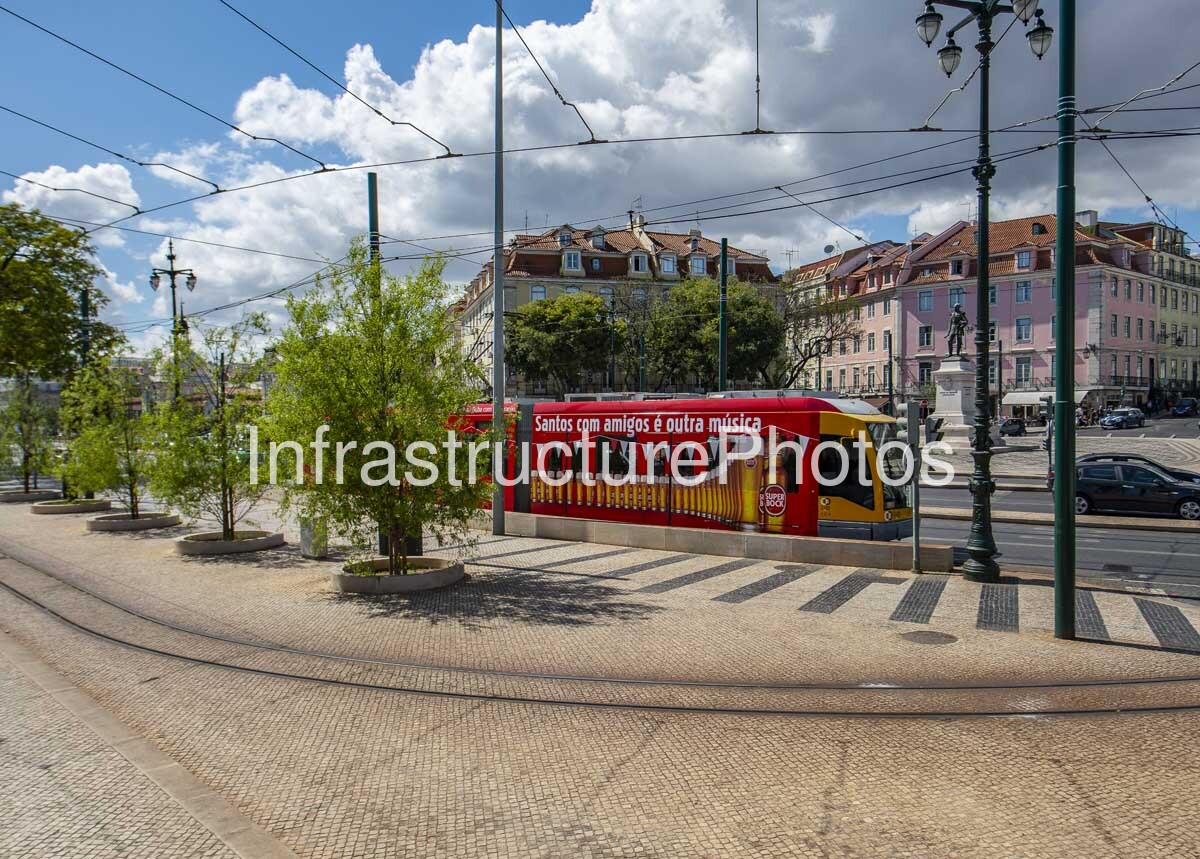
Praça Luís de Camões, commonly known as Largo de Camões, is one of the most recognisable public squares in central Lisbon, occupying a strategic position between the historic Chiado and Bairro Alto districts. The square is named after Luís de Camões, Portugal’s celebrated 16th-century poet and author of Os Lusíadas, and is dominated by the monumental statue erected in his honour in 1867. This photograph captures the square as a dynamic piece of Lisbon’s urban infrastructure, combining historic Pombaline architecture, Portuguese calçada paving, electric tram tracks, overhead traction wiring, ornate street furniture and modern road traffic.
The square developed as an important urban space during Lisbon’s post-earthquake reconstruction and later expansion. Its present architectural character is closely associated with the historic fabric of Chiado, where buildings constructed or rebuilt following the 1755 Lisbon earthquake established the ordered streets and façades characteristic of the Baixa and surrounding districts. The buildings visible around the square display the restrained proportions, tiled and rendered façades, balconies, regular window arrangements and red clay roof tiles associated with Lisbon’s historic urban architecture. Their varied pastel colours contribute significantly to the visual identity of the square.
The centrepiece is the Monument to Luís de Camões, designed by sculptor Vítor Bastos and inaugurated on 9 October 1867. The monument is approximately 11.5 metres high and combines a substantial octagonal pedestal of Lioz limestone with a four-metre-high bronze figure of Camões. The poet is represented standing with a laurel wreath, a sword and Os Lusíadas, while the lower portion of the monument is surrounded by eight sculpted figures representing prominent Portuguese writers, historians and intellectuals from the 15th and 16th centuries.
The figure visible towards the right-hand side of this photograph appears to be one of the sculptural figures associated with the Camões monument rather than the principal statue itself. This is an important detail because the photograph is not simply a portrait of the monument; it captures one element of the larger sculptural composition within the square. The surrounding monument incorporates historical figures including Fernão Lopes, Pedro Nunes, Gomes Eanes de Azurara, João de Barros, Fernão Lopes de Castanheda, Vasco Mouzinho de Quevedo, Jerónimo Corte-Real and Francisco de Sá de Menezes.
The square is also an important component of Lisbon’s historic tram network. Electric tram tracks run directly through the paved public space and connect with the surrounding streets, while an extensive overhead contact-wire system spans the square. Carris tram route 28 is particularly associated with Praça Luís de Camões, making the location one of the familiar landmarks along the city’s historic tram route. The square also functions as an interchange for several other Carris services, reinforcing its importance as both a historic gathering place and a functioning transport node.
The tram shown in the photograph provides an especially interesting contemporary element. Its traditional yellow-and-red appearance contrasts with the muted limestone paving and pastel façades, while the large Super Bock advertising wrap reflects the commercial character of Lisbon’s public transport system. The campaign visible on the vehicle, carrying the slogan “Santos com amigos é outra música”, was associated with Super Bock’s 2019 participation in Lisbon’s Santos Populares festivities.
The overhead electrical infrastructure is a significant feature of the image. Multiple traction wires intersect above the square, supported by tall green-painted poles and elegant decorative lamp standards. These elements illustrate the technical infrastructure required to maintain Lisbon’s historic electric tram system within a dense urban environment. The wires also create a complex linear pattern across the sky, contrasting with the softer forms of the mature trees and the regular geometry of the surrounding façades.
The paving is equally distinctive. Lisbon’s traditional calçada portuguesa uses small pieces of limestone and basalt arranged into geometric patterns. In Praça Luís de Camões, the pavement incorporates decorative motifs associated with the sea, including references to maritime imagery and Portugal’s navigational history. The relationship between the patterned paving, tram rails and historic architecture gives the square a particularly strong sense of place.
The square has also undergone significant urban renewal. A major regeneration project in 1999, associated with designer Daciano da Costa and his team, addressed the relationship between the surrounding architecture, public art, paving and street furniture. The project included proposals for extensive glazed-tile treatments to the surrounding façades and adjustments to the relationship between the Camões monument and the surrounding Pombaline urban fabric.
24 MB
Reviews
There are no reviews yet.