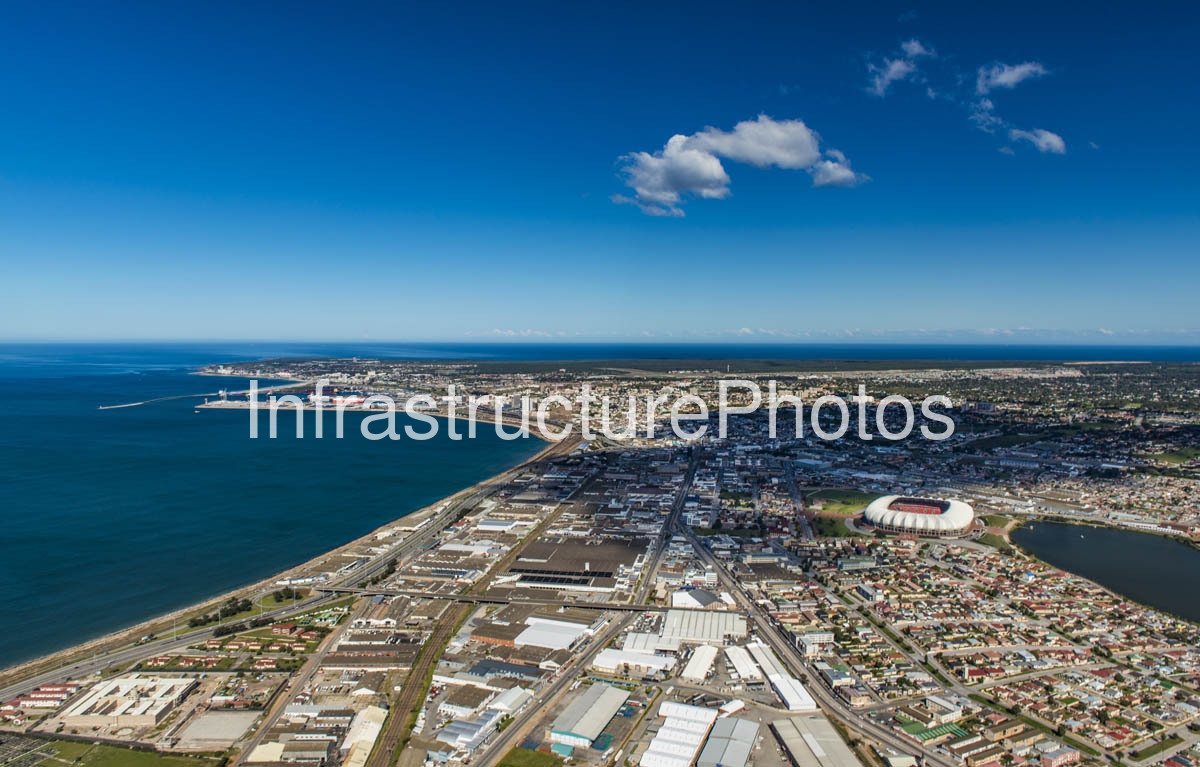
This aerial photograph presents a striking view of the Nelson Mandela Bay Stadium in Gqeberha, Eastern Cape, with the landmark sporting venue positioned prominently beside North End Lake and surrounded by the dense urban fabric of the city. Completed in 2009 for the 2010 FIFA World Cup, the stadium was developed as a major sporting and architectural landmark for Nelson Mandela Bay. From this elevated perspective, the relationship between the stadium, lake, surrounding neighbourhoods, commercial districts, industrial areas and wider road network is particularly clear. The image also captures the extensive urban landscape stretching toward the distant hills and mountain ranges, providing a strong sense of the stadium’s position within Gqeberha.
The stadium was designed by German stadium specialists GMP Architekten in collaboration with GAPP Architects, Dominic Bonnesse Architects and Architectural Design Associates. Its architectural style is contemporary and highly expressive, most notably characterised by its distinctive white roof structure, which has been likened to the petals of a flower. The roof combines curved steel trusses with translucent and opaque membrane sections, creating the building’s recognisable sculptural silhouette while providing protection from the region’s strong sun and coastal winds. The stadium rises approximately 40 metres above ground and was constructed on a raised platform beside North End Lake, allowing the building to become a prominent feature within the surrounding park landscape. The venue provides approximately 46,000 seats and was designed primarily for football and rugby, while also incorporating hospitality, conference and other event facilities. During the 2010 FIFA World Cup, it hosted eight matches, including group-stage fixtures, a round-of-16 match, the quarter-final between the Netherlands and Brazil, and the third-place playoff between Uruguay and Germany. The stadium remains one of Gqeberha’s most recognisable architectural landmarks and an important part of the city’s sporting infrastructure. The surrounding North End Lake and open recreational areas further strengthen the stadium’s visual identity, while the aerial viewpoint demonstrates how the complex integrates with the existing urban environment rather than standing as an isolated sporting facility.
19 MB
Reviews
There are no reviews yet.