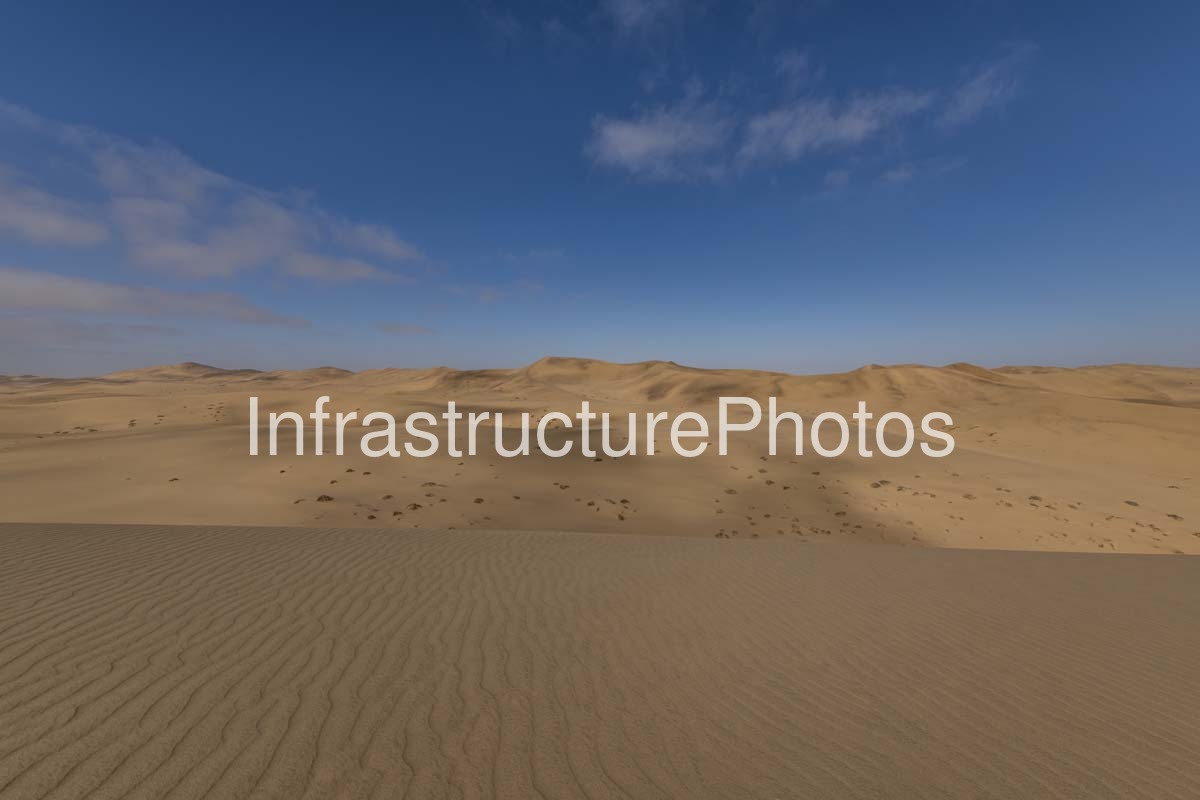
his photograph captures the expansive coastal dune landscape of Dorob National Park near Walvis Bay, Namibia. The image looks across a broad foreground dune covered with fine, evenly spaced wind ripples towards an extensive field of low, rolling sand dunes stretching across the horizon. The composition highlights the extraordinary scale and simplicity of the Namib Desert, with the textured foreground contrasting against the smoother, undulating dunes in the distance and a vast blue sky occupying the upper half of the frame.
Dorob National Park was proclaimed in 2010 and covers approximately 7,800 square kilometres along Namibia’s central Atlantic coastline. The park extends between the Ugab River and Skeleton Coast National Park in the north and the Namib-Naukluft landscape to the south. Its natural environment includes the Atlantic coastline, extensive gravel plains, sandy beaches and coastal dune formations. Swakopmund and Henties Bay are among the settlements situated within the wider park area.
The landscape visible in this photograph is characteristic of the extensive dune belt east of Walvis Bay. This dune system runs broadly parallel to the Atlantic coastline towards Swakopmund and forms an important component of the central Namib’s distinctive desert scenery. A 2018 environmental assessment for Walvis Bay describes the dune belt as extending along the coast between Walvis Bay and Swakopmund, within the broader Dorob National Park landscape.
The foreground is dominated by a gently sloping sand surface covered in remarkably regular ripples. These small-scale formations are produced by the movement of wind across loose sand, with individual grains being transported and deposited repeatedly as wind conditions change. The resulting patterns create a fine natural texture across the entire lower portion of the photograph. Beyond the foreground ridge, larger dunes form a succession of smooth hills and shallow valleys, demonstrating how wind operates at both microscopic and landscape scales.
Unlike the famous red-orange dunes of Sossusvlei in the southern Namib, the coastal dunes around Walvis Bay and Swakopmund generally have subdued beige, tan and golden-brown tones. Their appearance is influenced by the mineral composition of the sand, the coastal environment and atmospheric conditions associated with the nearby Atlantic Ocean. In this photograph, the relatively low-angle light produces subtle tonal changes across the dune surfaces, revealing the contours without creating excessively harsh shadows.
The immense apparent emptiness of the landscape is deceptive. Dorob National Park supports a specialised desert ecosystem adapted to extremely low rainfall and harsh coastal conditions. The Ministry of Environment, Forestry and Tourism identifies the vegetation as belonging to the Namib Desert biome and records species including pencil bush, dollar bush, shepherd’s tree, lichens and Welwitschia mirabilis. The park also supports wildlife including springbok, oryx, black-backed jackal, brown hyena, Cape fur seal and zebra, while approximately 270 bird species have been recorded.
The proximity of the Atlantic Ocean is fundamental to the ecology of this landscape. The cold Benguela Current contributes to the exceptionally arid conditions of Namibia’s coast, while coastal fog provides an important source of moisture for organisms capable of exploiting atmospheric humidity. Consequently, an environment that appears almost completely barren can support highly specialised life forms.
22 MB
Reviews
There are no reviews yet.