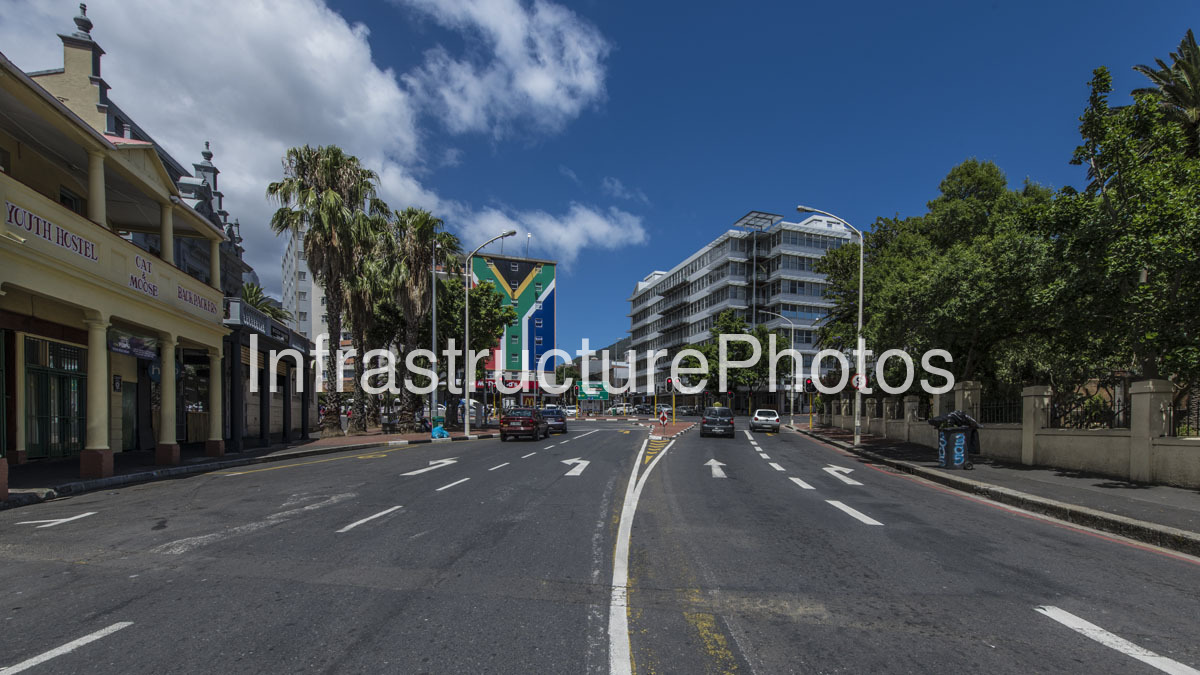
This photograph captures Long Street in central Cape Town, looking uphill towards the Gardens end of the City Bowl. Taken on 1 January 2018, the image presents a broad view of the street’s distinctive combination of historic architecture, contemporary commercial buildings, mature trees, palms and busy urban infrastructure. The road markings, traffic signals, pedestrian facilities and extensive lane configuration are prominent in the foreground, while Table Mountain’s lower slopes rise in the distance.
Long Street is one of Cape Town’s best-known historic streets and runs through the heart of the City Bowl between the central business district and Gardens. The street is particularly recognised for its collection of Victorian and Edwardian buildings, many of which feature ornate façades, balconies, colonnades and decorative ironwork. Its architectural character has survived remarkably well despite the considerable transformation of the surrounding city.
The building on the left is Cat & Moose Backpackers Lodge at 305 Long Street, which occupies one of the historic properties near the upper end of Long Street. Contemporary records identify the premises as a youth hostel, while a Cape Town Central City Improvement District guide describes the building as an 18th-century structure. The National Archives also records the historic buildings at 303A–309 Long Street, including the premises occupied by Cat and Moose Backpackers Lodge.
The Cat & Moose building provides an excellent example of the way historic Long Street properties have been adapted to modern uses. Its traditional façade incorporates a covered colonnade at street level, decorative columns and an elaborate roofline, while the ground floor has been adapted for commercial and hospitality activity. The visible “Youth Hostel” and “Cat & Moose Backpackers” signage reinforces the street’s long-standing role as a destination for international travellers.
Long Street has historically been associated with accommodation for younger travellers, restaurants, independent shops, bookshops, bars and nightlife. This mixture has helped give the street its distinctive bohemian identity. Cape Town Tourism describes it as a major cultural and entertainment destination, stretching through the City Bowl and attracting both local residents and international visitors.
The road itself is an important piece of urban infrastructure. At this point, Long Street operates as a one-way uphill route, with the traffic travelling towards the Gardens and Kloof Street area. The extensive lane markings visible in the photograph clearly separate through traffic and turning movements, while dedicated turning lanes and traffic islands manage the busy intersection ahead. Long Street’s parallel route, Loop Street, carries traffic in the opposite direction through the central city.
The intersection ahead provides a useful indication of the transition between the historic lower sections of Long Street and the more contemporary built environment towards Gardens. McDonald’s Long Street is located at the Kloof Street/Orange Street area near the upper end of the route, confirming the commercial character of this section of the street.
On the right side of the photograph, a substantial modernist office or commercial building contrasts sharply with the older structures on the opposite side of the road. Its horizontal bands of glazing, projecting floor plates and clean white façades represent a later phase of Cape Town’s urban development. The juxtaposition is characteristic of the City Bowl, where buildings from several different architectural periods occupy the same streetscape.
The photograph also illustrates Long Street’s relationship with green infrastructure. Mature trees line the eastern side of the road, while tall palms create a distinctive vertical rhythm around the older buildings. These trees soften what would otherwise be a heavily built urban environment and provide shade along the sidewalks. The combination of historic buildings, palms and mountain vegetation in the distance gives the street a particularly Cape Town character.
Long Street’s architecture is especially significant because many of its historic buildings retain features associated with Victorian Cape Town. These include decorative iron balconies, ornate parapets, columns and elaborate façades. South Africa’s official tourism material notes that Long Street’s colonnades and Edwardian shopfronts are particularly characteristic, with Victorian façades and balconies visible above the street-level commercial spaces.
Several individual buildings along Long Street have been formally recognised for their heritage value. For example, the Victorian dwelling at 134–136 Long Street is believed to date from approximately 1903 and was declared a National Monument under the former National Monuments Council legislation in 1985. The Blue Lodge Hotel at 206–208 Long Street is another important historic structure and was declared a National Monument in 1962.
Further along Long Street, the historic Mountain View Hotel at the corner of Green and Long streets dates back to the early twentieth century, with alterations by architects Parker and Forsyth recorded in 1905. The building demonstrates the mixture of commercial, hospitality and residential uses that has characterised the street for more than a century.
Long Street also contains some of Cape Town’s more unusual architectural survivals. The Palm Tree Mosque, for example, is associated with the early Muslim community of Cape Town and is recognised as one of the city’s important historic religious buildings. Its presence illustrates the cultural diversity that developed in the city during the colonial period and continued through subsequent generations.
The street’s social history is equally important. During the 1970s and 1980s, several theatres on Long Street were associated with anti-apartheid theatre and political expression. Although many of these venues have since disappeared or changed use, the street retained its reputation as a place where different cultural, political and social communities intersected.
The view towards the top of Long Street also provides an interesting reading of Cape Town’s geography. The street climbs gradually towards Gardens and the slopes of Table Mountain. Buildings become more dispersed towards the upper end, and the dense commercial fabric of the central CBD begins to give way to leafy neighbourhoods and larger residential and institutional properties.
The dramatic blue sky and scattered clouds in the photograph emphasise the verticality of the street’s architecture. The palm trees rise above the low historic buildings, while the taller contemporary structures create a contrasting skyline. The mountain backdrop, although partly obscured by buildings, remains an important visual element and reinforces the relationship between Cape Town’s dense urban core and its surrounding natural landscape.
The road surface itself is also visually significant. The freshly defined white lane arrows, yellow edge markings, traffic islands and pedestrian crossings demonstrate the considerable amount of infrastructure required to manage movement through one of the City’s busiest historic streets. The broad road occupies much of the foreground, creating strong perspective lines that lead towards the traffic signals and mountain landscape beyond.
The image therefore documents more than a historic street. It records the layered urban evolution of Cape Town: eighteenth- and nineteenth-century buildings adapted for modern commercial uses, twentieth-century office architecture, contemporary road infrastructure, mature urban landscaping and the continuing presence of the mountain environment.
Long Street remains particularly valuable from an architectural and photographic perspective because these different layers are visible within a relatively short stretch of road. Heritage buildings sit beside modern offices, restaurants occupy former residential properties, and tourism businesses operate within structures that are considerably older than many of the people who now use them.
The photograph also captures Long Street during a relatively quiet period of the day. Despite being one of Cape Town’s best-known nightlife destinations, the roadway is comparatively open, allowing the architectural relationship between the buildings and street infrastructure to be clearly seen. This makes the image a useful documentary record of the street as both a transportation corridor and a historic urban environment.
16 MB
Reviews
There are no reviews yet.