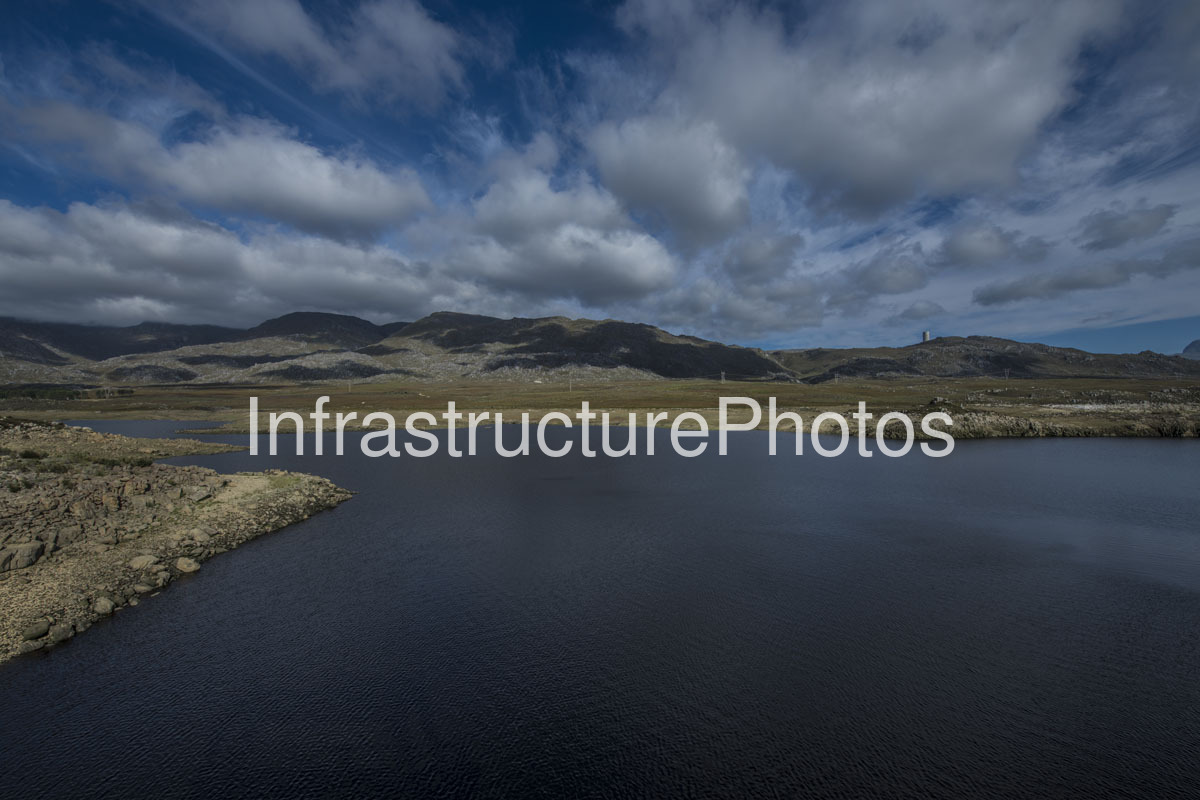
This photograph captures the broad expanse of Kogelberg Dam reservoir on the Palmiet River in the Western Cape, surrounded by the rugged mountain landscape of the Hottentots Holland range. The image looks across the dark, wind-rippled surface of the reservoir towards a largely undeveloped mountain landscape. Rocky shorelines, low fynbos vegetation and dramatic cloud formations create a powerful sense of wilderness, while the reservoir itself forms a major component of one of South Africa’s important integrated water and energy infrastructure schemes.
Kogelberg Dam is the lower reservoir of the 400 MW Palmiet Pumped Storage Scheme, operated by Eskom. The dam lies on the Palmiet River south of Grabouw, while the scheme’s upper reservoir, Rockview Dam, is situated on the watershed between the Palmiet and Steenbras river systems. Water is moved between the two reservoirs through a sophisticated system of underground tunnels, shafts and penstocks connected to two reversible pump-turbines.
The role of Kogelberg Dam is therefore considerably more significant than simply storing water. During periods of lower electricity demand, the Palmiet scheme uses surplus electricity to pump water from Kogelberg Dam uphill to Rockview Dam. When electricity demand increases, water is released from Rockview through the underground waterways and passed through the reversible turbines to generate electricity, before returning to Kogelberg Dam. The system provides approximately 400 MW of rapid-response generating capacity and can respond to changes in electricity demand within minutes.
The reservoir visible in this image has a gross storage capacity of approximately 19.3 million cubic metres, with an active storage capacity of approximately 15 million cubic metres. At full supply level, the reservoir covers approximately 155.4 hectares. The full supply level is approximately 246 metres above sea level, while the dam’s non-overflow crest is at approximately 252 metres.
The scale of the reservoir becomes particularly apparent from the photograph. The water occupies most of the foreground and extends towards the rocky shoreline at the base of the mountains. Unlike reservoirs surrounded by extensive agricultural development or urban settlements, the landscape here remains remarkably undeveloped. The shoreline is characterised by exposed rocks, low vegetation and gently sloping terrain, reinforcing the remote character of the Palmiet valley.
The mountain landscape in the background forms an important part of the photograph. The Hottentots Holland Mountains rise behind the reservoir in a series of rounded and sharply defined ridges, with exposed rock formations creating pale grey and brown patterns across the slopes. The vegetation is predominantly low-growing fynbos, reflecting the exceptional botanical character of the region.
The Kogelberg area is internationally recognised for its biodiversity. The Kogelberg Biosphere Reserve was designated under UNESCO’s Man and the Biosphere Programme in December 1998 and was the first biosphere reserve established in South Africa. Eskom describes the Kogelberg Nature Reserve as the heart of the Fynbos Plant Kingdom, with the wider biosphere reserve extending across approximately 92,000 hectares.
This ecological setting is particularly important because the Palmiet Pumped Storage Scheme was deliberately designed to minimise its visual and environmental impact. Much of the major power-generation infrastructure is underground rather than being housed in a conventional surface power station. Eskom describes the Palmiet project as a forerunner in environmental engineering, with the scheme receiving recognition for its technical, environmental and planning achievements.
The two 200 MW pump-turbine units are located underground, approximately 60 metres below ground level. They are installed at the base of large vertical machine shafts, while the associated water conveyance system includes tunnels, inclined shafts and buried penstocks. This arrangement allows the power station to remain relatively unobtrusive within the surrounding mountain environment.
The photograph’s almost untouched appearance is therefore partly a consequence of this engineering philosophy. Rather than surrounding the reservoir with large surface industrial structures, much of the scheme’s most substantial infrastructure is concealed beneath the mountain. The visible reservoir can consequently appear to be a natural mountain lake, despite forming part of a highly sophisticated electricity-storage system.
The water stored at Kogelberg also has an important water-transfer function. The Palmiet scheme was developed as part of the Palmiet River Government Water Scheme, and water transferred to the upper Rockview reservoir can be directed towards the Steenbras system. The broader system contributes to Cape Town’s water supply, demonstrating the unusual integration of electricity generation and strategic water management at Palmiet.
Historical water-resource documentation identifies Kogelberg Dam as the main storage reservoir for the scheme. Water is pumped from Kogelberg to Rockview during periods of low electricity demand and released back through the turbines during periods of high demand. Some water can subsequently be transferred from Rockview towards Steenbras Dam, where it contributes to the water-supply system serving Cape Town.
The reservoir is also an important example of pumped hydro energy storage. Unlike conventional hydroelectric dams that depend primarily on naturally flowing water, pumped-storage facilities deliberately move water between reservoirs at different elevations. The elevation difference stores potential energy, which can later be converted back into electricity through the turbines. In this case, the difference between Rockview and Kogelberg provides the hydraulic head necessary for high-output electricity generation.
Eskom’s technical information records that the Palmiet system has a rated head of roughly 260 metres and that the main waterway feeding the power station has an internal diameter of approximately 6.2 metres. During generation, flows of up to approximately 185 cubic metres per second can pass through the main waterway towards the underground turbine complex.
The project was constructed during the 1980s, with construction commencing in November 1983 and the two generating units commissioned in May 1988. The scheme subsequently received recognition from the South African Institution of Civil Engineering as an Outstanding Civil Engineering Achievement, as well as environmental awards. In 2003, Palmiet received the International Hydropower Association’s Blue Planet Prize for its technical, economic and environmental performance.
The natural landscape visible here helps explain why the project received such attention for environmental engineering. The reservoir is surrounded by steep, rocky terrain that is largely free from buildings and major surface infrastructure. The fynbos-covered mountains provide a continuous natural backdrop, while the reservoir itself reflects the sky and clouds, creating a strong visual transition between water and land.
The dramatic weather also contributes significantly to the character of the photograph. Large clouds move across the mountain ridges, creating alternating areas of light and shadow over the terrain. The dark surface of the reservoir contrasts with the pale exposed rocks along the shoreline and the muted greens and browns of the fynbos.
From an infrastructure-photography perspective, the image is particularly valuable because the infrastructure is present without dominating the scene. The reservoir is itself the engineered structure, but its appearance has been integrated so successfully into the landscape that the photograph initially reads as a wilderness landscape rather than an energy-storage facility.
The small structure visible on the distant ridge may relate to infrastructure associated with the broader Palmiet scheme, but the photograph does not provide sufficient detail to identify it conclusively. The dominant subject remains the Kogelberg reservoir and the surrounding mountain environment.
The image also documents the wider relationship between water, energy and conservation in the Western Cape. Kogelberg Dam sits within a landscape of exceptional ecological significance, yet it forms a critical component of a strategic infrastructure system capable of both storing electrical energy and supporting regional water management.
Kogelberg Dam is therefore an excellent example of multi-purpose infrastructure hidden within a natural landscape. Its reservoir stores water, supports pumped-storage electricity generation, forms part of a water-transfer system and contributes to the operational flexibility of the electricity grid. At the same time, the surrounding Kogelberg landscape remains one of South Africa’s most important centres of fynbos biodiversity.
The photograph ultimately captures the quiet side of major infrastructure: there are no turbines, transmission towers or industrial buildings dominating the frame. Instead, the engineering achievement is represented by a broad body of water nestled among ancient mountains. The result is a compelling record of how large-scale infrastructure can be designed to operate within — rather than overwhelm — an exceptionally sensitive natural environment.
19 MB
Reviews
There are no reviews yet.