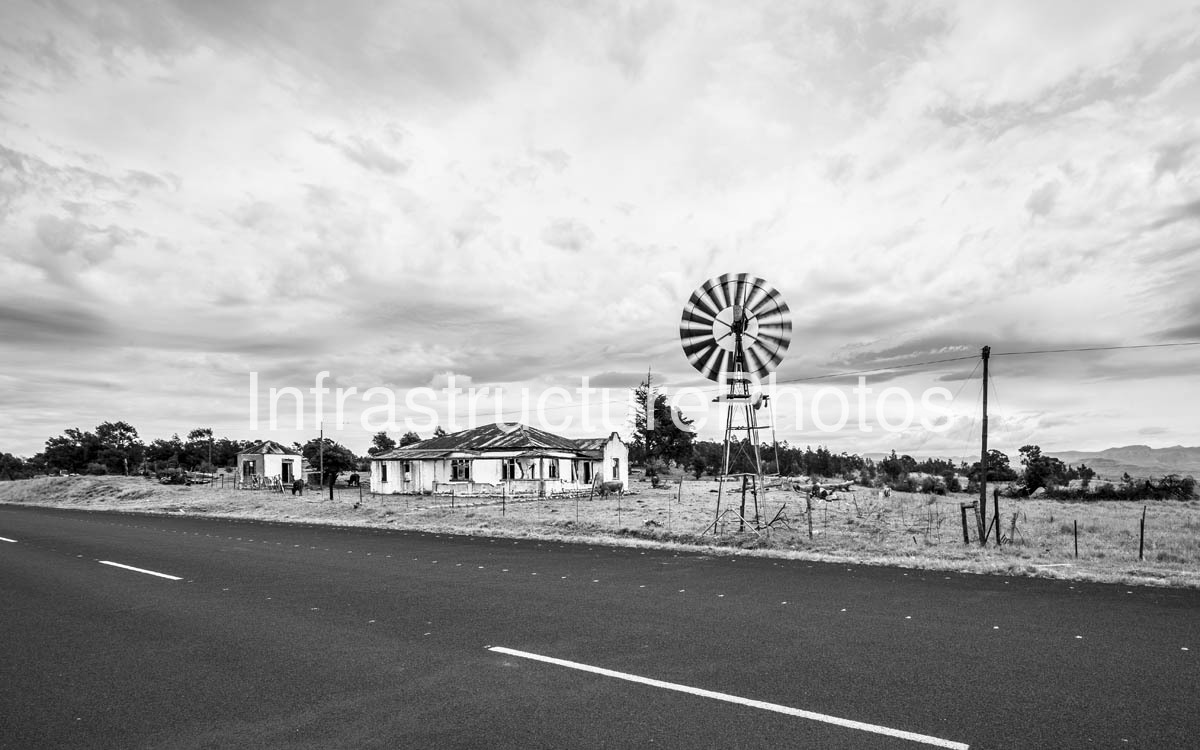
This black-and-white photograph captures a weathered rural homestead and traditional windpump standing beside a major South African road. The composition brings together several elements of the country’s agricultural landscape: an old farmhouse, a small outbuilding, wire fencing, grazing land, utility poles, a historic wind-driven water pump and the mountains visible on the distant horizon. The broad expanse of asphalt occupies much of the foreground, creating a strong contrast with the deteriorating buildings and open countryside beyond. The monochrome treatment emphasises texture, age and atmosphere, turning an ordinary roadside scene into a visual record of a changing rural landscape.
At the centre of the image is a traditional multi-bladed windpump mounted on a tall steel tower. These mechanical windmills became an important feature of agricultural landscapes across South Africa, particularly in areas where groundwater provided an essential source of water for livestock and farming communities. Unlike modern wind turbines, these structures were primarily mechanical devices, using the rotation of the blades to drive a pump and draw groundwater to the surface. Their distinctive silhouettes remain closely associated with South Africa’s farming regions and are often found alongside farmsteads, stock watering points and isolated rural settlements.
Behind the windpump stands an ageing single-storey farmhouse with a broad, low-pitched hipped roof. The building appears to have undergone years of exposure and deterioration, with sections of the roof weathered, damaged or missing and several openings visible in the walls. Its simple construction reflects the practical character of many historic rural buildings, where functionality and locally available materials were generally more important than architectural ornamentation. The surrounding outbuildings and fencing reinforce the agricultural character of the property.
The house and windpump together create an evocative connection between architecture and infrastructure. The farmhouse represents habitation and agricultural life, while the windpump represents the infrastructure that made farming possible in areas without reliable municipal water supplies. Positioned beside the road, the two structures also illustrate how historic rural properties developed in close relationship with transportation routes. The road provides the contemporary infrastructure of movement, while the homestead and windpump represent an earlier agricultural landscape that has remained in place alongside it.
8 MB
Reviews
There are no reviews yet.