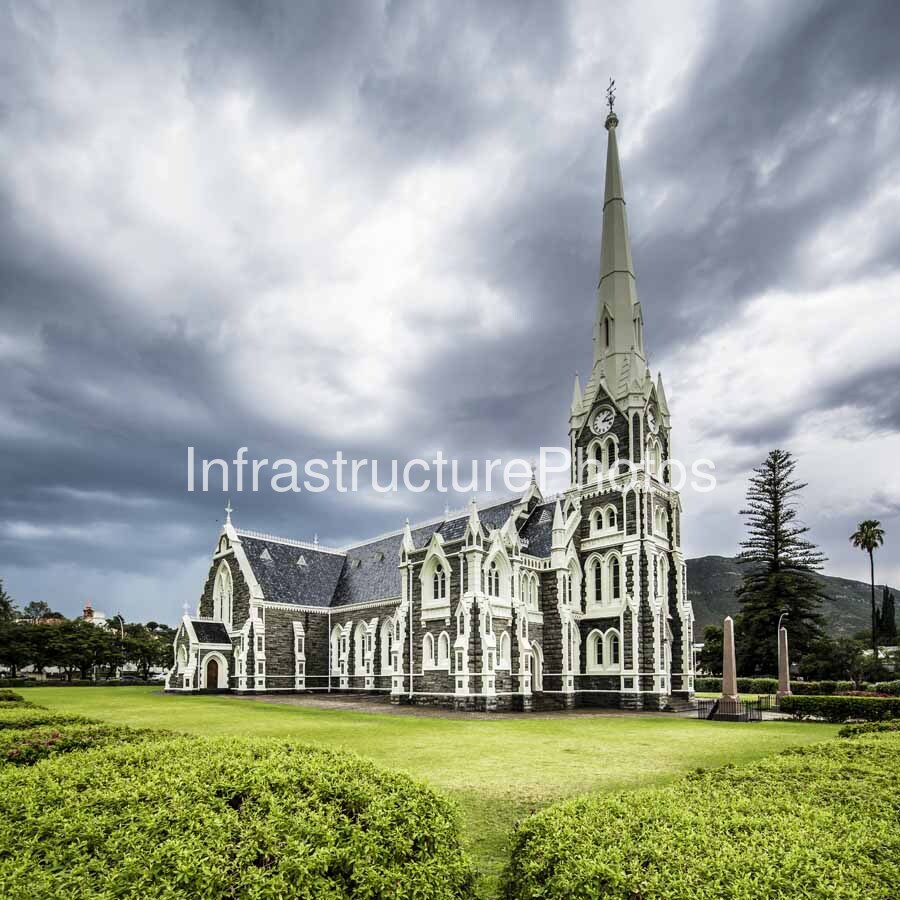
This photograph presents a dramatic exterior view of the Grootkerk, the historic Dutch Reformed Church in Graaff-Reinet, Eastern Cape, with its monumental Gothic Revival architecture set against the surrounding Karoo hills and a dramatic cloud-filled sky. Completed in 1887, the church is one of South Africa’s most impressive nineteenth-century ecclesiastical buildings and remains one of the defining architectural landmarks of Graaff-Reinet. Its distinctive composition combines dark local stone with contrasting white architectural detailing, steep slate roofs, elaborate Gothic tracery, pointed arches, decorative pinnacles and a soaring central tower crowned by a slender spire.
Location: Church Street, Graaff-Reinet, Eastern Cape, South Africa. The Grootkerk occupies a prominent position within the historic centre of Graaff-Reinet and forms an important part of the town’s exceptionally well-preserved nineteenth-century architectural environment.
Architect: James Bisset. The church is generally attributed to Cape Town architect James Bisset and was designed in the Gothic Revival tradition, reportedly drawing inspiration from Salisbury Cathedral in England.
Completed: 1887. Construction began following the laying of the foundation stone on 12 April 1886, with the completed church inaugurated in September 1887.
Architectural Style: Victorian Gothic Revival / Neo-Gothic, characterised by pointed arches, Gothic tracery, steeply pitched slate roofs, pinnacles, buttresses, decorative stonework and a monumental central tower and spire.
Building Use: Dutch Reformed Church and place of worship.
The central tower is the dominant feature of the composition, rising dramatically above the main body of the church. Its multiple levels contain pointed-arch openings and clock faces before transitioning into the exceptionally tall spire. The vertical emphasis of the tower is characteristic of Gothic Revival architecture, drawing the eye upwards and establishing the church as a landmark visible across Graaff-Reinet.
The tower’s intricate detailing becomes particularly apparent from this angle. White stone or rendered architectural elements frame the darker masonry, creating a strong graphic contrast around the arches, windows, clock faces, buttresses and decorative projections. The spire rises above a highly articulated belfry, while delicate ornamental work at its summit completes the vertical composition.
The main body of the church demonstrates an equally sophisticated approach to Gothic Revival design. A series of projecting gables and bays creates a complex rhythm along the elevations, with each section incorporating pointed-arch windows, decorative stone surrounds and small pinnacles. The repetition of these elements gives the building a coherent architectural language despite the complexity of its plan.
The extensive use of dark grey stone is one of the building’s most distinctive visual characteristics. Set against the bright white detailing, the masonry creates a polychromatic effect that emphasises the individual architectural components. This treatment also gives the church a powerful visual connection to its environment, with the rugged stone construction contrasting beautifully with the green lawns and surrounding vegetation.
The steeply pitched slate roofs are another defining element. Their dark surfaces reinforce the Gothic character of the building while creating a strong series of diagonal lines across the roofscape. Decorative roof cresting, small dormer-like openings and finials add further detail to the silhouette.
The large Gothic windows provide important focal points along the side elevations. Their pointed arches contain elaborate tracery, reflecting the Gothic Revival fascination with medieval architectural forms. Smaller lancet-style windows are incorporated throughout the building, creating a carefully controlled rhythm of openings that balances the heavier stone walls.
The church’s architectural ambition reflects the importance of Graaff-Reinet during the nineteenth century. The present building replaced an earlier church that had become too small for the congregation. The scale of the new structure allowed it to accommodate approximately 1,250 to 1,500 worshippers and represented a substantial investment in the town’s religious and civic infrastructure.
The design’s association with Salisbury Cathedral is particularly significant. While the Grootkerk clearly belongs to the international Gothic Revival movement, its execution in local stone and its setting within the Great Karoo give it a distinctive South African identity. The combination of imported architectural ideas and locally available materials is an important characteristic of nineteenth-century colonial architecture in the region.
The surrounding landscape reinforces this sense of place. The church stands within carefully maintained lawns and formal hedges, while the mountains and hills behind the building establish the distinctive topography of Graaff-Reinet. Mature trees, including tall conifers and palms, frame the church and provide a visual transition between the monumental architecture and the surrounding urban landscape.
The dramatic weather in this photograph adds another dimension to the composition. Heavy clouds gather above the church, creating a strong contrast with the bright stonework and vivid green landscape. The changing light emphasises the texture of the masonry and gives the building an imposing presence, while the surrounding hills provide depth behind the tall spire.
The Grootkerk was declared a National Monument in 1975, reflecting its architectural and historical importance. It remains an integral part of Graaff-Reinet’s heritage landscape and a significant example of Victorian Gothic Revival architecture in South Africa.
17 MB
Reviews
There are no reviews yet.