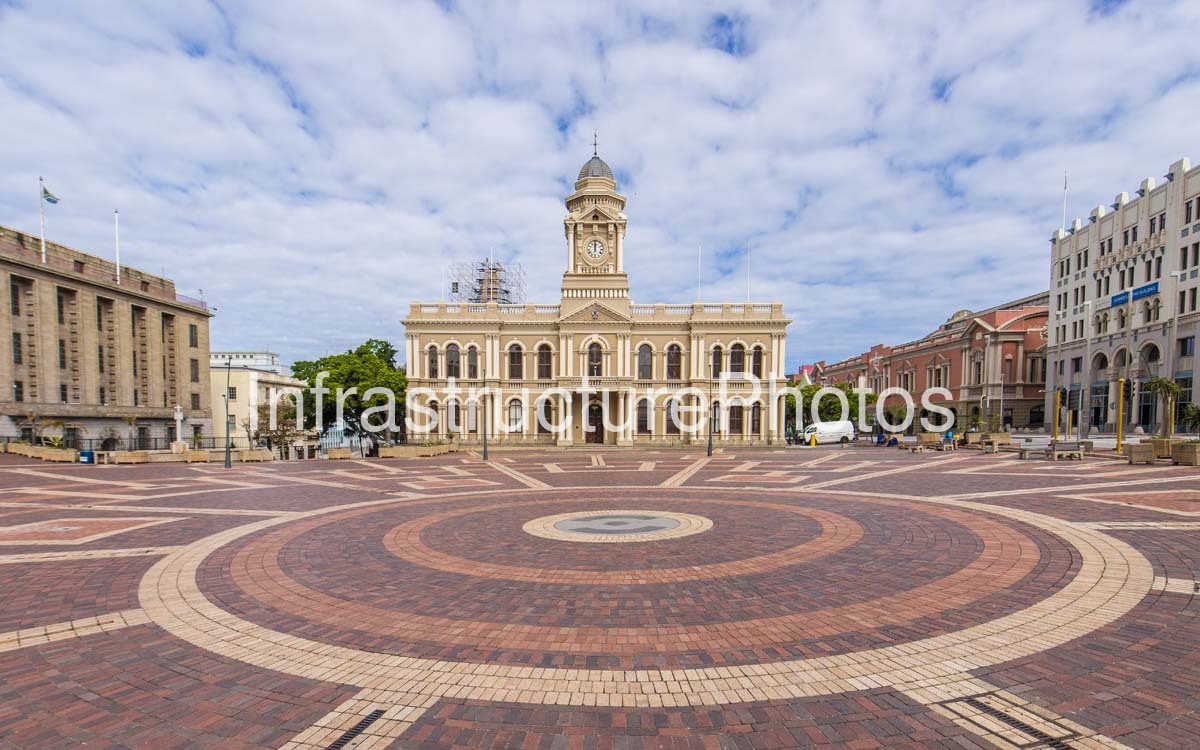
Gqeberha City Hall, formerly known as Port Elizabeth City Hall, stands prominently at the centre of Vuyisile Mini Square in the historic heart of Gqeberha, Eastern Cape. This photograph captures the building’s carefully restored historic façade, dominated by its distinctive clock tower and formal symmetrical composition, with the expansive patterned paving of the square creating a strong foreground. The result is a striking architectural record of one of the Eastern Cape’s most important civic buildings and one of the defining landmarks of the historic central city. The building remains closely associated with the administration of Nelson Mandela Bay Municipality, with the Office of the City Manager located on its first floor.
Location: City Hall, Vuyisile Mini Square, Govan Mbeki Avenue, Central, Gqeberha, Eastern Cape, South Africa. The square, formerly known as Market Square, occupies an important position in the historic development of the city. It was once closely associated with the landing and movement of goods into and out of the early settlement and became a focal point for trading and civic activity. Today, Vuyisile Mini Square remains one of Gqeberha’s most significant historic urban spaces, with City Hall forming its principal architectural landmark.
Architect: Robert Archibald, the Town Engineer of Port Elizabeth. The foundation stone for the original Town Hall was laid by Sir George Grey, Governor of the Cape, on 18 October 1858. Archibald designed the building as the Port Elizabeth Town Hall, which opened in 1861. The front porch was subsequently added in 1865, while the distinctive clock tower was added in 1883/84. The building was later renamed Port Elizabeth City Hall when the municipality achieved city status in 1913.
Completed: 1861, with the clock tower added in 1883/84. The building’s history, however, includes a major reconstruction following a devastating fire in 1977. The fire gutted the interior, after which the building underwent an extensive restoration programme. The historic external character was retained while the interior was substantially rebuilt.
Architectural Style: Victorian-era Italianate and neo-Classical civic architecture. The building is characterised by a highly symmetrical façade, classical proportions, decorative stucco, arched windows, pilasters, balustrades and an elaborate central clock tower. The tower provides the building with its strongest vertical emphasis, rising above the otherwise horizontally composed façade and creating a visual landmark across the square. Sources variously describe the architecture as Italianate and neo-Classical, reflecting the broader architectural vocabulary used for important civic buildings in the Cape during the nineteenth century.
12 MB
Reviews
There are no reviews yet.