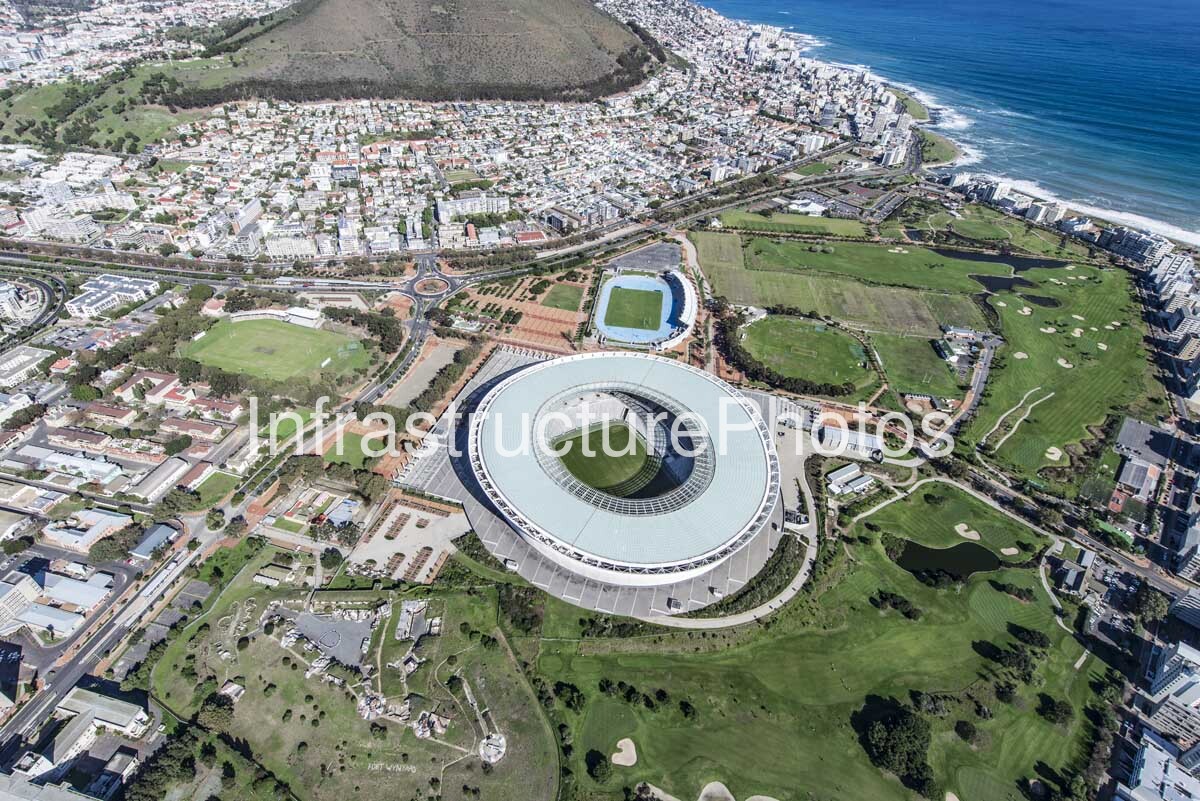
This spectacular aerial photograph captures DHL Stadium, formerly known as Cape Town Stadium, in its extraordinary setting between the Atlantic Ocean, the Victoria & Alfred Waterfront, Green Point and the dramatic mountains of Cape Town. The stadium sits prominently within Green Point Common, surrounded by extensive parkland, sports fields and urban development, while Table Mountain, Signal Hill, the City Bowl, the harbour and the Atlantic coastline create one of the most recognisable urban landscapes in South Africa.
The photograph has gained particular relevance following the extraordinary Airlink formation flypast over DHL Stadium on 29 August 2026, shortly before the Springboks faced the All Blacks in the second Test of the Rugby’s Greatest Rivalry series. Two Airlink Embraer aircraft performed a carefully planned low-level formation pass over the packed stadium, creating spectacular images that rapidly spread across social media and international news platforms. Flightradar24 analysis calculated that the lead aircraft passed approximately 41–46 feet (12.5–14 metres) above the stadium roof, based on the available flight-tracking data.
The flypast immediately became one of the most talked-about sporting moments of the weekend. While the spectacle was widely celebrated for its dramatic visual impact, the exceptionally low clearance also generated an international aviation-safety debate. Airlink subsequently stated that the operation had been carefully planned and rehearsed, with guidance, approval and support from the South African Civil Aviation Authority (SACAA) and Air Traffic Navigation Services (ATNS). The airline said both aircraft were operated by highly experienced crews and that flight data confirmed compliance with the approved altitude and speed limits.
The event also deliberately connected modern aviation with one of South Africa’s most famous sporting traditions. The flypast recalled the iconic South African Airways Boeing 747 flyover at Ellis Park before the 1995 Rugby World Cup final, when an aircraft passed over the stadium before South Africa faced New Zealand. More than three decades later, the tradition was recreated over Cape Town, this time with two modern Airlink Embraer jets and the spectacular backdrop of Table Mountain.
The photograph therefore captures DHL Stadium at an especially significant moment in its history. The stadium itself is a landmark of South Africa’s transformation of sporting infrastructure for the 2010 FIFA World Cup, while the recent flypast has once again placed the building at the centre of an extraordinary intersection between architecture, aviation, rugby and national sporting identity.
DHL Stadium was constructed between 2007 and 2009 specifically for the 2010 FIFA World Cup and opened in December 2009. The stadium was designed by gmp Architekten in collaboration with local architectural practices including Louis Karol Architects and Point Architects. Its design was conceived specifically to respond to Cape Town’s spectacular natural setting, with the architects seeking to integrate the stadium respectfully into the landscape formed by Table Mountain, Signal Hill and the Atlantic Ocean.
The result is one of the most visually distinctive stadiums in the world. Rather than competing with the surrounding mountains, the building has a relatively low, flowing profile. Its curved silhouette and translucent outer façade create an appearance that changes according to the surrounding light and weather conditions. The stadium’s architects describe the building as forming a visual relationship with the plateau of Table Mountain and the peak of Signal Hill.
From this aerial perspective, that relationship is particularly powerful. The stadium appears almost as a carefully positioned object within the green landscape of Green Point Common. Beyond it rises Signal Hill and, further behind, the enormous flat-topped mass of Table Mountain. Lion’s Head is visible to the right, creating a dramatic sequence of geological forms behind the modern stadium.
The positioning of the stadium is one of its greatest architectural strengths. Unlike many large sporting venues that are surrounded almost entirely by dense urban development, DHL Stadium sits within a broad landscape of parkland and sports fields. The open space allows the building to be appreciated as a complete architectural form, while the surrounding city and ocean provide an extraordinary natural frame.
The stadium’s outer skin is constructed from a translucent PTFE-coated glass-fibre membrane, creating a light-coloured envelope that responds to changing daylight. The surface can appear white, silver or subtly coloured depending on weather and illumination. The membrane also gives the stadium a lightweight visual quality despite the enormous structure contained beneath it.
The roof is an equally important component of the design. It consists of a suspended cable-net structure stabilised by an elevated truss system and clad with glass panels. The glass contributes significant weight to the roof, helping counteract the strong wind suction forces associated with Cape Town’s exposed coastal environment. A transparent membrane forms the inner roof and façade envelope, creating a bright and visually open interior.
The roof covers approximately 45,000 square metres, while the stadium’s main axes measure approximately 290 by 265 metres. During the 2010 FIFA World Cup, the venue accommodated approximately 68,000 spectators, including temporary seating that was subsequently removed. The permanent capacity is approximately 55,000.
The stadium was designed around the principles of visibility, comfort and intimacy. Its three-tiered bowl brings spectators close to the field, while the geometry ensures excellent sightlines across the playing surface. During the 2010 World Cup, the stadium’s design allowed spectators to remain within relatively close viewing distance of the action, contributing to the atmosphere of the venue.
DHL Stadium hosted eight FIFA World Cup matches in 2010, including the opening match between Uruguay and France and the quarter-final between Germany and Argentina. It quickly became one of the defining images of the tournament, particularly because of the extraordinary combination of the stadium’s modern architecture and Cape Town’s natural landscape.
The aerial view demonstrates why the building became such an important architectural symbol of the tournament. The stadium itself is relatively restrained in form, allowing the surrounding mountains and ocean to remain dominant. From the air, the building, parkland, city, harbour and mountains form a layered composition that is uniquely Cape Town.
Immediately to the west and southwest of the stadium is the Atlantic Ocean, while the Victoria & Alfred Waterfront occupies the area to the north. The photograph captures the complex relationship between the stadium and the waterfront precinct, including marinas, breakwaters, roads, commercial buildings and the harbour. The coastline curves around the foreground, creating a powerful natural boundary between the city and the ocean.
The photograph also shows the extensive Green Point Common surrounding the stadium. Golf-course landscapes, sports fields, cricket facilities, rugby fields and recreational areas create a large green framework around the building. This open landscape was an important part of the stadium’s integration into Cape Town, allowing the structure to sit within rather than overwhelm the existing environment.
The wider city extends towards Table Bay and the mountains. The dense urban fabric of Cape Town’s City Bowl is visible behind the stadium, while the slopes of Signal Hill and Table Mountain rise dramatically above it. The contrast between the modern stadium, historic city, natural landscape and ocean is one of the defining characteristics of the site.
The stadium’s environmental design also incorporated a number of sustainability measures. During construction, environmental management procedures were implemented to protect the surrounding area, while the completed stadium incorporated systems for rainwater collection and reuse. Rainwater harvested from the roof was stored for irrigation, while the translucent façade and roof helped provide natural light and reduce the visual and environmental impact of the enormous structure.
Since the World Cup, the stadium has continued to operate as a major sporting and entertainment venue. It is associated with Western Province Rugby, the DHL Stormers and Cape Town City, and has hosted international rugby, football, concerts and major public events. Its role has therefore evolved from a World Cup venue into an important permanent component of Cape Town’s sporting infrastructure.
The stadium’s location has also made it an important component of the city’s tourism and urban identity. Few major stadiums can claim such a dramatic setting: ocean immediately beyond the city, the working harbour, Green Point Common, Signal Hill and Table Mountain all forming part of the same visual field.
This aerial photograph captures that extraordinary relationship particularly well. The stadium occupies the centre of the image, but it is not isolated from its surroundings. Instead, it is embedded within the landscape, with the green parkland extending around it, the Waterfront and harbour immediately to the west, the Atlantic Ocean beyond, and Cape Town’s mountains forming an immense natural backdrop.
The recent Airlink flypast adds another fascinating dimension to the image. The stadium has now become associated not only with the architecture and legacy of the 2010 FIFA World Cup, but also with one of the most remarkable aviation spectacles ever staged above a South African sporting venue. The 29 August 2026 flypast demonstrated the power of the stadium as a visual stage: its distinctive roof provided the reference point for two passenger aircraft, while the surrounding mountains and ocean created an extraordinary backdrop that helped make the footage instantly recognisable around the world.
The contrast is particularly striking. In the photograph, DHL Stadium appears calm and integrated into the landscape, surrounded by green fields and the blue waters of Table Bay. During the flypast, the same structure became the centre of an intense sporting spectacle, filled with more than 50,000 spectators and approached by two passenger aircraft in formation.
This photograph therefore records much more than a stadium. It documents a major piece of South African architectural and sporting infrastructure within one of the world’s most dramatic urban landscapes. It captures the relationship between architecture, landscape, ocean, city and sport that has made Cape Town Stadium such an enduring landmark.
More than sixteen years after its completion, DHL Stadium remains one of the defining buildings of Cape Town. Its restrained architectural form, translucent façade and lightweight roof allow the surrounding landscape to remain the dominant visual feature, while its position within Green Point Common creates an unusually successful relationship between major sporting infrastructure and public open space.
25.5 MB
Reviews
There are no reviews yet.