The DHL Cape Town Stadium has once again taken centre stage, this time providing the dramatic backdrop for an extraordinary Airlink formation flyover that captivated audiences around the world. On 29 August 2026, shortly before the Springboks faced the All Blacks in the second Test of the Rugby’s Greatest Rivalry series, two Airlink Embraer E-Jets performed a spectacular formation flypast over the packed stadium. Footage of the aircraft passing remarkably close to the stadium roof rapidly spread across social media and international news platforms, turning an already iconic sporting venue into the focus of a global aviation story.
According to flight-tracking analysis by Flightradar24, the aircraft were recorded at approximately 205–210 feet above mean sea level after correction for local atmospheric pressure, while DHL Stadium stands at approximately 164 feet above sea level. This placed the aircraft approximately 41–46 feet, or 12.5–14 metres, above the top of the stadium at their lowest recorded point. The remarkable proximity prompted widespread discussion about the safety of the manoeuvre, although Airlink stated that the flypast had been carefully planned and rehearsed and was conducted within altitude and speed parameters approved by the South African Civil Aviation Authority (SACAA).
The spectacle also revived memories of one of South Africa’s most famous sporting aviation moments — the South African Airways Boeing 747 flyover at Ellis Park before the 1995 Rugby World Cup final. The 2026 Airlink flypast deliberately tapped into that powerful tradition, once again combining aviation, rugby and national sporting identity in a single spectacular moment. With the aircraft flying over a stadium filled with tens of thousands of spectators, and Table Mountain and Signal Hill forming the surrounding landscape, the event created an extraordinary new image in South African sporting history.
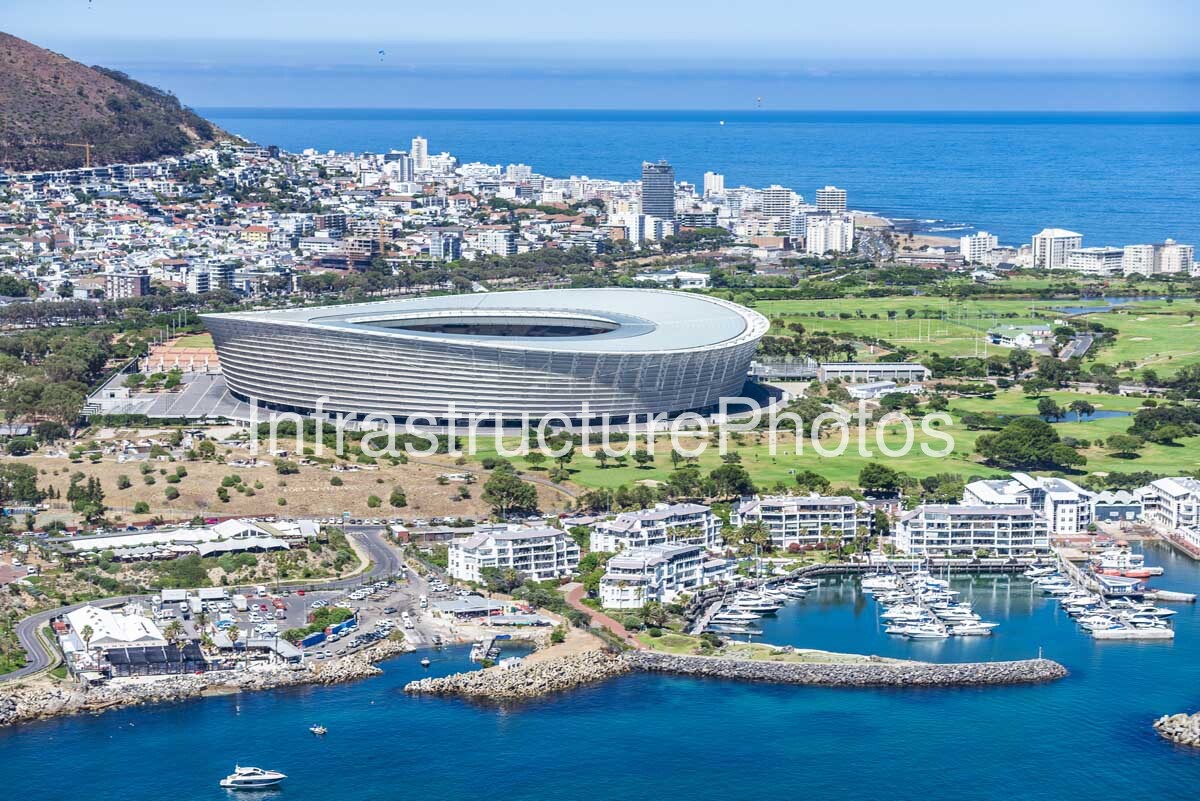
This aerial photograph captures the stadium and its remarkable setting from above, showing why DHL Stadium has become one of Cape Town’s most recognisable contemporary landmarks. Positioned in Green Point between Signal Hill, Table Mountain, the Atlantic Ocean and the V&A Waterfront, the stadium forms an important link between the city’s sporting, commercial, recreational and tourism infrastructure.
Originally known as Cape Town Stadium, the venue was conceived as one of the major architectural and infrastructure projects associated with the 2010 FIFA World Cup. Construction took place between 2007 and 2009, with the completed stadium providing seating for approximately 68,000 spectators during the tournament. The building was designed to accommodate the enormous requirements of an international sporting event while remaining sensitive to one of the most visually spectacular urban settings in the world.
The architectural design was led by German practice gmp Architekten, with Volkwin Marg and Hubert Nienhoff working with Robert Hormes, in a joint venture with South African practices Louis Karol Architects and Point Architects. The design deliberately responds to the surrounding landscape, with gmp describing the stadium as forming a visual triad with the plateau of Table Mountain and the peak of Signal Hill.
Architecturally, the stadium is characterised by a sweeping circular form, flowing roofline and translucent outer envelope. Its lightweight appearance is created by a sophisticated combination of steel, cables, glass and a translucent fibreglass fabric outer skin. The façade changes visually according to the prevailing light conditions, giving the stadium an almost luminous quality when viewed from a distance.
The roof is one of the building’s most significant engineering features. Covering approximately 36,000 square metres, it consists of a cable-supported trussed structure with extensive glazing. The roof’s double curvature provides structural rigidity while also assisting with rainwater drainage, an important consideration in Cape Town’s sometimes severe winter weather. Translucent laminated glass around the outer roof allows daylight into the stadium while helping protect the interior from direct solar radiation. The complete roof structure weighs approximately 4,500 tonnes.
The stadium was designed with three tiers of seating and an undulating upper edge created by its circular geometry. Its architectural form gives the building a surprisingly light appearance despite its considerable scale. Set within a landscaped podium and surrounded by open space, the stadium appears smaller than its actual physical dimensions when viewed from a distance — an intentional aspect of the architectural composition.
Following the 2010 FIFA World Cup, the venue transitioned into a permanent multi-purpose sporting and entertainment facility. It became a major home for rugby and football in Cape Town and has hosted international rugby fixtures, domestic competitions, concerts and major public events. The stadium is closely associated with Western Province Rugby and the DHL Stormers and has also become an important venue for the Springboks.
Its location is arguably as important to its identity as its architecture. To the west, the Atlantic Ocean stretches towards the horizon, while Signal Hill rises immediately behind the stadium. Table Mountain dominates the wider Cape Town skyline, providing an extraordinary natural counterpoint to the stadium’s contemporary architectural form. To the southeast, the V&A Waterfront and Cape Town Harbour create a dense network of commercial, tourism, maritime and recreational infrastructure.
This aerial perspective reveals the relationship between all these elements particularly well. The stadium sits within a landscape where mountains, ocean, harbour, residential neighbourhoods, public parks and major infrastructure meet within a relatively compact area. Few major sports venues have such a dramatic geographical setting.
The recent Airlink flyover adds another layer to the stadium’s continuing story. What began as a major architectural project for the 2010 FIFA World Cup has evolved into one of South Africa’s most recognisable sporting stages — a venue that continues to generate memorable images more than a decade after its completion. The extraordinary 2026 flypast demonstrated once again the stadium’s ability to provide a backdrop for moments that extend well beyond the sporting event itself.
31.3 MB
Reviews
There are no reviews yet.