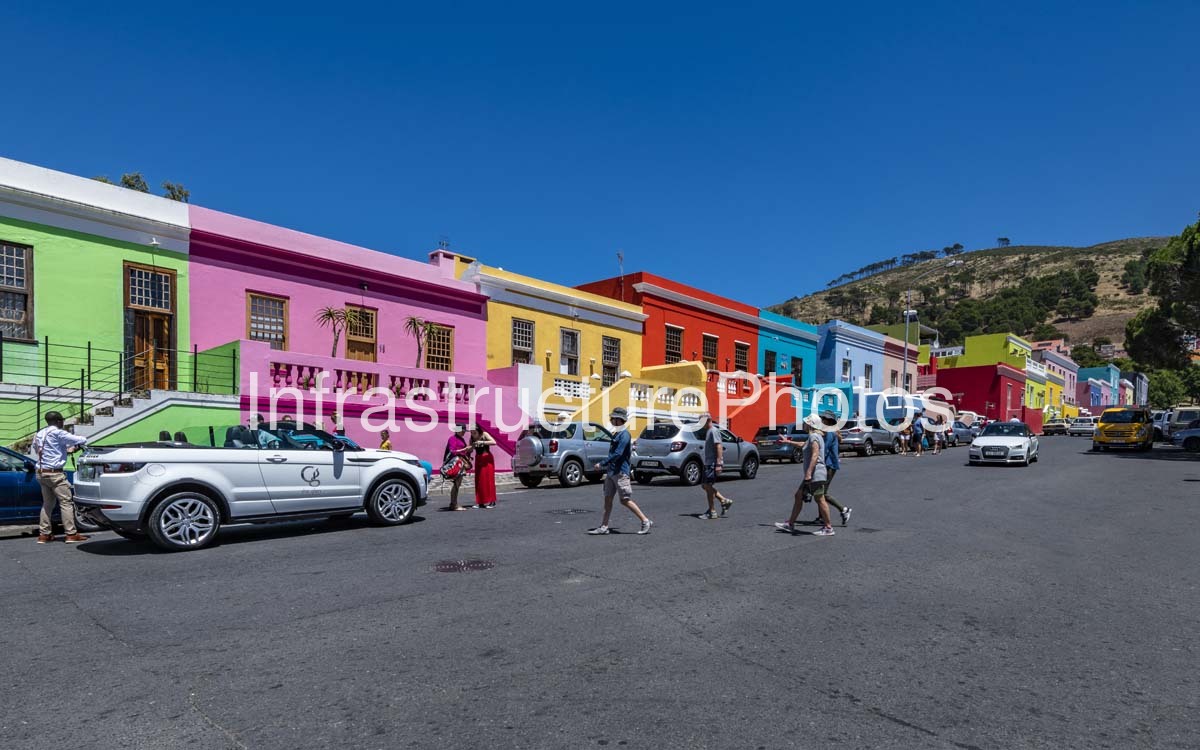
This photograph captures the vivid architectural character of Chiappini Street in the historic Bo-Kaap, Cape Town, where a continuous row of brightly painted houses forms one of the city’s most recognisable urban streetscapes. Green, pink, yellow, red, blue and turquoise façades create a striking sequence along the street, while Signal Hill rises immediately behind the neighbourhood, providing a dramatic natural backdrop. The combination of historic architecture, intense colour, pedestrian activity and the surrounding mountain landscape makes this an especially strong representation of Bo-Kaap’s distinctive identity.
Chiappini Street forms part of the historic core of the Bo-Kaap and developed as part of the neighbourhood’s expansion during the late 18th and 19th centuries. The City of Cape Town identifies Chiappini Street, together with Rose Street and parts of the surrounding street network, within the Provincial Heritage Site. Historic development in this part of the neighbourhood was characterised by compact rental houses constructed in continuous rows, creating a consistent urban scale and strong relationship between buildings and streets.
The architecture visible in the photograph reflects many of the characteristics that make the Bo-Kaap historically important. The houses are predominantly low-rise, with narrow frontages positioned close to the street and shallow raised stoeps providing a transition between private homes and the public realm. Decorative stoep walls, balustrades, evenly spaced windows, parapets and simple rectangular building forms are repeated along the row, producing a cohesive streetscape despite the individuality of each property. The City’s heritage guidelines specifically identify these raised stoeps, covered verandahs, evenly spaced openings and continuous street-facing building edges as important elements of Bo-Kaap’s architectural character.
The intense colours of the façades provide the strongest visual feature of the photograph. Although the history behind Bo-Kaap’s colourful houses is often simplified into a single explanation, the painted façades have become deeply associated with the neighbourhood and its cultural identity. The brightly coloured buildings contrast with the dark asphalt of Chiappini Street and the muted natural tones of Signal Hill, producing a highly graphic composition. The variation in colour also emphasises the individual identity of each house while the repeated scale and architectural forms maintain visual continuity across the streetscape.
Bo-Kaap’s cultural history is inseparable from its architecture. The neighbourhood developed from the 18th century and became closely associated with Cape Town’s Muslim community. Historic sources describe the area as a place where artisans, fishermen and other working-class residents lived, while its mosques, homes, streets and community spaces developed into an important centre of Cape Muslim heritage. The Bo-Kaap is also home to the Auwal Mosque, recognised as the first established mosque in South Africa.
The photograph also captures the Bo-Kaap as a functioning urban neighbourhood rather than simply a heritage setting. Tourists and pedestrians move through the street alongside parked vehicles, while the houses continue to serve residential and commercial purposes. This relationship between everyday life and heritage is central to the character of the area. The City of Cape Town has emphasised the importance of protecting the neighbourhood’s architectural and cultural heritage while allowing it to remain a living community.
Signal Hill provides a powerful backdrop, rising directly behind the colourful buildings and reinforcing the distinctive topography of the Bo-Kaap. The neighbourhood’s streets follow the contours of the lower slopes, creating a layered relationship between architecture and landscape. From this viewpoint, the brightly coloured façades form a foreground urban composition against the rugged hillside, illustrating how closely Cape Town’s built environment is connected to its surrounding natural geography.
18 MB
Reviews
There are no reviews yet.