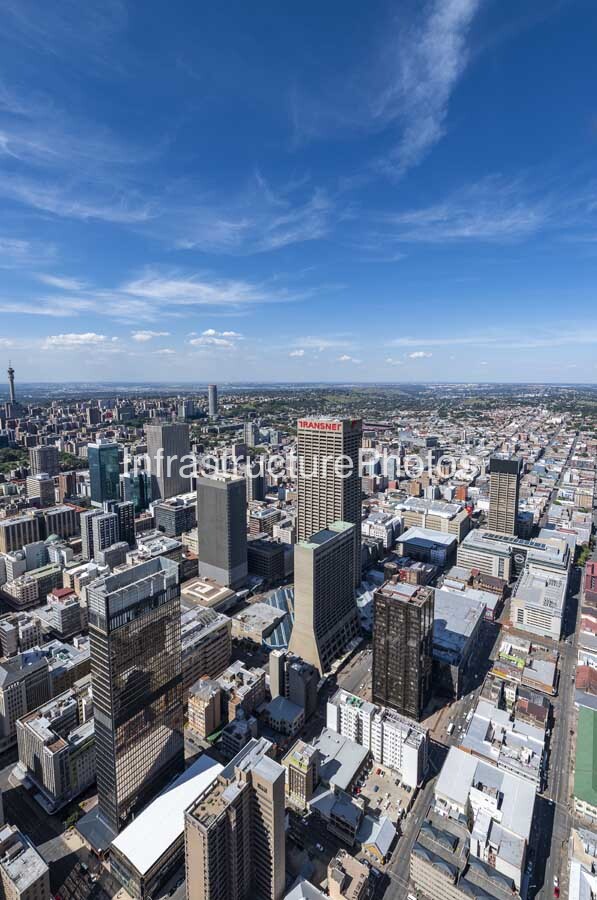
This aerial photograph captures the Carlton Centre at the heart of Johannesburg’s central business district, placing one of South Africa’s most recognisable skyscrapers within the dense urban landscape of the inner city. The distinctive tower, prominently marked with the TRANSNET logo, rises above the surrounding commercial buildings and remains one of the defining elements of the Johannesburg skyline. At 223 metres and 50 storeys, the Carlton Centre was completed in 1973 and became the tallest building in Africa, a title it retained for 46 years until 2019. It also briefly held the distinction of being the tallest building in the Southern Hemisphere.
The Carlton Centre was conceived during a period when Johannesburg was undergoing rapid commercial expansion and was intended to establish a major new centre of business, retail and hospitality within the CBD. The development was driven by Anglo American Properties and incorporated the Carlton Centre office tower, the Carlton Hotel and a substantial shopping complex. The scale of the project reflected the economic importance of Johannesburg at the time and the ambition to create a modern, internationally competitive commercial centre in the city. Construction began in 1967, with the tower opening in 1973. The architectural design is credited to the internationally renowned American practice Skidmore, Owings & Merrill (SOM), working alongside Rhodes-Harrison Hoffe and Partners in South Africa.
Architecturally, the Carlton Centre represents the modernist and International Style approach that defined many major corporate buildings of the 1960s and 1970s. Its tall rectangular form, repetitive façade and strong vertical presence were designed to communicate efficiency and permanence while maximising usable commercial floor space. The tower’s relatively restrained appearance contrasts with the more varied collection of buildings that surrounds it, making it particularly prominent in aerial views. The development also incorporated extensive underground space, connecting the office tower with the wider Carlton Centre complex and retail facilities.
The Carlton Centre’s history is closely connected with the changing fortunes of Johannesburg’s CBD. During its early decades, the complex was a major destination for business, shopping and hospitality. The Carlton Hotel, which opened in 1972, was an important five-star hotel and formed an integral part of the development. The hotel later closed in the late 1990s as the CBD experienced significant economic and social change, while corporate activity increasingly moved towards northern commercial nodes such as Sandton. The hotel is now an important historical component of the Carlton Centre story rather than an operating hotel.
The Carlton Centre was acquired by Transnet in 1999 and subsequently became associated with the state-owned transport and logistics group, whose headquarters have occupied the tower. The TRANSNET signage visible in this photograph therefore provides an important visual link between the building’s present-day identity and its role within South Africa’s transport infrastructure sector. The complex continues to incorporate commercial and retail functions, while its history and prominent position make it an important landmark in the architectural development of Johannesburg.
From this elevated perspective, the photograph illustrates the extraordinary density of the Johannesburg CBD. The Carlton Centre stands amid a mixture of modernist office towers, older commercial buildings, retail properties and smaller urban blocks. Further beyond the immediate CBD, the dense built environment gradually gives way to lower-rise residential neighbourhoods and the extensive suburban development that characterises Johannesburg. The photograph also captures the broader Highveld landscape and the exceptionally wide horizon that is characteristic of aerial views of the city.
25 MB
Reviews
There are no reviews yet.