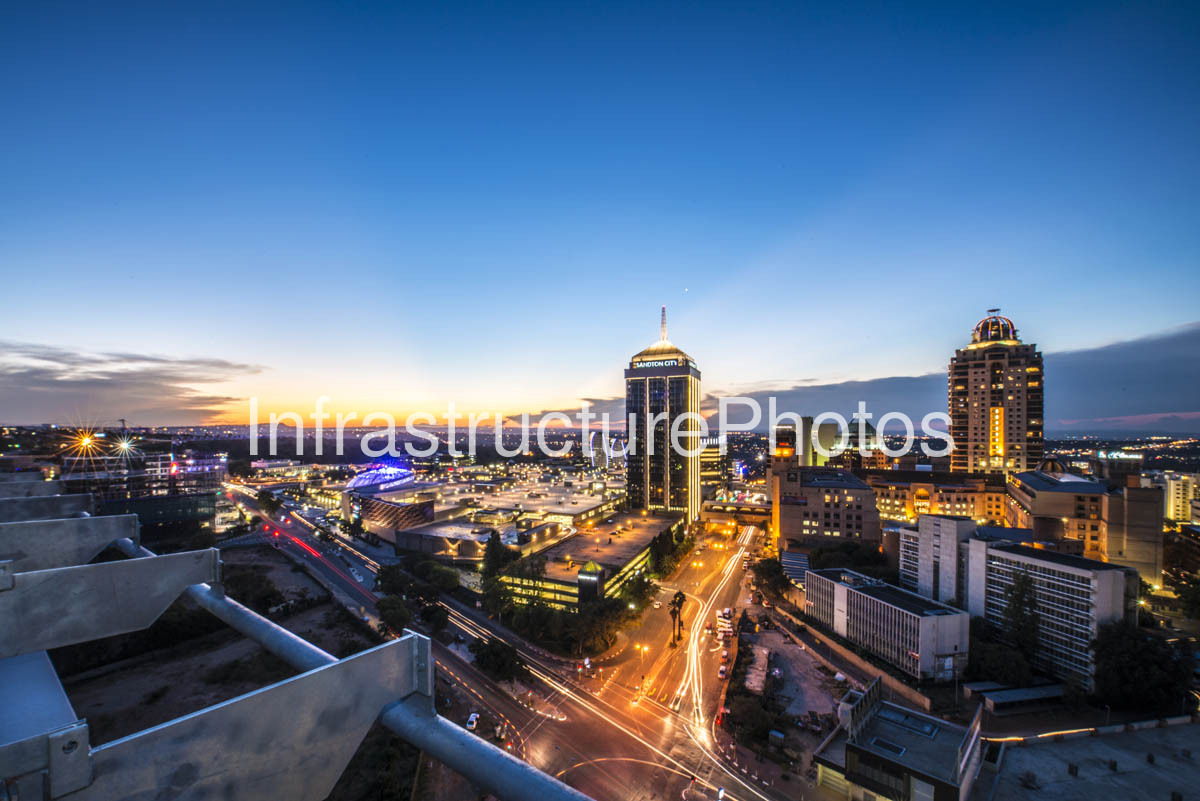
This elevated cityscape photograph captures Sandton, Johannesburg, at sunset, looking across the rapidly developing Sandton Central business district from Sandton Skye. The photograph, taken in March 2015, records an important moment in the transformation of Sandton from a decentralised commercial centre into one of Johannesburg’s most recognisable high-rise districts. The skyline is dominated by the distinctive Sandton City Office Tower and Michelangelo Towers, while the extensive Sandton City retail complex, surrounding office buildings, residential developments and busy road network create a dense metropolitan landscape below. The combination of illuminated buildings, moving traffic, the fading sunset and the expansive Highveld horizon gives the image a strong sense of both urban scale and architectural identity.
At the centre of the skyline is the Sandton City Office Tower, one of the buildings that helped establish Sandton as a major decentralised business district. Sandton City itself opened in September 1973 after being developed by Rapp and Maister, and its creation was a major catalyst for the transformation of what had previously been a largely suburban and semi-rural area. The original complex incorporated a 21-level office tower containing approximately 25,000 square metres of office space. Its development represented one of Johannesburg’s earliest major examples of decentralised office development outside the traditional central business district. (property24.com)
The Sandton City Office Tower visible in this photograph is particularly recognisable because of its distinctive illuminated crown and spire. The original concrete tower was later substantially refurbished, including the addition of its characteristic architectural cap. The wider Sandton City complex has undergone numerous expansions and upgrades since its opening, evolving from its original 50,000-square-metre shopping centre into a major mixed-use retail, hospitality and commercial destination. Sandton City describes its original development as the project that helped establish Sandton as the major commercial centre it is today. (sandtoncity.com)
To the right of the Sandton City tower is Michelangelo Towers, another defining landmark of the Sandton skyline. Completed in 2005, the high-rise development forms part of the prominent hospitality and residential precinct surrounding Nelson Mandela Square and Sandton City. Its elaborate crown and illuminated upper levels create a strong visual contrast with the more modern glazed office buildings surrounding it. In 2015, Michelangelo Towers remained one of the most prominent high-rise buildings in Sandton and was a major component of the skyline visible from Sandton Skye.
The photograph also captures Sandton during a period when a new generation of high-rise developments was beginning to reshape the skyline. Sandton Skye itself was one of the new residential projects responding to increasing demand for luxury apartments within the expanding commercial district. Other office and mixed-use developments were being constructed throughout Sandton Central, increasing the concentration of glass, steel and concrete towers around the established Sandton City precinct. This development pattern marked a significant shift from the low-density suburban character that had historically defined Sandton.
The extensive Sandton City retail complex occupies the centre of the image beneath the office tower. Its large illuminated roof structures, pedestrian areas and surrounding streets form a substantial urban footprint. Sandton City was originally developed on land that had once included horse trails and open grassland, and its success became a major catalyst for the transformation of the surrounding area. By the time this photograph was taken, the original shopping centre had become the centrepiece of a much larger commercial district containing offices, hotels, restaurants, luxury retail and high-density residential developments. (sandtoncentral.co.za)
21 MB
Reviews
There are no reviews yet.