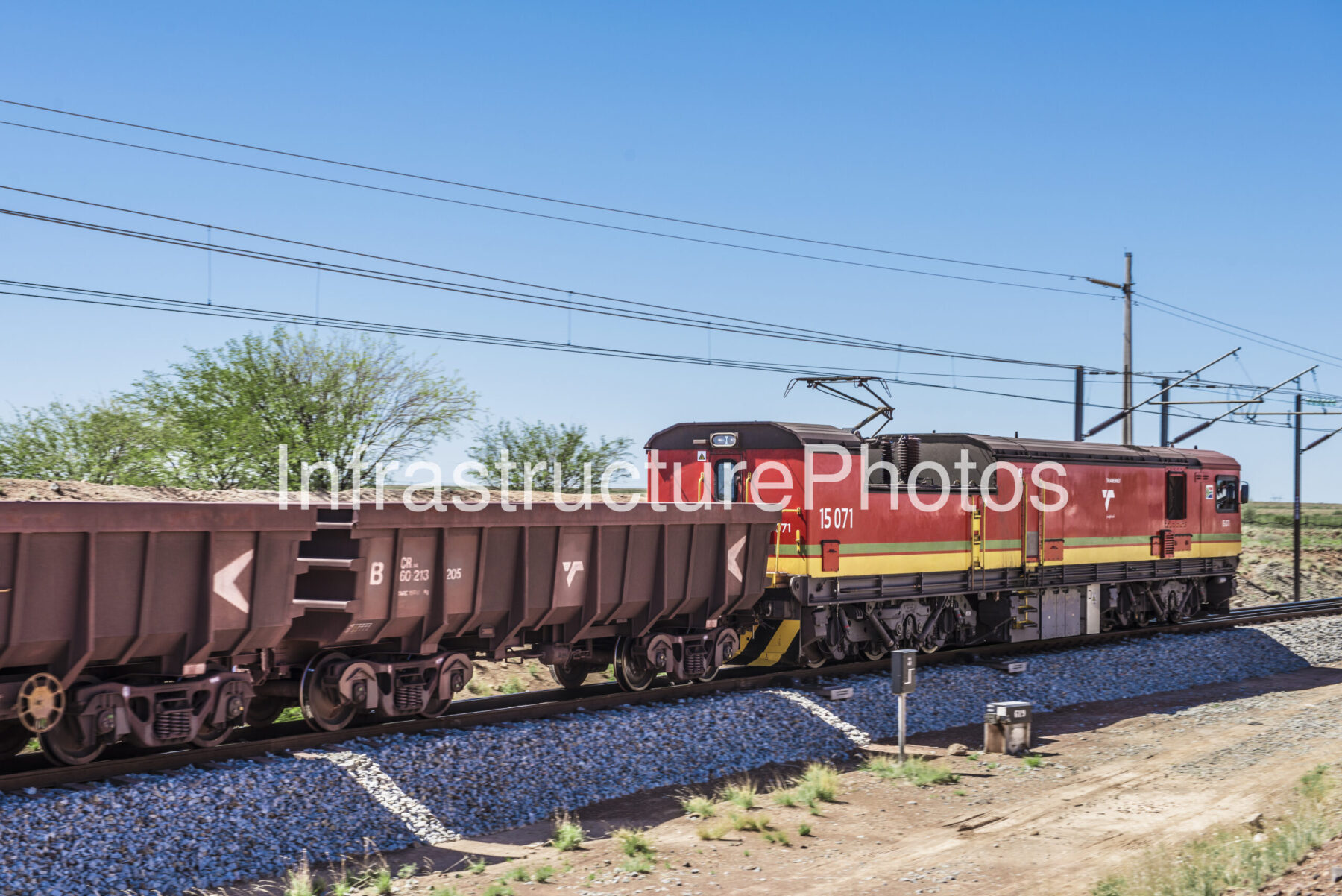
Transnet Freight Rail Class 15E locomotive 15-071 is captured hauling an iron-ore freight train across the Northern Cape on the Sishen–Saldanha Ore Line, one of South Africa’s most specialised and important freight railway corridors. The powerful red locomotive dominates the image as it moves beneath the extensive 50 kV AC overhead electrification system, with a heavy bulk-mineral wagon immediately behind it. The vast blue sky, sparse vegetation and reddish earth of the Northern Cape provide a dramatic setting for the highly engineered railway infrastructure.
Location: Sishen–Saldanha Ore Line, Northern Cape, South Africa. The 861-kilometre Orex railway connects the iron-ore mines around Sishen with the export terminal at Saldanha Bay on the Western Cape coast. The line was purpose-built for heavy-haul mineral transportation and is operated by Transnet Freight Rail. Toshiba identifies the route as an 861-kilometre railway electrified at 50 kV AC, specifically designed to support the enormous power requirements of iron-ore transportation.
Locomotive: Transnet Class 15E, number 15-071. The locomotive belongs to a fleet of 76 Class 15E electric locomotives introduced between 2010 and 2013 and numbered 15-001 to 15-076. A railway photographic record specifically identifies 15-071 as a Class 15E operating on the Sishen–Saldanha iron-ore line.
Designer and Manufacturers: The Class 15E was developed through a partnership involving Mitsui, Toshiba, DCD-Dorbyl’s RSD division and Union Carriage & Wagon (UCW). Mitsui was responsible for the design, Toshiba supplied the electrical and propulsion equipment, DCD-Dorbyl supplied major mechanical components, and UCW constructed the locomotive bodies and carried out assembly in South Africa.
Completed: 2009–2013, with the first Class 15E locomotives entering service in 2010. The final fleet comprised 76 locomotives.
The locomotive photographed here is 15-071, one of the 76 Class 15E units built for Transnet. Its six-axle Co-Co configuration provides the adhesion required to generate substantial tractive effort, while six Toshiba AC traction motors deliver a continuous rated output of approximately 4,500 kW. The locomotive weighs up to approximately 180 tonnesand has a maximum operating speed of around 90 km/h.
These specifications make the Class 15E less about speed and more about sustained pulling power. Iron-ore trains can consist of hundreds of wagons and weigh tens of thousands of tonnes. Toshiba notes that trains operating on the Orex line can extend to approximately four kilometres and contain more than 300 wagons, with multiple Class 15E locomotives positioned strategically throughout the train.
The photograph provides an excellent illustration of this heavy-haul environment. The large ore wagon in the foreground is a purpose-built bulk-mineral vehicle, its robust steel construction designed to withstand the repeated loading, transportation and unloading of iron ore. The wagon’s considerable dimensions provide a useful comparison with the locomotive itself and emphasise the enormous scale of the freight operation.
Above the train, the overhead catenary forms one of the photograph’s strongest graphic elements. Multiple electrical conductors stretch horizontally across the clear Northern Cape sky, supported by a series of substantial structures. The raised pantograph on locomotive 15-071 establishes the direct connection between the rolling stock and this electrical infrastructure. Together, the locomotive, wagon, track, ballast and catenary form a complete heavy-haul railway system.
The railway formation is equally significant. The deep layer of crushed stone ballast provides a stable foundation for the rails while allowing drainage and helping maintain the geometry of the track under the enormous loads imposed by heavy mineral trains. The carefully maintained track formation contrasts with the dry, comparatively undeveloped landscape surrounding it, clearly demonstrating the scale of engineering required to create a high-capacity freight corridor across this part of South Africa.
The landscape itself is an important part of the image. The Sishen region is characterised by a dry climate, open terrain and sparse vegetation, with the railway crossing long stretches of relatively remote country. The green trees visible behind the locomotive provide a subtle contrast with the reddish soil and pale railway formation. Above everything, the expansive blue sky reinforces the sense of distance and openness associated with the Northern Cape.
19 MB
Reviews
There are no reviews yet.