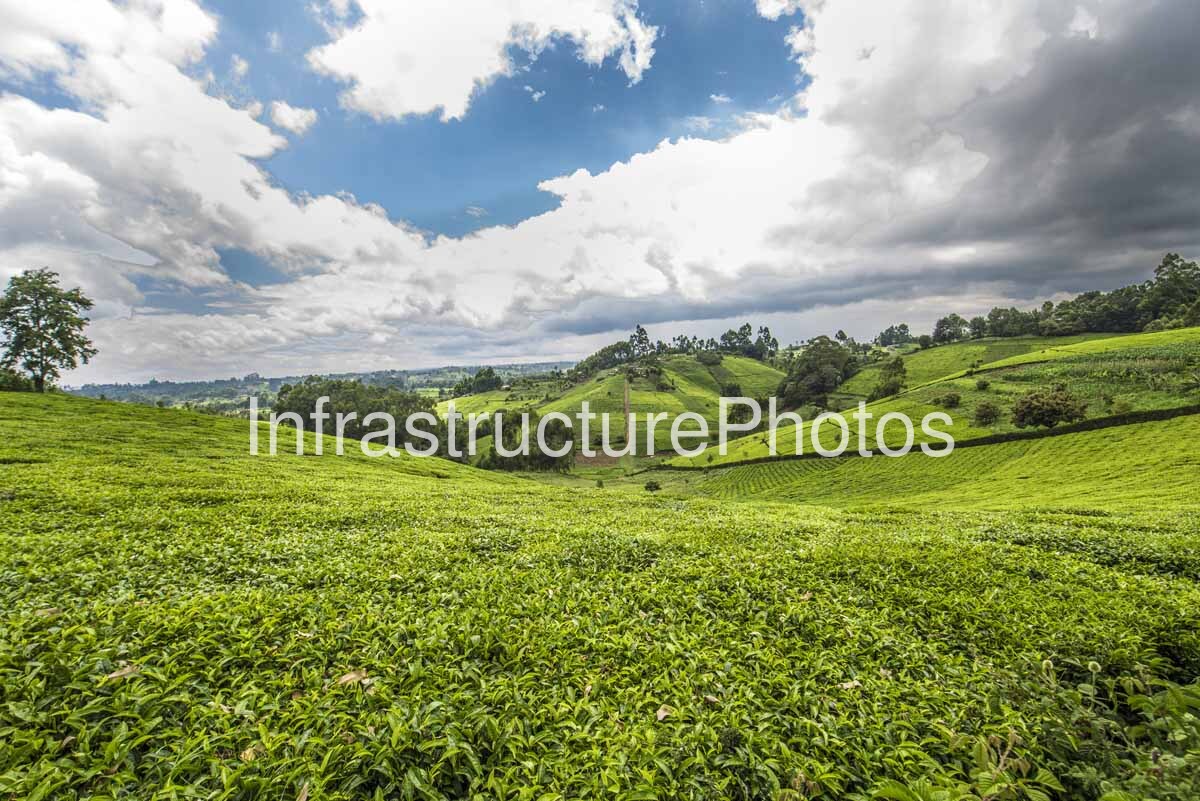
This photograph captures the lush landscape of a tea-growing region in Kenya, where meticulously cultivated tea fields spread across rolling green hills beneath a dramatic sky. The image highlights the distinctive agricultural landscape created by Kenya’s tea industry, combining dense rows of tea bushes, carefully managed planting patterns, mature trees and undulating highland terrain.
Kenya’s tea-growing areas are concentrated in the highlands on both sides of the Rift Valley, across 19 counties. Major tea-producing areas include Kericho, Bomet, Nandi, Kisii, Nyamira, Kiambu, Murang’a, Nyeri and Meru, among others. The West of the Rift region is particularly characterised by the rolling hills and expansive agricultural landscapes associated with areas such as Kericho and Nandi.
The foreground is dominated by a dense field of Camellia sinensis, the tea plant cultivated for commercial tea production. The closely spaced bushes form a continuous green carpet across the terrain, with the uniformity of the planting creating strong horizontal and diagonal patterns across the image. Tea bushes are regularly pruned and harvested to maintain the growth of young shoots and leaves used in tea production.
Behind the foreground plantation, the hillside rises gently and reveals a different stage of agricultural cultivation. Rows of young trees and carefully arranged planting lines follow the contours of the land, creating an intricate geometric pattern across the bright green slope. The combination of cultivated vegetation and naturally occurring mature trees gives the landscape a distinctive balance between agricultural production and the surrounding highland environment.
The topography is particularly important to Kenya’s tea-growing landscape. Tea is cultivated in highland areas generally between approximately 1,500 and 2,700 metres above sea level, where the combination of altitude, rainfall, temperatures and soils creates favourable conditions for production. Kenya’s tea-growing regions are also associated with well-distributed rainfall and fertile volcanic soils.
The landscape shown here is especially representative of western Kenya’s tea-growing belt, where Kericho, Bomet and Nandi are among the country’s major tea-producing counties. Production statistics have consistently identified these areas as significant contributors to Kenya’s tea industry.
The mature trees surrounding the plantation are an important visual component of the photograph. Tall eucalyptus and other trees rise above the tea fields and create vertical elements against the predominantly horizontal agricultural landscape. They also provide a sense of scale, demonstrating the extensive size of the cultivated slopes.
The dramatic cloud formations add another dimension to the image. Dark, moisture-laden clouds contrast strongly with the vivid green vegetation, reflecting the highland environment in which tea is cultivated. The changing weather conditions of Kenya’s tea-growing regions are closely linked to agricultural productivity, with rainfall playing an important role in maintaining tea growth throughout the year. Recent Tea Board of Kenya reports, for example, have highlighted the influence of rainfall and temperature variations on production across both the East and West of Rift tea-growing regions.
Tea is one of Kenya’s most important agricultural products and has significant economic importance for the country. The industry incorporates both large-scale estate plantations and smallholder production, with smallholders accounting for a substantial share of national tea production. Kenya’s tea industry therefore encompasses a wide variety of agricultural landscapes, from extensive commercial estates to smaller farms integrated into rural communities.
The origins of commercial tea cultivation in Kenya date back to the early twentieth century. The first tea seedlings were introduced experimentally at Limuru in 1903, while commercial cultivation began in 1924. Tea cultivation subsequently expanded into the highland regions that now form the country’s major tea-producing areas.
This photograph is particularly effective as a record of agricultural infrastructure and landscape. Unlike conventional images of industrial facilities or urban development, it documents the productive landscape that forms the foundation of an important national industry. The carefully maintained fields demonstrate how agriculture can shape entire regions, transforming naturally hilly terrain into highly organised patterns of cultivation.
The photograph also illustrates the visual relationship between agriculture and the natural environment. The tea fields follow the contours of the landscape rather than creating a completely flat agricultural surface. Hills, valleys, mature trees and cultivated slopes combine to create a layered composition that is characteristic of Kenya’s highland tea country.
From an aerial and landscape photography perspective, tea plantations offer particularly strong visual patterns. The repetitive rows of tea bushes create texture across the foreground, while the hillside plantations introduce diagonal lines and varying elevations. The trees provide vertical contrast, and the dramatic sky completes the composition.
26 MB
Reviews
There are no reviews yet.