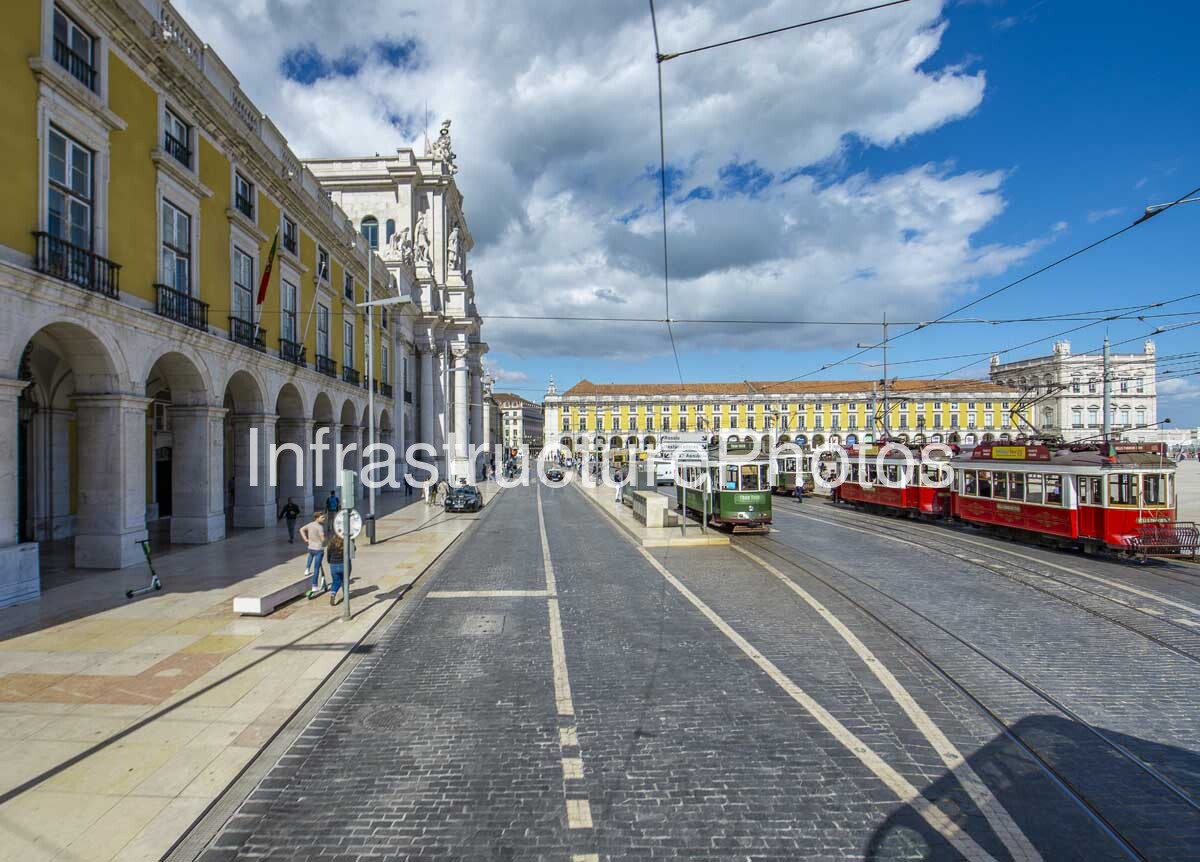
Praça do Comércio, one of Lisbon’s most recognisable urban spaces, is captured in this street-level architectural photograph showing the monumental Pombaline ensemble, traditional Lisbon trams and the distinctive granite-and-cobblestone streets of the Baixa district. Also historically known as Terreiro do Paço, the square occupies the site of the former Ribeira Palace, which stood beside the Tagus River until the catastrophic Lisbon earthquake of 1755 destroyed much of the royal complex and devastated the surrounding city. The reconstruction that followed transformed this part of Lisbon into a rational, highly ordered urban district, with Praça do Comércio becoming one of the defining spaces of the new city.
The photograph looks across the square towards the long yellow façades of the eastern side, while the monumental arcades of the western side dominate the foreground. The repeated stone arches create a strong rhythm along the pavement, contrasting with the tall yellow façades, white stone surrounds, wrought-iron balconies and classical detailing above. The architecture reflects the disciplined character of Pombaline Lisbon, where structural rationality, symmetry and repetition were combined with restrained classical ornament. The buildings surrounding the square form a large U-shaped composition that opens towards the Tagus, creating a powerful relationship between architecture, public space and the river.
The reconstruction of Praça do Comércio was undertaken as part of the rebuilding of Lisbon following the 1755 earthquake and was coordinated within the broader plans associated with the Marquis of Pombal. Architect Eugénio dos Santos played a central role in the reconstruction, with Carlos Mardel also associated with the design of the surrounding buildings and their uniform façades. The result was an exceptionally coherent urban composition based on repeated architectural elements and a carefully controlled street plan. The principal construction dates from the second half of the 18th century, with major portions of the square established during the 1750s and 1760s. Later architectural work continued into the 19th century, most notably the completion of the monumental Arco da Rua Augusta in 1873.
The architectural style can be described as Pombaline, incorporating Neoclassical principles and the practical architectural innovations developed during Lisbon’s post-earthquake reconstruction. The surrounding buildings were designed as coordinated blocks rather than isolated structures, producing a unified architectural environment. Their ground-floor arcades provided sheltered pedestrian routes and commercial spaces, while the upper floors incorporated regular windows and balconies. The two lateral wings terminate in prominent towers, recalling the monumental character of the former royal palace that once occupied the site.
The square has historically served a mixture of governmental, commercial and civic functions. Its buildings housed ministries and public institutions for many decades, while parts of the complex have also accommodated restaurants, cafés, hotels, cultural activities and tourism-related uses. The famous Martinho da Arcada café occupies one of the surrounding Pombaline buildings and has strong connections with Lisbon’s literary and artistic history, including Fernando Pessoa.
A particularly striking feature of this image is the integration of Lisbon’s historic tram network into the architectural setting. The red and green trams, overhead electrical wires and multiple tracks introduce a layer of active urban infrastructure into an otherwise monumental historic environment. The tramway is not simply a transport feature; it has become an important visual component of Lisbon’s identity, linking the historic architecture of the Baixa with the living, functioning city. The dark stone paving and carefully defined tram tracks further reinforce the perspective lines leading into the square.
The yellow façades visible across Praça do Comércio are another defining characteristic of the space. Although the buildings were painted pink following the 1910 Portuguese Revolution, they have since returned to a yellow colour associated with their earlier appearance. The combination of yellow rendered walls, white limestone detailing, arcaded walkways and traditional trams gives the square a distinctive visual character that has become synonymous with central Lisbon.
16 MB
Reviews
There are no reviews yet.