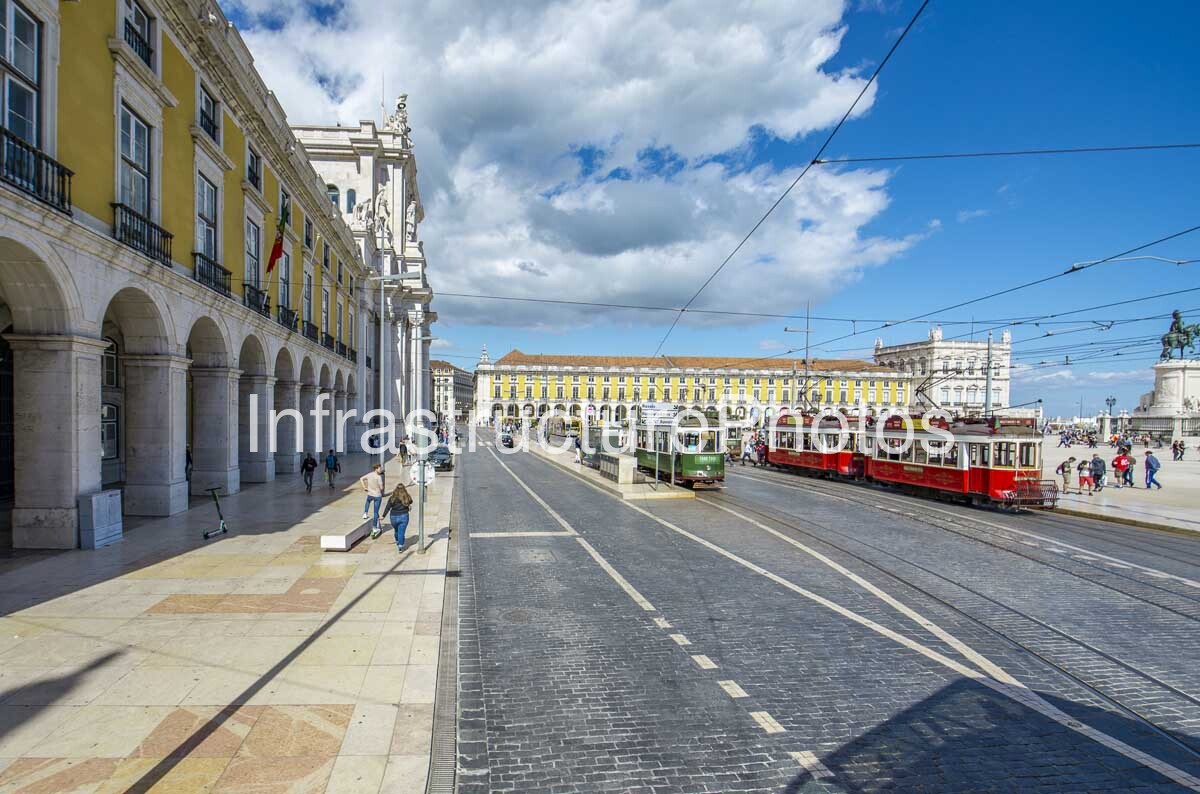
Praça do Comércio, also known historically as Terreiro do Paço, is one of the defining urban spaces of Lisbon and the monumental centrepiece of the city’s post-1755 reconstruction. Opening directly onto the River Tagus, the vast square was conceived as both a ceremonial gateway to the rebuilt capital and a powerful expression of royal and commercial authority. This photograph captures the eastern side of the square, looking across its broad transport corridor towards the long yellow façades of the Pombaline buildings and the waterfront, with Lisbon’s historic electric trams occupying the foreground.
The present Praça do Comércio replaced the former Terreiro do Paço, the site of the Royal Palace of Ribeira, which stood beside the Tagus before the catastrophic 1755 Lisbon earthquake and subsequent tsunami and fires destroyed much of the surrounding Baixa. The rebuilding of Lisbon was directed under the authority of the Marquês de Pombal, with a team of architects and engineers developing an exceptionally rational urban plan. Manuel da Maia, Eugénio dos Santos and later Carlos Mardel were central figures in the reconstruction programme. The new Praça do Comércio became one of its most ambitious components, deliberately opening the city towards the river.
Eugénio dos Santos developed the principal plan for the new square, which was subsequently continued by Carlos Mardel following Santos’s death. The design established a remarkably disciplined geometric composition, with three sides enclosed by monumental buildings and the fourth opening towards the Tagus. The arrangement reflected Enlightenment ideas about order, proportion, circulation and the relationship between architecture and public space. Lisbon’s reconstructed Baixa was organised around a rectilinear street grid, with Praça do Comércio functioning as its monumental riverside threshold.
The architecture surrounding the square is characteristic of the Pombaline style, one of the most important contributions of 18th-century Portuguese urban architecture. The buildings are organised into regular façades with repeated windows, balconies and arcaded ground floors. The arcades provide continuous sheltered pedestrian circulation around the square and create a strong architectural rhythm. In the photograph, the long sequence of arches along the building on the left is particularly prominent, demonstrating how the architecture integrates public movement directly into the building fabric.
The Pombaline buildings were not designed merely as decorative façades. Their construction incorporated innovative approaches to earthquake resilience, including structural systems intended to reduce the vulnerability of buildings to seismic forces. The regularity of the façades and repetition of structural components also allowed large sections of the rebuilt city to be constructed efficiently following the destruction of 1755.
At the centre of the square stands the Equestrian Statue of King José I, one of Lisbon’s most important public monuments. Designed by sculptor Joaquim Machado de Castro, the bronze statue was inaugurated in 1775, commemorating the monarch whose reign coincided with the reconstruction of Lisbon. The king is depicted on horseback, while the sculptural composition incorporates allegorical elements representing Portugal’s power and the rebuilding of the city. The statue was deliberately positioned as the visual focus of the square, reinforcing its original role as a monumental royal space.
The square’s transformation from Terreiro do Paço to Praça do Comércio was symbolic. The former name emphasised the royal palace that once occupied the waterfront, while the new name celebrated commerce and the economic importance of Lisbon. The rebuilt square consequently represented not only the restoration of the capital after the earthquake but also the growing importance of merchants and commercial activity in the city’s economic life. Lisbon’s municipality describes it as the most emblematic space of the Pombaline reconstruction.
18 MB
Reviews
There are no reviews yet.