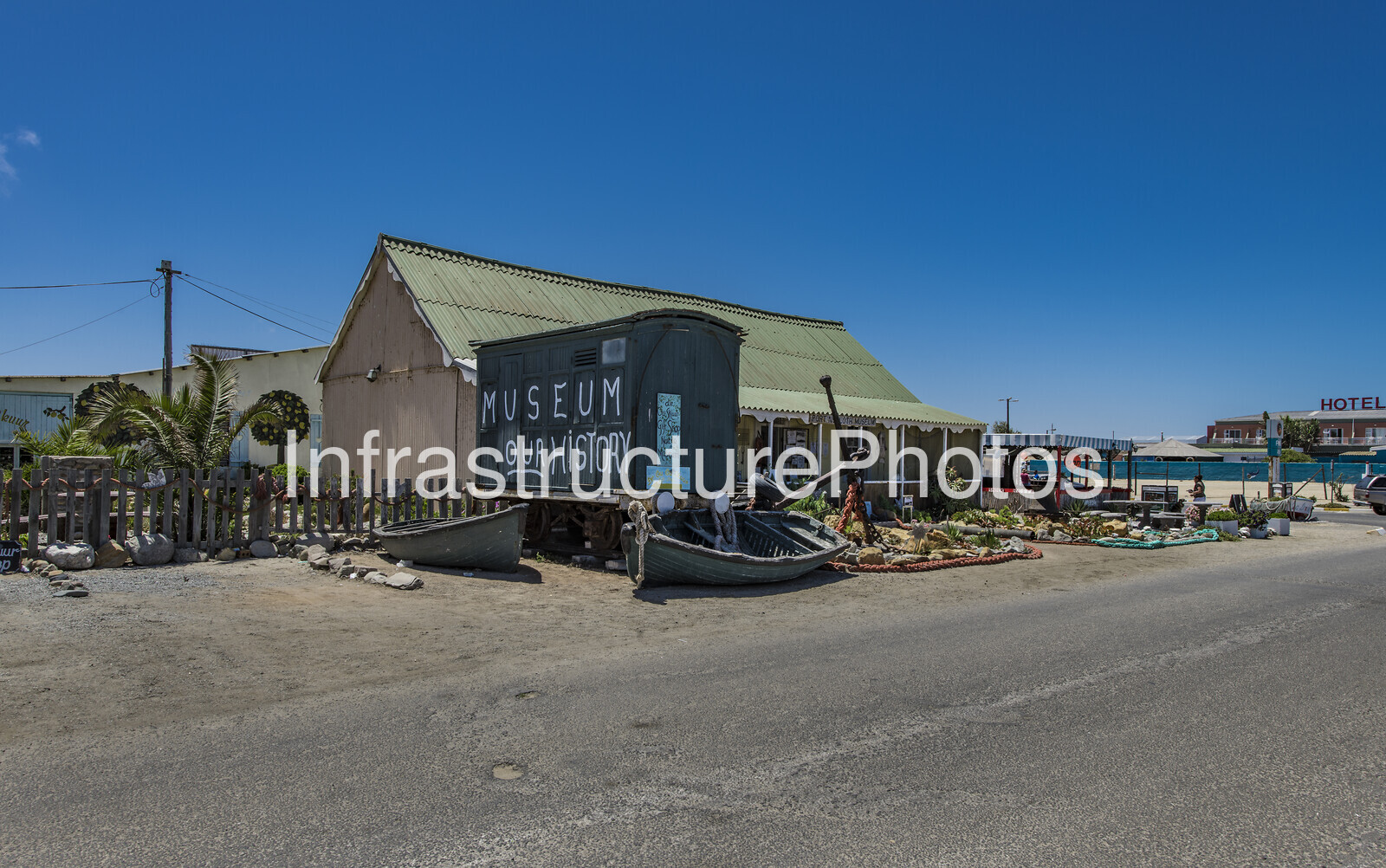
The Port Nolloth Museum stands as a tangible reminder of the extraordinary industrial, maritime and cultural history of this remote Northern Cape coastal town. Built around 1880, the modest building reflects the practical vernacular architecture of Port Nolloth, with its simple gabled form, corrugated-metal roof and weathered exterior shaped by the harsh Atlantic environment. The building was transformed into a museum in the 2000s, creating a home for a remarkable collection documenting the town and surrounding Namaqualand.
Port Nolloth itself has a history that stretches far beyond its present-day identity as a quiet fishing settlement. Originally known as Aukwatowa Bay, the location was selected as a harbour following the discovery of copper at Okiep in 1852. The development of Port Nolloth was driven largely by the need to transport copper ore from the interior to the coast, turning the settlement into an important link in the mining and transportation network of 19th-century Namaqualand. South African History Online
By the late 19th century, Port Nolloth had developed into a busy mining port. A jetty, wharfage, stores, moorings and navigational infrastructure supported the movement of copper ore and the arrival of supplies. By 1882, the settlement had grown to approximately 2,000 inhabitants, an extraordinary transformation for such an isolated stretch of the Atlantic coast.
The museum’s collections reflect the many chapters of this history. Photographs and artefacts document the copper-export era, while later material records Port Nolloth’s diamond-mining period. The discovery of alluvial diamonds in 1926 revived the town after the decline of the copper industry, while fishing subsequently became another important part of the local economy.
The building’s surroundings make this photograph particularly evocative. Traditional fishing boats sit directly outside the museum, linking the physical structure to the maritime culture that continues to define Port Nolloth. Objects associated with fishing, mining, shipping, shipwrecks and everyday life help tell a much broader story of a community shaped by its relationship with the sea.
The museum collection has included porcelain recovered from shipwrecks, historic medicine bottles, a Nama Bible, Khoi clay-pot fragments, ostrich-shell fragments and other artefacts reflecting the indigenous, maritime and colonial histories of the region.
The image captures more than an old building: it records a distinctive piece of South Africa’s industrial and coastal heritage. The combination of the weathered museum, fishing boats, harbour environment and stark West Coast landscape illustrates how architecture can preserve the memory of places whose economic importance has changed dramatically over time.
Professional high-resolution infrastructure photograph available for commercial licensing. This image is suitable for editorial, architectural, construction, infrastructure, commercial, city planning, property development, urban documentation, marketing, publishing and corporate use. The downloadable file provides a high-quality version for professional applications. Buyers can use this licensed image in accordance with the store licence terms after purchase.
Original upload size: 24.66 MB
Reviews
There are no reviews yet.