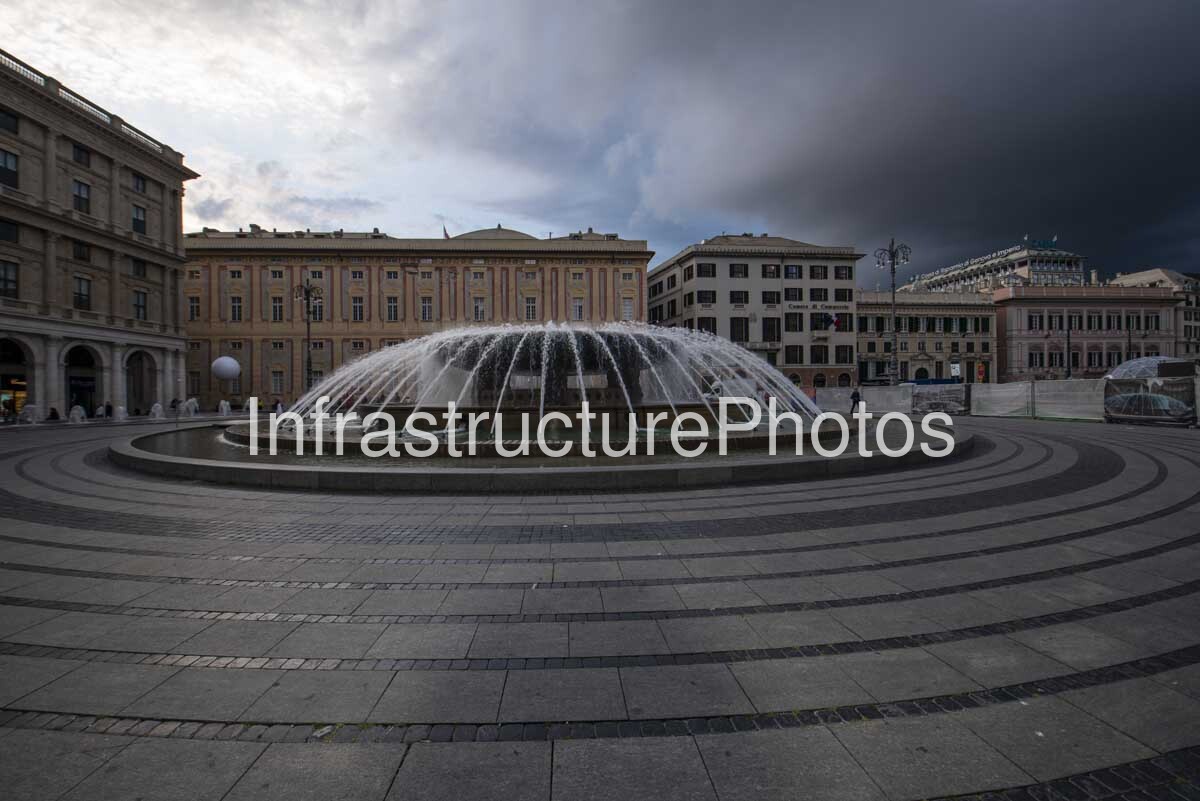
Piazza De Ferrari is the principal public square and symbolic heart of Genoa, Italy, bringing together some of the city’s most important historic, civic, cultural and commercial buildings around its monumental central fountain. This photograph captures the fountain from the southern side of the square, looking across its broad circular basin towards the historic buildings that define the northern and eastern edges of the piazza. The dramatic storm clouds, subdued evening light and sweeping concentric paving patterns create a particularly atmospheric architectural view of one of Liguria’s most recognisable urban spaces. Piazza De Ferrari is not simply a square but an important meeting point between Genoa’s medieval historic centre and the more formally planned commercial city that developed during the nineteenth and early twentieth centuries.
The Location is Piazza De Ferrari, Genoa, Liguria, Italy. The square takes its name from Raffaele De Ferrari, Duke of Galliera, a Genoese banker and philanthropist who contributed significantly to the expansion of the city’s port. Its present form emerged through a series of major urban interventions that transformed the area around the former San Domenico convent and created new streets connecting the historic centre with the expanding modern city. Among the most important of these new routes were Via XX Settembre, Via Dante and Via Petrarca. The resulting Piazza De Ferrari became a major urban crossroads and one of Genoa’s principal civic spaces.
The central feature of the photograph is the famous Piazza De Ferrari Fountain. Designed by architect Giuseppe Crosa di Vergagni, the monumental bronze fountain was inaugurated on 24 May 1936 and soon became one of the defining symbols of Genoa. The fountain was donated by the Piaggio family and was conceived as the central architectural and visual focus of the newly formalised square. Its broad circular basin and numerous jets create a dramatic dome of water, while the surrounding paving reinforces the geometry through a series of concentric bands.
The fountain’s design is particularly successful because it operates simultaneously as sculpture, infrastructure and public-space architecture. Water rises from the central and surrounding jets before cascading back into the broad basin, creating constant movement within an otherwise monumental stone environment. The fountain has undergone several interventions over the decades, including the addition of supplementary water features and improvements to its hydraulic systems. During the redevelopment of Piazza De Ferrari, the surrounding public realm was substantially repaved and additional fountains were introduced around the original structure.
The square surrounding the fountain is equally important to the character of the image. The paving consists of large stone slabs combined with darker bands of smaller paving blocks, producing a series of sweeping concentric curves around the fountain. These patterns visually extend the circular geometry of the water feature deep into the foreground. The result is an unusually strong relationship between architecture, landscape design and public infrastructure. The almost entirely pedestrian character of the central square allows the fountain and surrounding buildings to dominate the visual field, although selected roads and public transport routes continue around its perimeter.
20 MB
Reviews
There are no reviews yet.