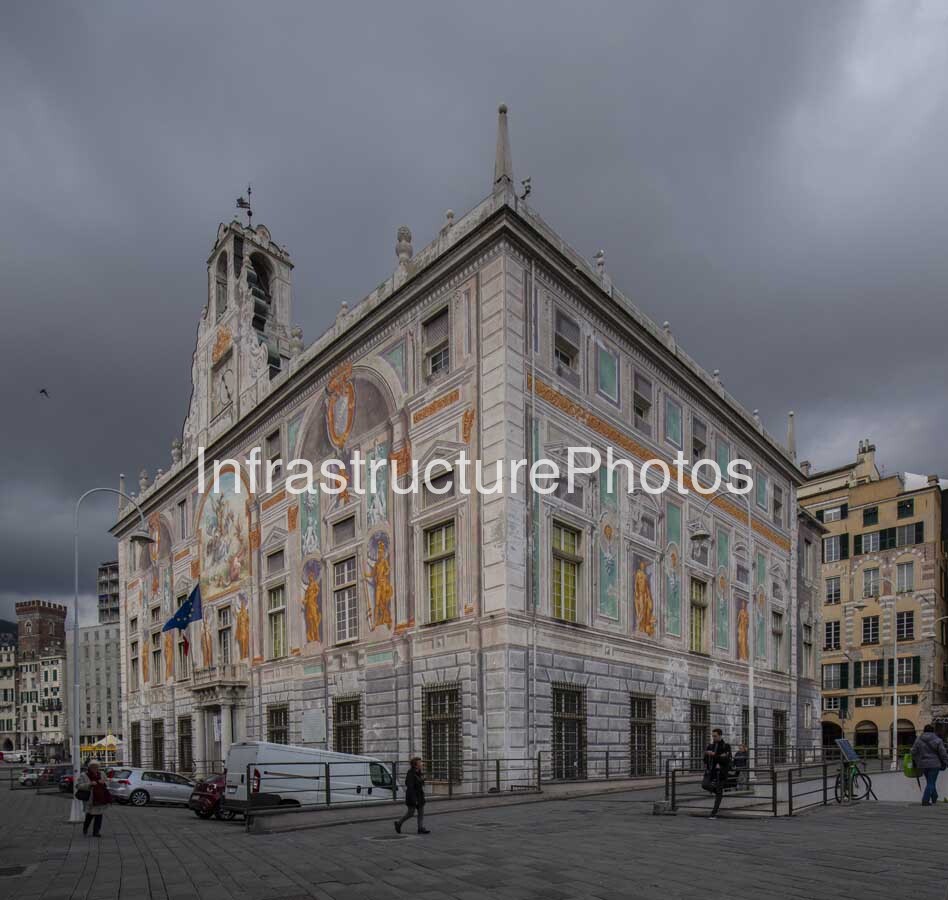
Palazzo San Giorgio is one of Genoa’s most historically significant civic and maritime buildings, occupying a prominent position between the historic city centre and the Porto Antico. This photograph captures the Renaissance wing of the palace from Via della Mercanzia, highlighting its remarkable painted façade, corner tower and elaborate architectural decoration beneath a dramatic Genoese sky. The building’s richly coloured frescoes, geometric patterns, simulated stonework and allegorical figures contrast strongly with the surrounding historic urban fabric, making it one of the most distinctive architectural landmarks of the old port.
The origins of Palazzo San Giorgio date to the mid-thirteenth century, when Guglielmo Boccanegra, Captain of the People of Genoa, commissioned a new public palace close to the harbour. Construction was entrusted to Friar Oliverio, a Cistercian monk with considerable technical and construction expertise who had previously directed works on the Molo Vecchio. The palace was built between 1257 and 1260 on land created by covering the mouth of the Suziglia stream. Its location was highly strategic, placing the city’s civic administration directly beside the principal commercial and maritime activities of the port.
The original building was one of Genoa’s earliest purpose-built public palaces, establishing a separate seat of civic authority away from the religious power centred on the Cathedral of San Lorenzo. Its role changed considerably over the centuries. After briefly serving as a public palace, it became associated with customs and later with the Casa delle Compere e dei Banchi di San Giorgio, commonly known as the Bank of Saint George. The institution became one of the most powerful financial organisations in medieval and Renaissance Genoa, managing public finances and taxation and playing an important role in the economic administration of the Republic.
The palace underwent a major transformation during the sixteenth century. From around 1570, the building was enlarged towards the sea and acquired the Renaissance wing that gives the complex much of its present character. This extension created a more compact and monumental building with façades decorated in the elaborate Genoese Renaissance manner. The maritime-facing and harbour-facing elevations were subsequently covered with extensive fresco decoration, transforming the building into an architectural statement of Genoa’s wealth, commercial power and maritime influence.
The façade visible in this photograph is particularly notable for its painted imitation of stone architecture. The surface is divided into rusticated blocks, pilasters, geometric panels, decorative bands and framed scenes, creating the impression of a richly carved marble building while much of the effect is achieved through painted architectural illusion. Figures, allegories and heraldic elements occupy the panels between the windows, producing an unusually colourful exterior for a major civic building.
The decorative programme has undergone several stages of restoration. At the beginning of the seventeenth century, Lazzaro Tavarone was commissioned to redecorate the sea-facing façade, replacing an earlier cycle by Andrea Semino. Tavarone’s work, completed between 1606 and 1608, included representations of important figures and symbols associated with Genoa’s maritime history, including Saint George and the Dragon, Neptune, Andrea Doria, Simon Boccanegra, Christopher Columbus and other historical figures.
Much of what is visible today also reflects later conservation and reconstruction. In 1912, Lodovico Pogliaghi repainted the façade decoration as part of restoration work commissioned by the Autonomous Port Consortium. The painted surfaces were subsequently restored by Raimondo Sirotti in 1992 during the Columbus celebrations. These successive interventions explain why Palazzo San Giorgio should not be understood simply as a perfectly preserved medieval or Renaissance façade; rather, it is a historic building whose appearance has been repeatedly reconstructed and interpreted while retaining its historical iconography.
14 MB
Reviews
There are no reviews yet.