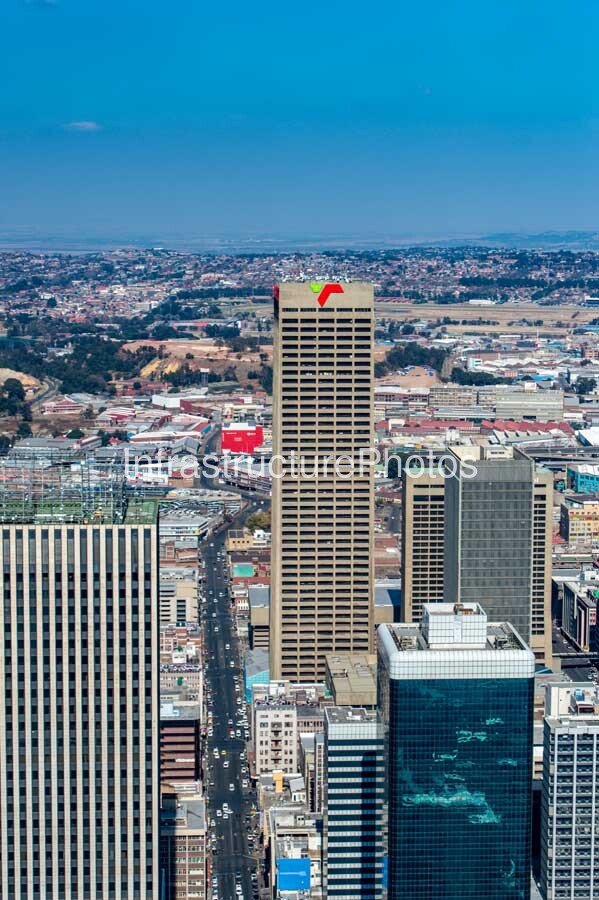
The Carlton Centre is one of Johannesburg’s most recognisable architectural landmarks and a defining feature of the city’s central business district skyline. Located on Commissioner Street in Johannesburg CBD, the 50-storey skyscraper forms part of a major mixed-use complex that historically combined offices, retail, hospitality and underground shopping. Rising approximately 223 metres above the city, the Carlton Centre was completed in 1973 and remained the tallest building in Africa for 46 years, until 2019.
Designed by the internationally renowned American architectural practice Skidmore, Owings & Merrill (SOM) in association with the Johannesburg practice W. Rhodes-Harrison Hoffe & Partners, the Carlton Centre represents an important chapter in the development of modern high-rise architecture in South Africa. Its construction reflected Johannesburg’s position as the country’s principal commercial and financial centre during the second half of the twentieth century, when increasing economic activity and corporate expansion were driving the city towards a more intensely vertical urban form.
The Carlton Centre was conceived as considerably more than a single office tower. The development was planned as a large-scale urban complex incorporating the 50-storey office tower, a 30-storey hotel, retail accommodation, extensive underground shopping, parking and public spaces. The Carlton Centre and the former Carlton Hotel were connected through the underground commercial complex, creating an integrated destination within the Johannesburg CBD.
Architecturally, the Carlton Centre is firmly rooted in Modernist and International Style skyscraper design. Its restrained exterior is characterised by strong vertical proportions, repetitive horizontal window bands and a carefully controlled rectangular form. Rather than relying on decorative architectural elements, the building derives its visual authority from scale, repetition and proportion. The tower rises prominently above the surrounding buildings, making it an especially important reference point when viewing Johannesburg from the air or from other high-rise buildings.
This aerial photograph places the Carlton Centre within the extraordinarily dense urban environment of Johannesburg. The surrounding city is composed of a mixture of high-rise commercial buildings, older office blocks, retail buildings, industrial structures and tightly packed streets. The image demonstrates the dramatic contrast between the vertical scale of Johannesburg’s landmark towers and the much lower buildings that form the majority of the CBD.
The broader urban landscape visible around the Carlton Centre is equally significant. Beyond the immediate commercial core, Johannesburg spreads across a vast landscape of residential neighbourhoods and suburban development. The elevated viewpoint provides a powerful sense of the city’s geographical scale, showing how the dense CBD forms one concentrated component within the much larger Johannesburg metropolitan area.
The Carlton Centre’s historical importance extends beyond its architecture. At 223 metres and 50 storeys, it became the tallest building in Africa when completed in 1973 and retained that distinction until 2019, when Johannesburg’s The Leonardo surpassed it. It also held the distinction of being the tallest building in the Southern Hemisphere from its completion until 1977.
This record-breaking height established the Carlton Centre as an international symbol of Johannesburg. During the height of the city’s twentieth-century economic expansion, the tower represented technological confidence, corporate growth and the emergence of Johannesburg as a major African business centre. Its silhouette became synonymous with the Johannesburg skyline and remains one of the most recognisable architectural images associated with the city.
The building also has an important connection with the Top of Africa, the viewing experience historically associated with the uppermost levels of the tower. From the 50th floor, visitors have historically been able to obtain expansive views across Johannesburg and its surrounding suburbs. The observation experience has contributed significantly to the Carlton Centre’s status as both an architectural landmark and a visitor attraction.
The Carlton Centre’s position within Johannesburg’s eastern CBD is also significant. The surrounding streets form part of the historic structure of the central business district, where buildings from different periods sit alongside one another. Consequently, the Carlton Centre provides an architectural reference point for understanding the transformation of Johannesburg from a low-rise nineteenth-century mining settlement into a modern high-rise metropolis.
The scale of the original development was remarkable for its time. The project involved substantial underground construction, with a large portion of the complex located below street level. The extensive underground shopping centre and parking infrastructure demonstrated an ambitious approach to integrating commercial activity, transportation and pedestrian movement within a single development.
The Carlton Centre therefore represents an important example of large-scale integrated urban development. Its combination of offices, retail, hospitality and public circulation anticipated many of the mixed-use commercial developments that would become increasingly common in major cities around the world.
The Carlton Centre remains one of the defining buildings of Johannesburg and one of the most historically significant skyscrapers in South Africa. Its Modernist architecture, exceptional height, mixed-use origins and long-standing association with the Johannesburg skyline ensure its continuing importance as a subject for architectural, commercial-property, infrastructure and urban photography.
32 MB
Reviews
There are no reviews yet.