
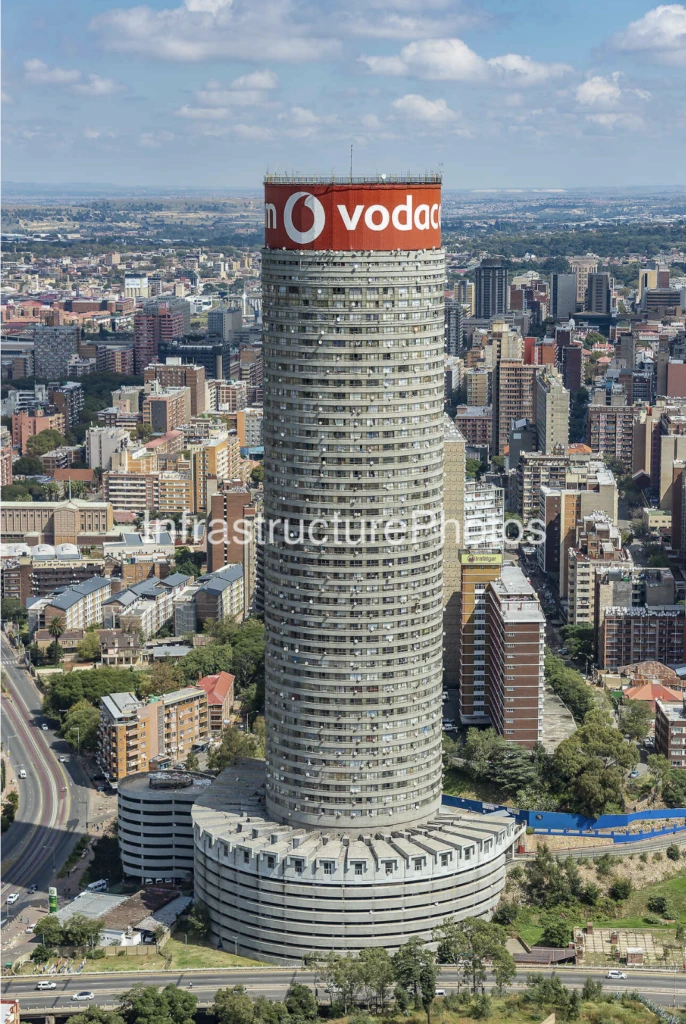
Seen from a helicopter, Ponte City is one of the few buildings that can make an entire city look small. The grey ribbed cylinder rises 173 metres above Berea, wearing a bright red crown and standing on a round concrete base. Around it, the brick and plaster blocks of Hillbrow, Berea and Yeoville run out to the edge of the Highveld.
When it opened in 1975, Ponte was the tallest residential building in Africa, and it kept that title for 48 years. Its life since has been a story of luxury, collapse and recovery, and it remains Johannesburg’s most recognisable skyline landmark. This is the story behind the tower in our photograph.
A cylinder with a hole in the middle
Ponte was designed by Mannie Feldman’s team with Manfred Hermer and a 29-year-old Rodney Grosskopff. They took inspiration from Bertrand Goldberg’s round Marina City towers in Chicago. The building’s most unusual feature came from a building bylaw: kitchens and bathrooms needed windows. Grosskopff’s answer was to hollow out the cylinder, so every flat has an outward view and an inward one, looking onto an open core that runs the full height of the tower to the sky.
Completed in 1975, the tower rises 173 metres over about 54 to 55 storeys (sources differ) and holds 486 apartments. Its open core covers about 3,000 m² and is open to the sky. It was the tallest residential building in Africa until 2023.
It was marketed as the most exclusive address in Johannesburg. Six triplex penthouses had saunas and wine cellars, and the podium held shops, a bowling alley, a pool and tennis courts. Early plans even considered an indoor ski slope on the floor of the core.
From luxury to the city’s cautionary tale
Ponte was built for apartheid Johannesburg’s white elite, and it didn’t hold onto that world for long. As the inner city changed through the 1980s and 1990s, many original residents left, and Hillbrow and Berea became home to Black South Africans and migrants from across Africa. Owners stopped investing, services were cut, and gangs took control of parts of the building.
The open core became the tower’s most famous image of decline. Rubbish thrown from the flats piled up at the bottom, by various accounts five storeys high or more. In the mid-1990s there was even talk of turning the building into a prison. In films such as District 9, Dredd and Chappie, Ponte stood in for urban dystopia.
That reputation was never the whole story. Even at its lowest, Ponte was home to thousands of people who had made their lives there, in a city that offered them few other options.
The comeback
In 2007, developers launched a “New Ponte” plan to turn the tower into upmarket flats with retail and leisure space. The core was cleared and units were stripped. Then the 2008 global financial crisis cut off bank finance, and the building went back to the Kempston Group, which had owned it since the 1990s.
Kempston carried on with a steadier refurbishment. Today Ponte is marketed as safe, affordable rental housing, with security, CCTV, parking and backup generators. Studios rent from about R2,800 a month. When the tower was put up for sale by private tender in February 2025, about 75% of its 486 apartments were occupied, and Broll’s CEO said it had “absolutely turned around.”
The community has played a big part. The social enterprise Dlala Nje runs walking tours of the building and the neighbourhood, and runs a youth centre in a former shop unit at the base. Visitors now come to Ponte on purpose, which would have been hard to imagine in the 1990s.
A crown for sale
Ponte’s crown has always been for sale. For years it carried a Coca-Cola sign, said to be the largest neon sign in the Southern Hemisphere. From 2000 the red Vodacom banner took over, the version in our photograph, and it became a navigation point for anyone driving into Johannesburg. Since 2023 it has carried VodaPay branding.
The sign is more than advertising. Because Ponte can be seen from almost anywhere in the city, the crown has become part of Johannesburg’s identity, a red band that says you’re nearly home.
Reading the aerial photograph
Most photographs of Ponte are taken from the street, looking up at its walls. Our image is shot from a helicopter, almost level with the crown. That angle shows things a street view can’t:
- The full form. The tower reads as one clean column from crown to base, with no foreshortening.
- The podium. The round, ribbed base and the separate circular parking drum show how the architects carried the cylinder theme down to street level.
- The texture of daily life. Satellite dishes cover the facade, one of the clearest signs that this is a lived-in home for hundreds of households, not an empty icon.
- The context. Hillbrow and Berea’s dense apartment blocks, the arterial road sweeping past, and the Highveld horizon place Ponte in the neighbourhood that shaped its story.
It is architecture, housing policy and urban history in a single frame.
Still standing, still changing
Fifty years on, Ponte is neither the luxury dream it was sold as nor the ruin the films showed. It is a working home, with an ownership change possibly ahead after the 2025 tender. A building like this is never finished; it keeps being remade by the people who live in it.
InfrastructurePhotos photographs South Africa’s landmarks, cities and infrastructure from the air and the ground, for architects, developers, planners and publishers. Our aerial images of Ponte City are available as limited-edition licences, with each image licensed no more than five times, at marketplace.infrastructurephotos.com. To commission aerial or architectural photography, contact sales@infrastructurephotos.com.