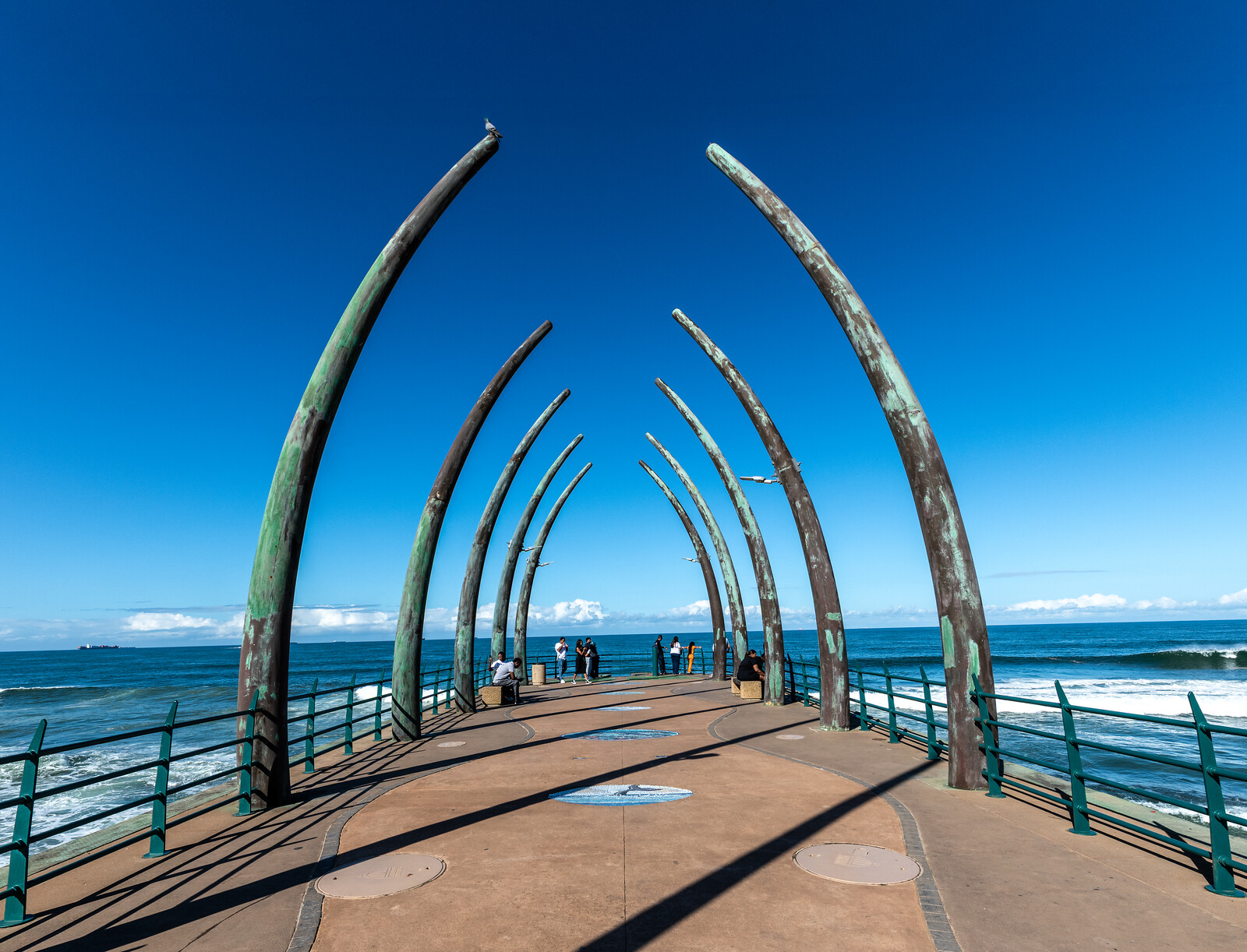
The iconic Whale Bone Pier at Umhlanga Rocks, north of Durban in KwaZulu-Natal, extends into the Indian Ocean as one of South Africa’s most recognisable contemporary coastal structures. This photograph looks along the length of the pier, capturing its distinctive series of sweeping, rib-like arches against a brilliant blue sky and the expansive Indian Ocean beyond.
Commonly known as the Whale Bone Pier or Umhlanga Pier, the structure forms part of the Umhlanga beachfront promenade and was designed as an innovative stormwater outlet extending approximately 80 metres from the shore into the ocean. Its sculptural architecture has become one of the defining landmarks of Umhlanga and an important feature of the KwaZulu-Natal coastline.
The most striking architectural feature is the sequence of tall, curved arches positioned along both sides of the walkway. Their weathered green-bronze appearance and organic form create the impression of an enormous marine skeleton, giving the pier its popular “whale bone” name. The arches gradually increase in height and converge visually towards the end of the pier, creating a powerful sense of perspective. The design was inspired by a nautical theme, with the sculptural ribs adding both visual identity and structural character to the promenade.
Designed by architect Andre Duvenage of the Architects Collaborative, the pier was conceived as considerably more than a conventional recreational jetty. It forms part of a stormwater management system intended to carry water away from the developed areas of Umhlanga and discharge it beyond the beach into a deeper offshore channel. The combination of civil engineering infrastructure, architecture and public space has made the structure particularly distinctive.
The walkway provides visitors with uninterrupted views of the Indian Ocean, while the open structure allows the surf and coastline to remain visible on both sides. In this photograph, several visitors can be seen standing near the end of the pier, emphasising the scale of the structure and its function as a public viewing platform. The railings, curved arches and paving create strong leading lines that draw the viewer towards the horizon.
The ocean dominates the background, with waves breaking along the Umhlanga coastline beneath a remarkably clear blue sky. The contrast between the warm tones of the concrete deck, the green-blue patina of the arches and the deep blue of the Indian Ocean gives the photograph a particularly strong coastal character. Long shadows cast by the arches across the walkway further emphasise the geometry and rhythm of the structure.
The Umhlanga Promenade, of which the pier forms a major landmark, stretches along the beachfront and connects several of the area’s major attractions and hotels. The promenade is widely used by walkers, runners, cyclists and visitors enjoying the coastline. The pier itself has become an important photographic and tourism landmark, with its distinctive architectural form providing a recognisable symbol of Umhlanga.
The Whale Bone Pier has also received considerable international recognition for its unusual design. It was highlighted by CNN in 2014 as the world’s most beautiful pier, helping to establish the structure as an internationally recognised example of South African coastal architecture.
Professional high-resolution infrastructure photograph available for commercial licensing. This image is suitable for editorial, architectural, construction, infrastructure, commercial, city planning, property development, urban documentation, marketing, publishing and corporate use. The downloadable file provides a high-quality version for professional applications. Buyers can use this licensed image in accordance with the store licence terms after purchase.
Original upload size: 20.69 MB
Reviews
There are no reviews yet.