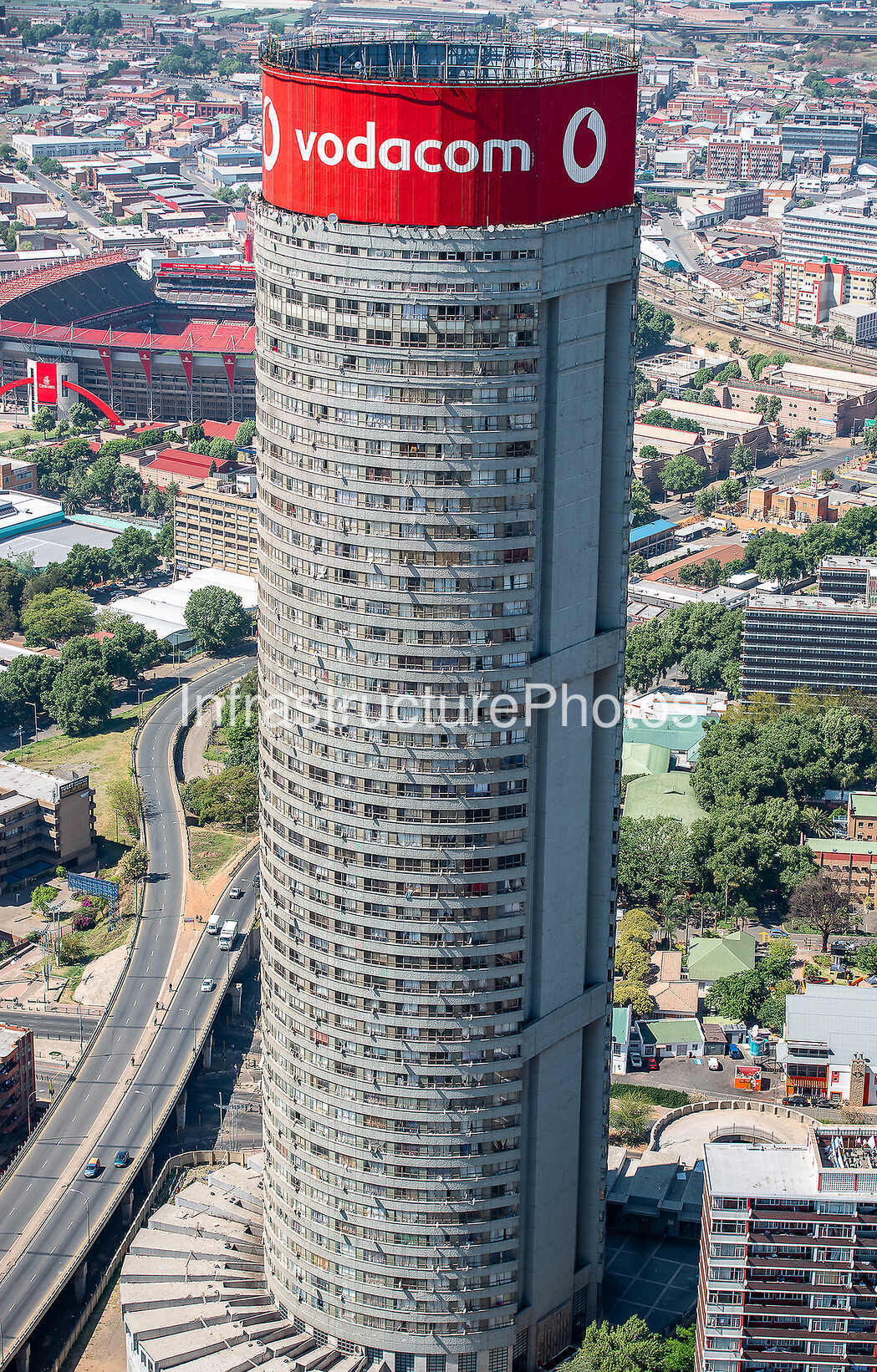
This striking aerial photograph captures Ponte City Apartments, one of the most recognisable landmarks in Johannesburg and one of the most distinctive residential towers in South Africa. Located in Berea, immediately adjacent to Hillbrow in Johannesburg, Ponte City rises approximately 173 metres above the city and is instantly identifiable by its extraordinary cylindrical form and the large red Vodacom advertising structure that historically crowned the building. The photograph provides an exceptional view of the tower’s relationship with the surrounding Johannesburg inner city, including major transport routes, dense residential and commercial development, and the nearby Ellis Park sports precinct.
Completed in 1975, Ponte City was conceived as a high-density residential development at a time when Johannesburg was experiencing a major period of high-rise construction. Its circular plan was highly unusual for the city and represented an ambitious approach to residential architecture. The building was designed by Mannie Feldman, working with Manfred Hermer and Rodney Grosskopff. The design team developed the cylindrical form partly in response to Johannesburg’s building regulations, which required kitchens and bathrooms to have windows. The central open core allowed natural light to reach apartments from both the exterior façade and the internal atrium.
Ponte City contains approximately 55 storeys and was designed as a vertical residential community. Its unusual cylindrical geometry creates a continuous curved façade around a dramatic hollow centre, giving the tower a distinctive architectural identity from almost every direction. The form has frequently been associated with Modernist and Brutalist architecture, particularly through its exposed reinforced-concrete structure, repetitive horizontal bands and monumental scale.
One of the most important characteristics of Ponte City is the enormous internal core. Rather than constructing a conventional solid residential tower, the architects created a cylindrical building surrounding a large open atrium. This allowed the wedge-shaped apartments to receive light and ventilation from both sides while creating an extraordinary communal void running through the centre of the skyscraper. The official Ponte City history describes the building as the first cylindrical skyscraper in Africa.
When it was completed, Ponte City represented a highly desirable form of modern urban living. The apartments offered spectacular panoramic views across Johannesburg, while the lower levels incorporated retail and supporting facilities intended to create a “city within a city”. The development was therefore not simply a residential tower but an experiment in vertical urbanism, concentrating hundreds of households and supporting amenities on a relatively compact site.
The tower’s position is particularly significant. From this aerial perspective, the surrounding city illustrates the dramatic mixture of residential, commercial, industrial and transport infrastructure that characterises Johannesburg’s inner eastern suburbs. Roads curve around the base of the tower while the dense urban fabric extends towards the Johannesburg city centre. The nearby Ellis Park sports precinct is clearly visible, providing an important geographic reference point and demonstrating Ponte City’s position within one of Johannesburg’s most historic sporting and entertainment districts.
The large Vodacom advertising structure at the top of the building became one of Ponte City’s defining visual features. Vodacom branding was installed on the tower around 2000, replacing the previous Coca-Cola advertising presence. The advertising structure is approximately 15 metres high and 132 metres long, creating an enormous illuminated landmark visible across much of Johannesburg. JCDecaux later described the installation as providing Vodacom with an almost 360-degree presence over the Johannesburg skyline, with thousands of metres of LED lighting incorporated into the structure.
The red Vodacom branding visible in this photograph dates from the period when the company’s red identity dominated the tower. The transformation from the earlier blue Vodacom display to the red installation was itself a significant outdoor-advertising engineering project. More than a tonne of red paint and approximately seven kilometres of LED lighting were reportedly used in the 2011 refurbishment of the display.
Professional high-resolution infrastructure photograph available for commercial licensing. This image is suitable for editorial, architectural, construction, infrastructure, commercial, city planning, property development, urban documentation, marketing, publishing and corporate use. The downloadable file provides a high-quality version for professional applications. Buyers can use this licensed image in accordance with the store licence terms after purchase.
Original upload size: 32.92 MB
Reviews
There are no reviews yet.